
Afflict and inflict look and sound similar, and that is exactly why English learners often mix them up.
Both words are connected with pain, suffering, or something unpleasant, but they describe very different relationships between the person or thing causing the problem and the person or thing experiencing it.
Compare these two sentences:
The disease afflicted the village.
The disease inflicted serious damage on the community.
The first sentence focuses on the people or place suffering from a problem. The second focuses on the damage or suffering caused by something.
There is another important difference in everyday grammar. We commonly say that a person, disease, problem, or condition afflicts someone or something.
With inflict, we usually talk about causing something unpleasant, such as pain, injury, damage, punishment, or suffering.
That distinction matters because choosing the wrong verb can make a sentence sound unnatural or change what you are trying to say.
Afflict is generally about suffering from or being troubled by something. Inflict is about causing something painful or harmful to happen.
Once you understand who is suffering and who or what is causing the suffering, the difference becomes much easier.
What Does “Afflict” Mean?
Afflict is a verb meaning to cause someone or something to suffer from a serious problem, illness, difficulty, or unpleasant condition.
The person or thing that experiences the problem is the object of afflict.
A simple way to understand it is:
Something afflicts someone.
For example:
The disease afflicted thousands of people.
The disease is causing suffering, while thousands of people are experiencing it.
Afflict is often used with things such as:
- diseases
- poverty
- hunger
- war
- anxiety
- natural disasters
- social problems
- physical conditions
- emotional difficulties
- serious troubles
When do we use “afflict”?
Use afflict when you want to describe a person, group, place, or community that is suffering from a problem or condition.
For example:
- The disease afflicted many elderly patients.
- Poverty continues to afflict rural communities.
- The region was afflicted by severe flooding.
- He has been afflicted with a painful condition for years.
- The country was afflicted by years of conflict.
- Many families are afflicted by unemployment.
- The town was afflicted by a shortage of clean water.
- She was afflicted with constant headaches.
Notice the common pattern. The focus is on the victim or sufferer.
Common grammatical patterns with “afflict”
The most useful structure is:
subject + afflict + person/place/group
For example:
The disease afflicted the population.
You can also see:
be afflicted by + problem
The region was afflicted by drought.
And:
be afflicted with + illness/problem
He was afflicted with severe pain.
The exact preposition can depend on the construction, but afflicted by and afflicted with are both common.
Common learner confusion
A frequent mistake is to use afflict when the writer really means cause or impose something.
For example:
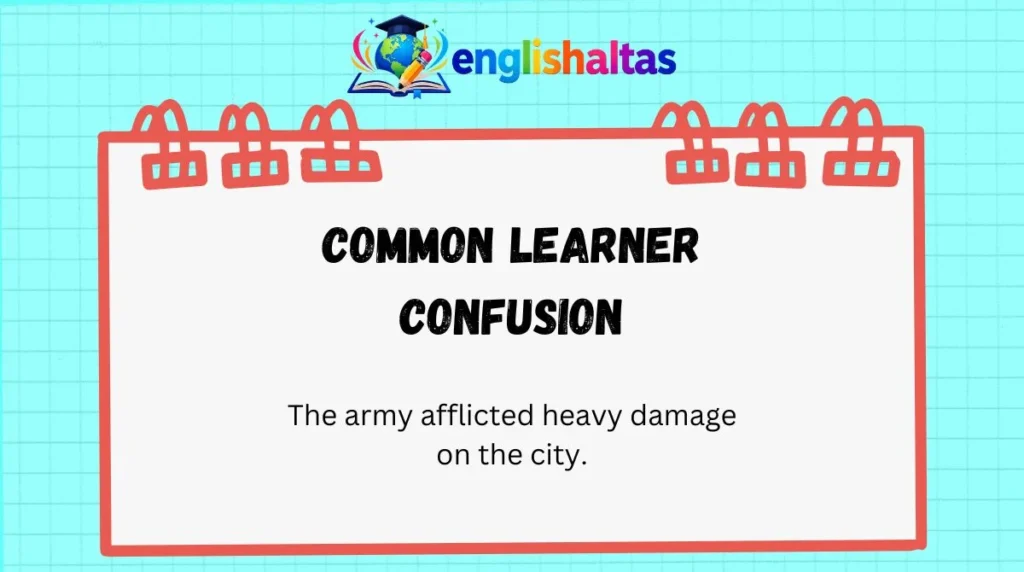
The army afflicted heavy damage on the city.
This is incorrect.
The natural expression is:
The army inflicted heavy damage on the city.
Why? Because damage is something that is caused or imposed, so inflict is the appropriate verb.
Think of afflict as focusing on the sufferer.
The city was afflicted by war.
The city is suffering from the problem.
What Does “Inflict” Mean?
Inflict means to cause something unpleasant, painful, harmful, or damaging to happen to someone or something.
The important idea is deliberately or directly causing a negative effect.
For example:
The attacker inflicted serious injuries on the victim.
The attacker caused the injuries.
This gives us a useful basic pattern:
Someone or something inflicts something on someone or something.
The “something” being caused is often a noun such as:
- pain
- damage
- injury
- suffering
- punishment
- wounds
- losses
- harm
- defeat
- humiliation
When do we use “inflict”?
Use inflict when the emphasis is on the harm, pain, damage, punishment, or suffering being caused.
Examples:
- The accident inflicted serious damage on the building.
- The injury inflicted considerable pain on the athlete.
- The soldiers inflicted heavy losses on the enemy.
- The judge inflicted a severe punishment on the offender.
- The storm inflicted millions of dollars in damage.
- The attack inflicted serious injuries on several people.
- The drought inflicted enormous losses on farmers.
- His words inflicted emotional pain on his friend.
Common grammatical pattern
The most important structure is:
subject + inflict + harm/pain/damage/punishment + on + object
For example:
The storm inflicted serious damage on the town.
Another example:
The accident inflicted severe injuries on the passengers.
You will often see inflict followed by a negative consequence.
Common learner confusion
The biggest mistake is using inflict as if it simply meant hurt.
Although inflict can describe causing pain or injury, it normally appears with a noun describing the thing that is being caused.
For example:
The attacker inflicted serious injuries on the victim.
This is natural.
But:
The attacker inflicted the victim.
This is not natural standard English.
The person is not normally the direct object of inflict. The injury, pain, punishment, or damage is what gets inflicted.
That grammatical difference is one of the easiest ways to separate inflict from afflict.
Difference Between Afflict and Inflict
The simplest distinction is this:
Afflict = cause someone or something to suffer.
Inflict = cause pain, damage, injury, punishment, or another unpleasant thing.
They overlap in meaning because both involve something negative, but their sentence structures are different.
Comparison Table
| Feature | Afflict | Inflict |
|---|---|---|
| Basic meaning | Cause someone/something to suffer | Cause something unpleasant to happen |
| Main focus | The sufferer | The harm or consequence |
| Common object | Person, group, place, population | Pain, damage, injury, punishment, losses |
| Common pattern | afflict + person/place | inflict + harm + on + person/place |
| Example | Disease afflicted the population | Disease inflicted damage on the economy |
| Often used with illness? | Yes | Less commonly |
| Often used with damage? | Usually no | Yes |
| Often used with punishment? | No | Yes |
| Often used with pain? | Sometimes indirectly | Yes |
Compare the focus
Consider:
The disease afflicted the population.
The sentence tells us who suffered.
Now compare:
The disease inflicted severe damage on the healthcare system.
The sentence tells us what damage was caused and who or what received that damage.
The two verbs can appear in the same general context, but they are not doing the same grammatical job.
Grammar logic
With afflict, the person or thing suffering can be the direct object:
The disease afflicted the villagers.
Structure:
cause/problem + afflict + sufferer
With inflict, the unpleasant consequence is normally the direct object:
The disease inflicted serious damage on the villagers’ homes.
Structure:
cause + inflict + harm/damage/injury + on + receiver
That difference is extremely useful.
Sentence structure difference
Afflict
The drought afflicted the farmers.
The drought = cause
afflicted = verb
the farmers = people suffering
Inflict
The drought inflicted heavy losses on the farmers.
The drought = cause
inflicted = verb
heavy losses = harm caused
on the farmers = people affected
Notice what changes.
With afflict, farmers directly receive the action of the verb.
With inflict, losses receive the action, while farmers appear after on.
Meaning comparison
Here is another useful pair:
The war afflicted the country.
This emphasizes the country’s suffering.
The war inflicted enormous damage on the country.
This emphasizes the damage caused by the war.
Both sentences can describe the same situation, but they present it from different angles.
Grammar Rules You Must Remember
Rule #1: Use “afflict” for the person or thing suffering
When the direct object is the sufferer, afflict is often the right choice.
The disease afflicted thousands of people.
The people are suffering from the disease.
Another example:
Poverty afflicts many families.
The families are experiencing the problem.
Rule #2: Use “inflict” for the harm being caused
When the direct object is pain, damage, injury, punishment, or another negative consequence, use inflict.
The storm inflicted serious damage on the village.
The storm caused the damage.
Another example:
The accident inflicted severe injuries on the driver.
The injuries are the thing being inflicted.
Rule #3: “Inflict” commonly follows the pattern “inflict + something + on someone”
This is one of the most useful patterns to memorize.
The attack inflicted heavy losses on the enemy.
The accident inflicted serious injuries on the passengers.
The storm inflicted millions of dollars in damage on local businesses.
The thing being caused comes directly after inflict, while the affected person or group usually follows on.
Rule #4: “Afflict” often appears with “with” or “by” in passive constructions
You may hear:
She was afflicted with a rare illness.
Or:
The region was afflicted by severe drought.
Both constructions are common, although their emphasis can vary slightly depending on context.
A useful shortcut is:
afflicted with + condition
He was afflicted with chronic pain.
afflicted by + problem/cause
The community was afflicted by poverty.
Common Mistakes Students Make
The confusion between these verbs usually happens because learners notice that both are associated with suffering and harm. They then treat them as interchangeable.
They are not.
Mistake 1: Using “afflict” with damage
Incorrect:
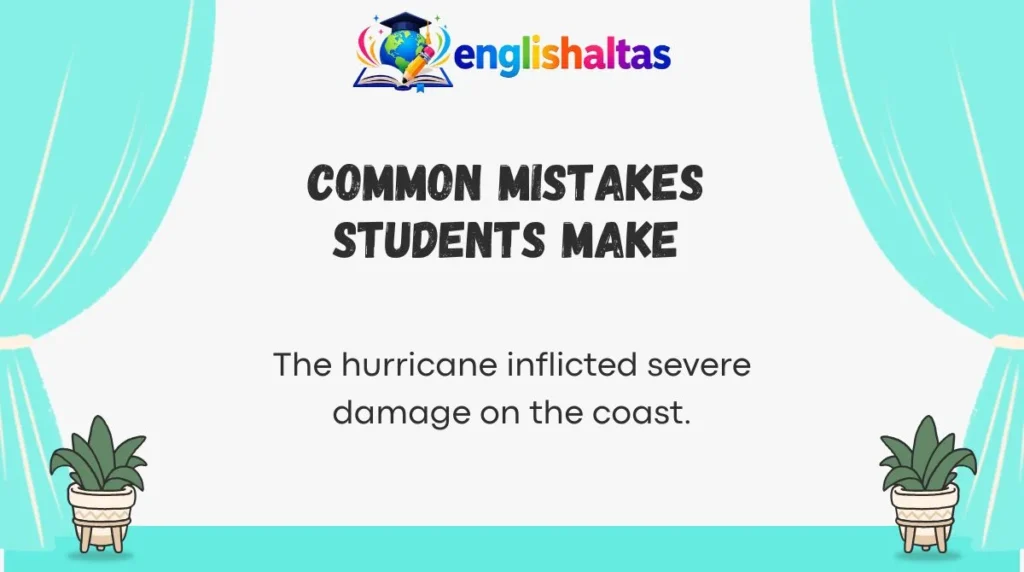
The hurricane afflicted severe damage on the coast.
Correct:
The hurricane inflicted severe damage on the coast.
Why?
Because damage is the thing being caused. The correct verb is inflict.
You could also say:
The hurricane afflicted the coastal communities.
Now afflict works because the communities are the ones suffering.
Mistake 2: Using “inflict” directly on a person
Incorrect:
The disease inflicted thousands of patients.
Correct:
Afflict vs Inflict
Or:
Afflict vs Inflict
The second sentence uses inflict correctly because severe pain is what is being inflicted.
Mistake 3: Forgetting “on” after an inflicted consequence
Incorrect:
Afflict vs Inflict
Correct:
Afflict vs Inflict
When you identify the person or group receiving the harm, on is normally needed.
Mistake 4: Using “inflict” with an illness in the wrong structure
Incorrect:
Afflict vs Inflict
Natural alternatives include:
Afflict vs Inflict
or:
Afflict vs Inflict
Afflicted with is a standard expression for being troubled by an illness or condition.
Mistake 5: Assuming every negative situation requires “inflict”
Not every sentence about suffering needs inflict.
For example:
Afflict vs Inflict
This is natural.
You could also say:
Afflict vs Inflict
But you would not normally say:
Afflict vs Inflict
The grammar does not fit.
Easy correction tip
Ask yourself:
What comes immediately after the verb?
If it is the person or thing suffering, consider afflict:
Afflict vs Inflict
If it is the pain, injury, damage, punishment, or loss, consider inflict:
Afflict vs Inflict
That quick test can prevent many errors.
Easy Trick to Remember the Difference
Try this simple classroom trick:
Afflict → Affected person
Both words begin with A:
Afflict vs Inflict
Think:
Afflict vs Inflict
That is usually the focus of afflict.
Afflict vs Inflict
The villagers are the sufferers.
Inflict → Injury or negative effect
Think:
Afflict vs Inflict
Ask:
Afflict vs Inflict
The answer might be:
- pain
- injury
- damage
- punishment
- losses
- suffering
For example:
Afflict vs Inflict
The injuries are what the accident caused.
A quick memory sentence
Remember:
Afflict vs Inflict
It is not a rule that covers every possible sentence, but it is an excellent starting point for learners.
Another way to picture it:
Afflict → Who suffers?
Inflict → What suffering is caused?
Once you ask those two questions, the correct verb becomes much easier to choose.
Daily Life Examples
1. Talking about an illness
A: Why hasn’t Maria been coming to work?
B: She’s been afflicted with a serious illness.
Here, afflicted with describes Maria’s condition.
2. Talking about a storm
A: Did the storm damage the town?
B: Yes. It inflicted severe damage on several buildings.
The damage is what the storm caused, so inflict is appropriate.
3. Talking about poverty
A: Why are so many families struggling?
B: Poverty afflicts many households in the region.
The households are experiencing the problem.
4. Talking about an accident
A: Was anyone seriously hurt?
B: Yes. The accident inflicted serious injuries on two passengers.
The injuries are the direct object of inflicted.
5. Talking about a difficult year
A: How was business last year?
B: The economic crisis afflicted small businesses across the country.
The businesses are the ones experiencing the difficult conditions.
6. Talking about emotional pain
A: Why did he stop speaking to his friend?
B: Those harsh comments inflicted a lot of emotional pain on him.
The emotional pain is what was caused.
7. Talking about a natural disaster
A: How badly was the farming community affected?
B: The drought afflicted farmers for several months.
The farmers experienced the difficult condition.
You could also say:
Afflict vs Inflict
Here, the focus shifts from the sufferers to the losses.
8. Talking about punishment
A: What happened after the trial?
B: The court inflicted a heavy punishment on the offender.
The punishment is what was imposed.
In everyday modern English, however, imposed a heavy punishment may sound more natural in many contexts.
9. Talking about war
A: Why did so many people leave the region?
B: Years of conflict afflicted the local population.
The population is suffering from the conflict.
You could also say:
Afflict vs Inflict
Again, the focus changes.
10. Talking about workplace stress
A: Why is Daniel taking time off?
B: Constant stress has afflicted him for months.
The sentence focuses on Daniel’s experience.
If you want to focus on the harm, you could say:
Afflict vs Inflict
The structure changes because strain is now the thing being caused.
Practice Section
Choose afflict or inflict to complete each sentence.
1.
The disease has ___ thousands of people in the region.
2.
The earthquake ___ millions of dollars in damage on the city.
3.
Many families are ___ by poverty.
4.
The accident ___ serious injuries on the driver.
5.
The long drought ___ local farmers for several years.
Answers
1. afflicted — The people are the sufferers.
2. inflicted — Damage is the thing being caused.
3. afflicted — The families are experiencing poverty.
4. inflicted — Injuries are being caused, and they are inflicted on the driver.
5. afflicted — The farmers are suffering because of the drought.
Quick test
If you are still unsure, change the sentence into a question:
Who is suffering? → usually afflict
What pain, damage, injury, or punishment is being caused? → usually inflict
FAQs
What is the difference between afflict and inflict?
Afflict means to cause someone or something to suffer from a problem, illness, or difficult condition. Inflict means to cause pain, injury, damage, punishment, or another unpleasant consequence.
Compare: “The disease afflicted the patients” and “The disease inflicted severe pain on the patients.”
Can we use “afflict” in questions?
Yes. Afflict can be used naturally in questions, although it is somewhat more formal than everyday verbs such as bother, trouble, or affect.
For example:
Afflict vs Inflict
You can also ask:
Afflict vs Inflict
Is “inflict” formal or informal?
Inflict is a standard English verb, but it often sounds more formal than simple words such as cause or give. It is common in news reports, academic writing, serious discussions, and descriptions of injury or damage.
For example, “The storm inflicted serious damage” is more formal than “The storm caused a lot of damage.”
Is “afflict” the same as “affect”?
No. Affect is much broader and simply means to influence or have an effect on something.
Afflict specifically suggests causing suffering, trouble, or distress.
For example:
Afflict vs Inflict
Afflict vs Inflict
Can a disease afflict someone?
Yes. This is one of the most common uses of afflict.
You can say:
Afflict vs Inflict
You can also use the passive form:
Afflict vs Inflict
The word often appears with illnesses, painful conditions, and other serious problems.
Can we say “inflict pain on someone”?
Yes. Inflict pain on someone is a standard expression.
For example:
Afflict vs Inflict
You can also say:
Afflict vs Inflict
The important structure is inflict + pain + on + person.
Conclusion
Afflict vs inflict is easier to understand when you stop focusing on how similar the two words look and instead focus on what the sentence is emphasizing.
Use afflict when a person, group, place, or population is suffering from a problem, illness, hardship, or difficult condition:
Afflict vs Inflict
Use inflict when someone or something causes pain, injury, damage, punishment, losses, or another unpleasant consequence:
Afflict vs Inflict
The most useful memory trick is simple:
Afflict the sufferer; inflict the suffering.
That shortcut will not cover every advanced use, but it works remarkably well for everyday English.
When you read or hear these verbs, pay attention to what comes after them. If it is the person or group experiencing the problem, afflict is often the right choice.
If it is the injury, pain, damage, punishment, or loss being caused, inflict is usually the better verb.
With a little practice, the distinction will start to feel natural rather than something you have to consciously remember.

Oliver Bennett is an English language educator and content writer passionate about simplifying grammar. He creates clear, practical lessons, writing tips, and learning resources that help readers improve their English with confidence.