About and around are two everyday English words that look simple but often leave learners wondering which one sounds right.
The confusion is understandable because, in many sentences, they can mean almost exactly the same thing.
For example, both “I’ll arrive at about 7” and “I’ll arrive at around 7” are natural. You can also say “There were about 50 people” or “There were around 50 people.”
In these examples, both words mean approximately.
The trouble starts when about and around have different jobs.
About can introduce the subject of a conversation, book, question, or concern. Around can describe a position, direction, or movement.
So while “We talked about the problem” is perfectly natural, “We sat around the table” has a completely different use of around.
This distinction matters in everyday English because using the wrong word can make a sentence sound unnatural or change what you mean.
The good news is that you do not need to memorize dozens of complicated rules. Once you understand the main meanings of these two words, the choice becomes much easier.
This guide explains about vs around with simple grammar rules, natural examples, common mistakes, spoken-English situations, and practice questions you can use to check your understanding.
What Does “About” Mean?
About is one of the most common words in English. It can function as a preposition or an adverb, and its meaning changes depending on how it is used.
One of its most familiar meanings is “approximately,” “roughly,” or “close to.”
We use about when a number, time, amount, distance, age, or measurement is not exact.
When do we use “about”?
Use about before information that is approximate rather than precise.
Common patterns include:
about + number
There were about 50 people at the meeting.
about + time
I’ll be there at about 8 o’clock.
about + amount
The repair will cost about $200.
about + duration
The journey takes about three hours.
about + age
He is about 30 years old.
about + distance
The station is about five miles away.
Examples of “about” meaning approximately
- There were about 100 students in the hall.
- I’ll call you at about six tonight.
- The box weighs about four kilograms.
- She is about twenty-five years old.
- It takes about half an hour to get there.
- The house is about two miles from the station.
- I paid about $50 for the shirt.
- He arrived about ten minutes ago.
In every example, the speaker is giving an estimate, not an exact figure.
If someone says, “It will take about an hour,” they may actually mean 55 minutes, 65 minutes, or something close to an hour. The exact amount is not important.
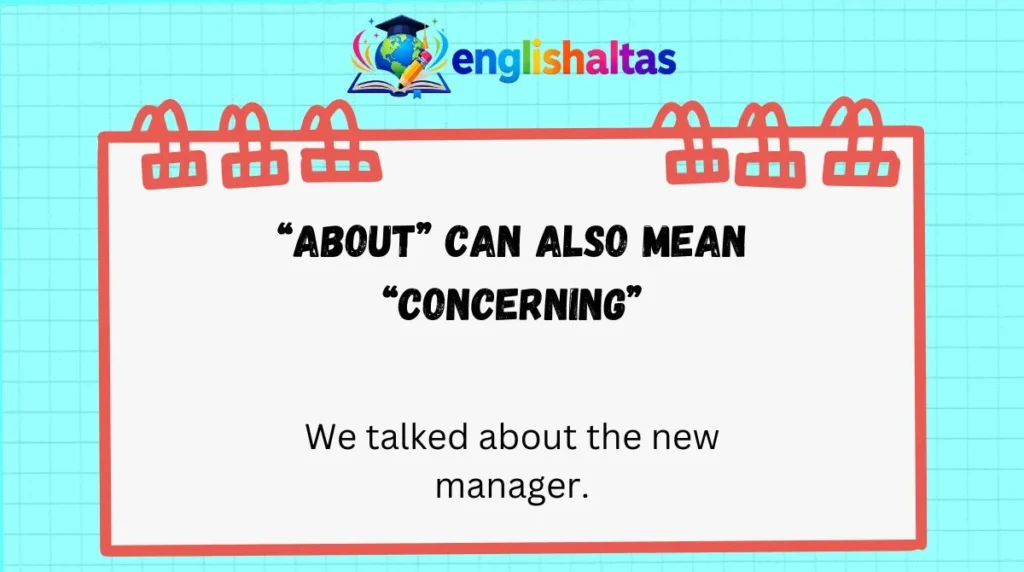
“About” can also mean “concerning”
This is an important meaning that learners sometimes forget.
Look at this sentence:
We talked about the new manager.
Here, about does not mean approximately. It means concerning, regarding, or on the subject of.
You will see this use frequently in everyday English:
- What is the movie about?
- We need to talk about the problem.
- She knows a lot about computers.
- I read a book about space.
- He asked me about my new job.
- Tell me about your trip.
- They were worried about the exam.
- I want to learn more about English grammar.
This is one reason you cannot treat about and around as complete synonyms.
You can say:
Tell me about your trip.
But you would not normally say:
Tell me around your trip.
The second sentence does not express the intended meaning.
Common learner confusion with “about”
Many learners first learn about through expressions such as about 10, about five minutes, or about $100. They then associate the word only with approximate numbers.
That can cause mistakes.
Compare:
There are about 20 students in the room.
Here, about means approximately.
Now compare:
We talked about the students in the room.
Here, about means concerning.
The spelling is identical, but the meaning comes from the context.
What Does “Around” Mean?
Around is another highly useful English word with several meanings.
Like about, it can mean approximately. It can also describe something that is surrounding another thing or movement through a particular area.
When around means approximately, it is usually very close in meaning to about.
For example:
I’ll be home around 9.
This means the speaker expects to arrive at approximately 9 o’clock.
When do we use “around”?
Use around for approximate:
- times
- numbers
- ages
- prices
- distances
- quantities
- durations
- measurements
Examples of “around” meaning approximately
- I’ll be home around nine.
- There were around 200 people at the concert.
- She is around 25 years old.
- The trip takes around three hours.
- It costs around $100.
- We need around ten chairs.
- He ran around five miles.
- The temperature was around 30 degrees.
In all these sentences, around means roughly or approximately.
“Around” can describe position
Now consider:
The children were sitting around the table.
This time, around does not mean approximately. It describes where the children were positioned.
They were sitting on different sides of the table or surrounding it.
More examples:
- We sat around the fire.
- There are trees around the house.
- She put a fence around the garden.
- Everyone gathered around the teacher.
- The chairs were arranged around the stage.
- A crowd formed around the entrance.
Here, around expresses a spatial relationship.
“Around” can describe movement
Around is also commonly used when someone moves through or near a place.
For example:
We walked around the park.
This suggests movement through different parts of the park or along its surrounding area.
Other examples include:
- She drove around the city.
- I looked around the shop.
- They traveled around Europe.
- He walked around the building.
- We spent the afternoon walking around town.
Again, the meaning is completely different from about meaning “approximately.”
Common learner confusion with “around”
Because around can mean approximately, learners sometimes try to use it wherever they see about.
That does not work.
For example:
We talked about the new policy.
This means the new policy was the subject of the conversation.
You cannot simply change it to:
We talked around the new policy.
That expression can have a special meaning in some contexts, but it does not simply mean “talked about.”
Difference Between About and Around
The easiest way to understand about vs around is to separate their shared meaning from their different meanings.
When both words mean approximately, they are often interchangeable.
Comparison Table
| Use | About | Around | Both possible? |
|---|---|---|---|
| Approximate time | about 7 p.m. | around 7 p.m. | Yes |
| Approximate number | about 50 people | around 50 people | Yes |
| Approximate age | about 30 | around 30 | Yes |
| Approximate price | about $100 | around $100 | Yes |
| Approximate duration | about two hours | around two hours | Yes |
| Approximate distance | about five miles | around five miles | Yes |
| Topic or subject | about the problem | around the problem | Usually no |
| Surrounding position | about the table | around the table | No |
| Movement | about the park | around the park | Usually no |
The central rule is simple:
About and around overlap when they mean “approximately,” but they are not interchangeable in every context.
1. Approximate time
Both are natural:
I’ll call you at about 5.
I’ll call you at around 5.
The speaker is not promising to call at exactly 5:00.
In casual conversation, both expressions are extremely common.
2. Approximate numbers
You can say:
There were about 80 guests.
or:
There were around 80 guests.
Both indicate that 80 is an estimate.
Perhaps there were 75, 82, or 90 guests. The speaker is giving a general figure.
3. Approximate price
Both choices work:
The phone costs about $500.
The phone costs around $500.
The exact price may be slightly higher or lower.
4. Talking about a subject
This is where about is different.
We talked about the meeting.
Here, about means concerning the meeting.
You would not normally replace it with around.
5. Describing position
Use around when something surrounds another thing:
The children stood around their teacher.
The word tells us where the children were positioned.
6. Describing movement
Use around for many expressions involving movement:
We walked around the lake.
She drove around the city.
He looked around the room.
In these sentences, around gives a sense of movement or location.
Grammar logic
When about means approximately, it commonly follows this pattern:
about + number/time/amount/measurement
Examples:
- about 20 people
- about $50
- about two hours
- about 7 p.m.
- about five kilometers
Around follows the same basic pattern when it means approximately:
around + number/time/amount/measurement
Examples:
- around 20 people
- around $50
- around two hours
- around 7 p.m.
- around five kilometers
But about has another major pattern:
about + topic
Examples:
- about the exam
- about your family
- about the problem
- about the new project
Meanwhile, around frequently appears with a place or object when expressing position or movement:
around + place/object
Examples:
- around the house
- around the table
- around the city
- around the garden
Meaning comparison
Think of these three meanings:
About = approximately
about 10 minutes
About = concerning
about the meeting
Around = approximately
around 10 minutes
Around = surrounding/movement
around the building
Once you identify the meaning, the correct word is usually much easier to choose.
Grammar Rules You Must Remember
Rule #1: Use “about” for approximate information
When giving an estimate, about is a natural choice.
The repair will take about two days.
The speaker does not mean exactly 48 hours.
Rule #2: Use “around” for approximate information too
Around can also introduce an estimate.
The repair will take around two days.
There is no major difference in meaning between this and “about two days.”
Rule #3: Use “about” when you mean “concerning”
When you are naming the subject of a conversation, question, book, movie, concern, or discussion, about is normally the right word.
We talked about the new project.
What is the book about?
She asked about the interview.
Rule #4: Use “around” for surrounding position or movement
When you describe something positioned around another thing or someone moving around a place, around is generally the natural choice.
About or Around
About or Around
About or Around
Common Mistakes Students Make
The confusion usually happens because learners translate English words directly into their first language or memorize only one meaning for each word.
That approach can work for simple vocabulary, but it becomes unreliable when a word has several meanings.
Mistake 1: Assuming the words are always synonyms
A learner may think:
About or Around
That is only true in certain contexts.
Correct:
About or Around
About or Around
Both work.
But:
About or Around
should not normally become:
About or Around
The second sentence has a different possible meaning.
Mistake 2: Using “about” for surrounding position
A learner might say:
About or Around
For ordinary modern English, the natural expression is:
About or Around
The people are positioned around the table.
Mistake 3: Using “around” to introduce a topic
Incorrect:
About or Around
Correct:
About or Around
Here, about means “concerning.”
Mistake 4: Saying “about approximately”
Avoid combinations such as:
About or Around
Both words already express approximation.
Better:
About or Around
or:
About or Around
or:
About or Around
The same principle applies to around approximately.
Mistake 5: Thinking “around” always means approximately
Compare:
About or Around
Here, around means approximately.
Now:
About or Around
Here, around describes movement.
The surrounding words and the context tell you which meaning is intended.
Easy correction tip
When you are unsure, stop and ask:
Am I estimating something, naming a topic, or describing a place or movement?
If you are estimating, about and around will often both be correct.
If you mean concerning, choose about.
If you mean surrounding or moving around, around is usually the natural choice.
Easy Trick to Remember the Difference

A simple memory trick can make this much easier.
Think: ABOUT = estimate or topic
Remember these two examples:
About or Around
About or Around
The first means approximately 20.
The second means concerning the exam.
So when you see about, think:
estimate + topic
Think: AROUND = estimate or circle
Now picture a circle.
About or Around
means approximately 20.
And:
About or Around
means surrounding the table.
You can add movement:
About or Around
The idea is that around often gives you a sense of space, position, or movement.
A real-life mental picture
Imagine someone says:
About or Around
Picture a clock with a small invisible circle around 8. The person does not mean exactly 8:00. They might arrive at 7:55 or 8:10.
Now imagine someone says:
About or Around
Picture several people forming a circle around a fire.
That simple visual distinction helps many learners remember the difference without memorizing a long grammar rule.
Daily Life Examples
These examples show how native speakers naturally use about and around in ordinary situations.
1. Making plans
A: What time are you coming?
B: Probably around 7 p.m.
You could also say:
B: Probably about 7 p.m.
Both are natural because the time is approximate.
2. Asking about a crowd
A: How many people were at the wedding?
B: About 150 people.
Or:
B: Around 150 people.
The exact number is not important.
3. Talking about money
A: How much did that jacket cost?
B: About $80.
Or:
B: Around $80.
The speaker is giving an approximate price.
4. Discussing work
A: What were you talking about?
B: We were talking about the new project.
Here, about introduces the subject.
5. Sitting at a table
A: Where should we sit?
B: Let’s sit around the table.
Here, around describes position.
6. Asking someone’s age
A: How old is your brother?
B: He’s about 25.
Or:
B: He’s around 25.
Both mean approximately 25.
7. Asking how long something takes
A: How long does the journey take?
B: About three hours.
Or:
B: Around three hours.
Both are fine.
8. Looking for someone
A: Where’s Tom?
B: He should be somewhere around the office.
Here, around means in or near the general area.
9. Talking about distance
A: How far is the airport?
B: It’s about 20 kilometers from here.
You can also say:
About or Around
Both express an approximate distance.
10. Talking about a personal plan
A: What did you discuss with Sarah?
B: We talked about her plans for next year.
Because her plans are the subject of the conversation, about is the natural choice.
Practice Section
Choose about or around in each sentence. In some cases, both answers are possible.
1.
I’ll arrive ___ 8 o’clock.
2.
We talked ___ the new teacher.
3.
There were ___ 300 people at the stadium.
4.
The children ran ___ the garden.
5.
The laptop costs ___ $800.
Answers
1. about / around — Both are correct because the time is approximate.
2. about — About introduces the topic of the conversation.
3. about / around — Both are correct because the number is an estimate.
4. around — Around describes movement in relation to the garden.
5. about / around — Both can express an approximate price.
FAQs
What is the difference between “about” and “around”?
When both mean approximately, there is usually very little difference. About 10 minutes and around 10 minutes both mean roughly 10 minutes.
The important difference is that about can also mean concerning, while around can describe position, surrounding space, or movement.
Can we use “about” and “around” with time?
Yes. Both are very common with approximate times.
You can say “I’ll arrive at about 6” or “I’ll arrive at around 6.” Both mean that 6 o’clock is an estimated time rather than an exact arrival time.
Can “about” be used in questions?
Yes. About is extremely common in questions.
For example:
About or Around
About or Around
About or Around
Here, about introduces the subject or topic.
Is “about” formal or informal?
About is standard English and works in both formal and informal situations.
You can use it in everyday conversation, emails, reports, school writing, and professional communication. The more formal word approximately may sometimes be preferred in technical contexts, but about is not incorrect.
Is “around” informal English?
Around is standard English, not slang. It is very common in everyday speech and also appears frequently in writing.
When expressing an approximate number or time, around can sound especially natural in conversation.
Can “about” always be replaced by “around”?
No. The substitution works mainly when about means approximately.
For example:
About or Around
But:
About or Around
cannot normally become:
About or Around
without changing the meaning.
Similarly, around is needed in expressions such as sit around the table when you mean surrounding the table.
Conclusion
About and around are easy to confuse because they share one very common meaning: approximately.
When you are estimating a time, number, price, age, distance, or duration, both words will often work.
You can say “about 20 people” or “around 20 people.” You can say “about 7 p.m.” or “around 7 p.m.” In these situations, the difference is very small.
The important thing is to notice when the words have other meanings. About can introduce a topic or subject, as in “We talked about the exam.”
Around can describe position or movement, as in “We sat around the table” or “We walked around the park.”
So instead of memorizing about = around, remember the bigger picture: they overlap when they mean approximately, but they are not interchangeable everywhere.
Pay attention to these words when you hear native speakers talking, and try making your own sentences.
After a little practice, choosing between about and around will start to feel natural rather than like a grammar test.

Oliver Bennett is an English language educator and content writer passionate about simplifying grammar. He creates clear, practical lessons, writing tips, and learning resources that help readers improve their English with confidence.