English learners often get confused by two very small words: in and to. Both are common prepositions, and both appear in many everyday sentences.
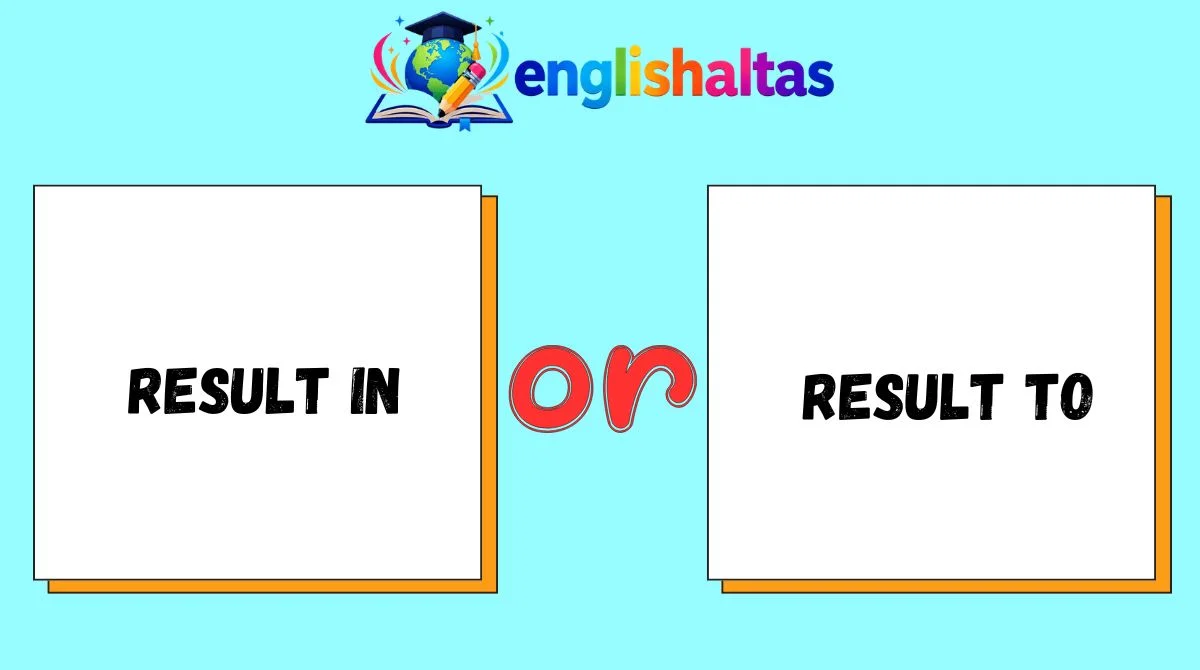
So when students want to use the phrase “result,” it is natural to wonder: Should we say result in or result to?
The good news is that the answer is much simpler than it may seem.
In standard English, result in is the normal and correct phrase when you want to say that one thing causes another thing to happen.
For example, “Heavy rain can result in flooding.” Here, heavy rain is the cause, and flooding is the result.
The phrase result to is usually not correct when “result” means “cause something to happen.”
This is one of those small grammar points that can make a big difference in writing and speaking.
After learning this lesson, you will know exactly when to use “result in,” why “result to” is usually wrong, how to build sentences with both phrases, and how to avoid common mistakes.
You will also see simple examples from school, work, travel, health, technology, and daily conversations.
What Does “Result In” Mean?
Result in means to cause something to happen or to lead to a particular outcome.
The first thing is usually the cause, and the thing after “in” is the effect or outcome.
Basic grammar rule
The basic structure is:
Cause + result in + effect
For example:
Lack of sleep can result in poor concentration.
The cause is lack of sleep. The effect is poor concentration.
Another example is:
Careless driving can result in accidents.
Here, careless driving is the cause, while accidents are the possible outcome.
The word in is important because “result in” is a fixed verb-preposition combination in English. Native speakers commonly use it to connect a cause with its outcome.
Examples of “result in”
- Too much rain can result in flooding.
- Poor planning may result in delays.
- Regular practice can result in better performance.
- A broken cable could result in a loss of power.
- Eating too quickly may result in stomach discomfort.
- Hard work often results in success.
- The mistake resulted in a serious problem.
- The new rule may result in higher costs.
Notice that the word after in is normally the outcome or consequence.
“Result in” in different tenses
The phrase can be used in several tenses.
Present:
Too much noise results in poor concentration.
Past:
The heavy traffic resulted in a late arrival.
Future:
The change may result in better service.
Present perfect:
The new system has resulted in faster deliveries.
The form of result changes according to the tense, but the preposition in remains.
Result in + noun
A noun can come after “result in.”
The accident resulted in traffic problems.
The mistake resulted in extra costs.
The storm resulted in power cuts.
Result in + -ing form
You can also use a gerund, which is an -ing form.
The delay resulted in missing the train.
Poor preparation resulted in losing the match.
Heavy rain resulted in canceling the event.
A common learner mistake is trying to put “to” before the verb here. Standard English does not normally say:
The delay resulted in to miss the train. ❌
Instead, say:
The delay resulted in missing the train. ✅
A common learner confusion
Students sometimes think “result” should be followed by “to” because many English verbs use “to.”
For example:
want to go
need to study
decide to leave
But result works differently. The normal expression for cause and effect is result in.
Think of “result in” as one useful grammar unit:
result in = cause / lead to / produce
What Does “Result To” Mean?
The phrase result to is generally not used in standard English when you mean that something causes an outcome.
For example:
The accident resulted to traffic problems. ❌
This should normally be:
The accident resulted in traffic problems. ✅
This mistake often happens because learners know the phrase lead to.
For example:
Poor planning can lead to problems.
Because “lead” uses to, a learner may think “result” can use “to” in the same way. But English does not always allow us to replace one verb with another and keep the same preposition.
The important difference
We say:
lead to a problem
but:
result in a problem
These expressions have a similar meaning, but their grammar is different.
Examples
Correct:
The storm resulted in major damage.
Incorrect:
The storm resulted to major damage.
Correct:
Poor communication resulted in confusion.
Incorrect:
Poor communication resulted to confusion.
Correct:
His mistake resulted in a delay.
Incorrect:
His mistake resulted to a delay.
Why does “result to” sound possible?
One reason is that learners hear many phrases containing “to” after verbs.
For example:
contribute to
lead to
belong to
happen to
speak to
It is easy to assume that “result” follows the same pattern.
However, prepositions are often part of fixed English expressions. There is no simple rule saying that every verb meaning “cause” must use “to.”
That is why it is useful to learn:
result in + outcome
rather than trying to build the phrase from scratch.
Is “result to” ever possible?
In standard modern English, result to is not the normal construction for expressing cause and effect.
You may occasionally see unusual uses in non-native writing, but learners should not copy them.
If your meaning is “cause something to happen,” use result in.
For example:
The change resulted in higher prices. ✅
If you want another natural option, use:
The change led to higher prices. ✅
Difference Between “Result In” and “Result To”
The easiest way to understand the difference is to remember that result in is the standard expression for cause and effect, while result to is normally an incorrect choice for this meaning.
| Expression | Normal use | Example |
|---|---|---|
| result in | Shows a cause and its outcome | The rain resulted in flooding. |
| result to | Not normally used for this meaning | The rain resulted to flooding. ❌ |
| lead to | Shows a cause and its outcome | The rain led to flooding. |
| result from | Shows the source or cause of something | The flooding resulted from heavy rain. |
There is an important relationship between result in and result from.
Compare:
Heavy rain resulted in flooding.
This sentence focuses on what the rain caused.
Now look at:
The flooding resulted from heavy rain.
This sentence focuses on where the flooding came from or what caused it.
The direction changes.
Result in
Cause → result
Lack of exercise resulted in poor fitness.
Result from
Result ← cause
Poor fitness resulted from lack of exercise.
This is a useful grammar pattern because it helps you understand why “in” works.
Meaning comparison
Result in = cause something.
The error resulted in a delay.
Result from = be caused by something.
The delay resulted from an error.
Lead to = cause or bring about something.
The error led to a delay.
Result to = normally avoid it when you mean cause something.
Sentence structure
With result in:
Subject + result + in + outcome
The decision resulted in higher costs.
With result from:
Subject + result + from + cause
Higher costs resulted from the decision.
With lead to:
Subject + lead + to + outcome
The decision led to higher costs.
This is why you should not mix the structures.
Grammar Rules You Must Remember
Rule #1: Use “result in” for an outcome
When one thing causes another thing to happen, use result in.
Too much stress can result in poor sleep.
Here, stress is the cause and poor sleep is the result.
Rule #2: Do not replace “in” with “to”
Even though lead to is correct, result to is normally not correct.
The mistake led to confusion. ✅
The mistake resulted in confusion. ✅
The mistake resulted to confusion. ❌
Remember that similar meanings do not always mean identical grammar.
Rule #3: Use “result in” with a noun or -ing form
You can use a noun after “result in.”
The storm resulted in damage.
You can also use an -ing form.
The storm resulted in canceling the flight.
Do not normally use the infinitive directly after “result in.”
It resulted in to cancel the flight. ❌
It resulted in canceling the flight. ✅
Rule #4: Use “result from” when talking about the cause
If you want to say what caused something, use result from.
The delay resulted from heavy traffic.
If you want to say what happened because of something, use result in.
Heavy traffic resulted in a delay.
This simple change helps you choose the right preposition.
Common Mistakes Students Make
Mistake 1: Using “result to”
A very common sentence is:
Lack of sleep results to tiredness. ❌
The correct version is:
Lack of sleep results in tiredness. ✅
Easy tip: When you mean “causes,” think result in.
Mistake 2: Mixing “result in” and “lead to”
Students sometimes write:
The accident resulted to a traffic jam. ❌
They may be thinking of:
The accident led to a traffic jam. ✅
Or:
The accident resulted in a traffic jam. ✅
Both correct sentences express a similar idea, but their prepositions are different.
Mistake 3: Using “result in to + verb”
For example:
Poor planning resulted in to miss the deadline. ❌
Better:
Poor planning resulted in missing the deadline. ✅
Or:
Poor planning caused us to miss the deadline. ✅
The second version uses “cause,” which can be followed by an object and an infinitive.
Mistake 4: Forgetting the “s” with a singular subject
Look at:
Too much noise result in stress. ❌
The subject “too much noise” is singular, so the verb should be:
Too much noise results in stress. ✅
But with a plural subject:
Loud noises result in stress. ✅
Mistake 5: Confusing “result in” with “result from”
Compare these:
The rain resulted in flooding.
The flooding resulted from heavy rain.
The first sentence starts with the cause.
The second sentence starts with the effect.
A quick question can help:
What did it cause? → result in
What caused it? → result from
Easy Trick to Remember the Difference

Here is a simple memory trick:
IN = the result goes IN the sentence as the outcome
Think:
Cause → result IN → outcome
For example:
Hard work → results in → success.
Another useful trick is to connect the phrases with words you already know.
Result in = lead to = cause
So:
Exercise can result in better health.
means:
Exercise can lead to better health.
and:
Exercise can cause better health.
The grammar is slightly different, but the general idea is similar.
Now remember:
Result to ❌
Result in ✅
You do not need to memorize a long grammar explanation every time you write. Just remember the small pair:
Result In or Result To
For example:
Result In or Result To
Result In or Result To
Result In or Result To
Result In or Result To
Once you see this pattern several times, it becomes much easier to use naturally.
Daily Life Examples
Here are some simple examples that sound natural in everyday English.
1. School
Result In or Result To
A teacher might use this sentence when explaining why preparation matters.
2. Work
Result In or Result To
This is common when people talk about teamwork.
3. Traffic
Result In or Result To
The accident caused the traffic problem.
4. Weather
Result In or Result To
This is a common cause-and-effect sentence.
5. Technology
Result In or Result To
The weak connection is the cause.
6. Money
Result In or Result To
The phrase works naturally in advice and general conversation.
7. Travel
Result In or Result To
This means the delay may cause travelers to miss another flight or connection.
8. Home
Result In or Result To
This sentence shows a simple everyday consequence.
9. Sports
Result In or Result To
The cause is poor teamwork, while the outcome is the performance.
10. Daily habits
Result In or Result To
Again, the pattern is clear:
cause + result in + outcome
Practice Section
Choose the correct option: result in or result to.
1. Too much noise can ______ poor concentration.
2. The heavy rain resulted ______ flooding.
3. Poor planning may ______ unnecessary costs.
4. The mistake resulted ______ a delay.
5. Lack of preparation can ______ problems during the test.
Answers
1. result in
Result In or Result To
2. in
Result In or Result To
3. result in
Result In or Result To
4. in
Result In or Result To
5. result in
Result In or Result To
If you chose result in every time, you have understood the main rule.
FAQs
What is the difference between “result in” and “result to”?
Result in is the standard phrase used to show that one thing causes another thing to happen. “Result to” is normally incorrect when used with this meaning. For example, “The storm resulted in flooding” is correct.
Can we use “result in” in questions?
Yes. “Result in” can easily be used in questions. For example: “Can lack of sleep result in poor concentration?” This asks whether lack of sleep can cause poor concentration.
Is “result in” formal or informal?
“Result in” is a neutral expression. It works in everyday English as well as school, business, academic, and professional writing. It is useful whenever you need to explain cause and effect clearly.
Why is “result to” wrong?
“Result to” is normally wrong because the standard English expression for showing an outcome is result in. Learners sometimes confuse it with lead to, which is another correct expression for cause and effect.
Can I say “result in” and “lead to” in the same sentence?
You can use either expression when the meaning fits, but you should not combine their prepositions. Say “The problem resulted in delays” or “The problem led to delays.” Do not say “result to” because you are thinking of “lead to.”
What is the difference between “result in” and “result from”?
“Result in” introduces the outcome of an action or event. “Result from” introduces the cause. Compare: “Heavy rain resulted in flooding” and “The flooding resulted from heavy rain.”
Conclusion
The main rule is simple: when you want to show that one thing causes another thing to happen, use result in.
Result In or Result To
For example:
Result In or Result To
Do not normally use result to for this meaning. If you want to use “to,” choose another verb such as lead to:
Result In or Result To
Also remember the useful difference between result in and result from. “Result in” points toward the outcome, while “result from” points back to the cause.
The best way to learn this grammar point is to notice it in real sentences and use it yourself. Try making a few sentences about school, work, weather, travel, or your daily routine.
Once result in + outcome becomes familiar, this small grammar problem will become much easier.
Keep practicing, and soon you will choose the correct preposition without having to stop and think about it.

Oliver Bennett is an English language educator and content writer passionate about simplifying grammar. He creates clear, practical lessons, writing tips, and learning resources that help readers improve their English with confidence.