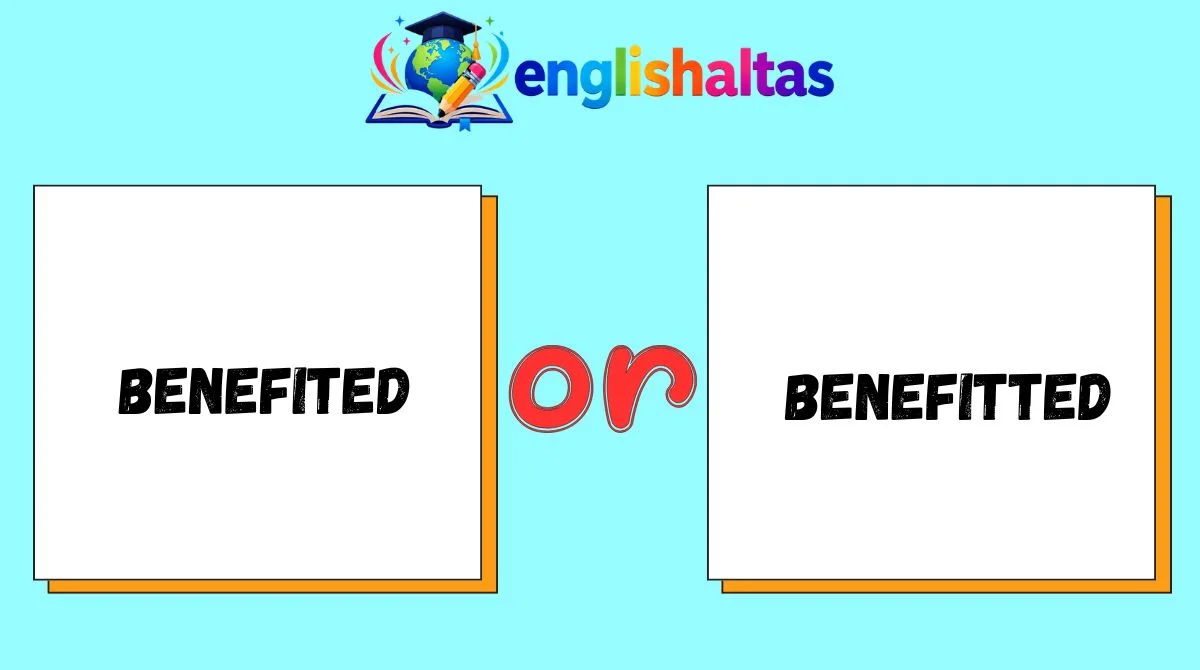
Benefited or benefitted? If you have ever written this word and stopped to count the letters, you are not alone.
Both spellings look reasonable, and both can be found in dictionaries. That is what makes this little spelling question confusing for English learners.
The good news is simple: both “benefited” and “benefitted” are accepted spellings. They are different spellings of the past tense and past participle of the verb benefit.
Major dictionaries, including Merriam-Webster and Oxford Learner’s Dictionaries, list both forms.
The real question is not whether one spelling is completely wrong.
Instead, it is about which spelling you should choose, especially when you are writing for school, work, or an international audience.
There is another useful point to learn. The spelling changes, but the meaning does not change.
If someone says, “I benefited from the course,” and another person says, “I benefitted from the course,” they mean the same thing.
This guide will make the choice much easier. You will learn the meaning of both forms, their grammar, how they differ in spelling, common mistakes, and how to use them naturally in everyday English.
By the end, you should be able to write benefited or benefitted with confidence instead of wondering whether your spell checker is about to complain.
What Does “Benefited” Mean?
Benefited is the past tense and past participle of the verb benefit.
The verb benefit means to receive an advantage, help, or useful result, or to give someone an advantage or useful result. Merriam-Webster lists benefited as the main form and benefitted as an alternative spelling.
For example:
I benefited from the extra practice.
This means that the extra practice helped me or gave me an advantage.
You can also use benefited when a person, group, organization, or thing receives a positive result.
When should you use “benefited”?
Use benefited when talking about something that helped someone or produced a useful result in the past.
It commonly appears with from when someone receives an advantage:
- She benefited from the advice.
- The students benefited from the new program.
- We benefited from the experience.
It can also be used directly with an object when something helps someone:
- The new system benefited the workers.
- The training benefited everyone.
- The changes benefited local businesses.
Oxford gives both transitive and intransitive uses of the verb. In simple terms, benefit can either describe something helping someone or someone gaining an advantage.
Examples with “benefited”

- I benefited from my teacher’s advice.
- She benefited from regular reading practice.
- The company benefited from the new technology.
- The students benefited from smaller classes.
- He benefited greatly from his work experience.
- Our community benefited from the new library.
- They benefited from the changes in the system.
- The team benefited from having an experienced coach.
Notice that the meaning stays the same in all of these examples: someone or something received an advantage or useful result.
A common learner confusion
Some learners think benefited must be the American spelling while benefitted must always be the British spelling.
That is too simple.
There can be regional preferences, but the distinction is not a strict rule that works in every dictionary or every English-speaking country. Oxford lists both forms, and Cambridge also recognizes both -t- and -tt- spellings.
So do not think:
American = benefited
British = benefitted
That is not a rule you should rely on.
What Does “Benefitted” Mean?
Benefitted has exactly the same meaning as benefited.
It is an alternative spelling of the past tense and past participle of benefit. Oxford lists both benefited and benefitted for these forms.
For example:
The students benefitted from the extra lessons.
This means exactly the same as:
The students benefited from the extra lessons.
There is no difference in meaning between these two sentences.
When should you use “benefitted”?
You can use benefitted when your chosen variety of English or writing style accepts the double-t spelling.
It is especially useful if you are following a particular British English style guide, dictionary, school preference, or publication style.
However, if you want the spelling that is often the safest and most widely recognized choice in international writing, benefited is a very practical option.
Examples with “benefitted”
- She benefitted from the training course.
- The children benefitted from the new playground.
- The business benefitted from better planning.
- He benefitted from years of experience.
- We all benefitted from the discussion.
- The town benefitted from the new road.
- The team benefitted from the manager’s advice.
- Many people benefitted from the program.
Again, there is no special meaning hidden inside the extra t.
Why does “benefitted” look strange to some learners?
The word benefit ends in t, so some learners naturally think the past form should add another t before -ed.
That gives:
benefit + ted = benefitted
This looks logical.
But English spelling does not always follow one simple pattern. In this case, both benefited and benefitted are established forms.
Merriam-Webster specifically gives benefited and says benefitted is also used.
Difference Between Benefited and Benefitted
The most important fact is this:
Benefited and benefitted have the same meaning and perform the same grammatical job.
The main difference is spelling preference, not grammar or meaning.
Quick comparison
| Feature | Benefited | Benefitted |
|---|---|---|
| Base verb | benefit | benefit |
| Meaning | Received or provided an advantage | Received or provided an advantage |
| Past tense | Yes | Yes |
| Past participle | Yes | Yes |
| Meaning difference | None | None |
| Spelling | One “t” before -ed | Two “t”s before -ed |
| Accepted English | Yes | Yes |
| Best for consistency | Very common choice | Use when preferred by your style |
Both forms are recognized by major dictionaries. Oxford lists benefited/benefitted as past forms, while Merriam-Webster lists benefited and notes benefitted as an alternative.
Usage difference
Suppose you write:
The students benefited from the lesson.
Now change it to:
The students benefitted from the lesson.
The meaning does not change.
Both sentences say that the students received a useful result from the lesson.
Grammar logic
Both words come from the same verb:
benefit → benefited / benefitted
They can be used as:
- simple past
- past participle
For example:
Simple past:
She benefited from the course.
Present perfect:
She has benefited from the course.
Past perfect:
She had benefited from the course.
The same grammar works with benefitted:
She benefitted from the course.
She has benefitted from the course.
She had benefitted from the course.
Sentence structure
A common structure is:
Subject + benefited/benefitted + from + noun
Examples:
I benefited from the experience.
They benefitted from the training.
Another structure is:
Subject + benefited/benefitted + object
Examples:
The program benefited the students.
The changes benefitted local businesses.
The spelling does not change the sentence structure.
Meaning comparison
Consider these two sentences:
Maria benefited from the advice.
Maria benefitted from the advice.
Both mean:
The advice helped Maria or gave her an advantage.
There is no difference in how much help Maria received. The extra t does not create a new meaning.
Grammar Rules You Must Remember
Rule #1: Both forms are past forms of “benefit”
You can use either spelling for the past tense and past participle.
Example:
He benefited from the experience.
or
He benefitted from the experience.
Both are grammatically acceptable.
Oxford lists both forms as past simple and past participle forms.
Rule #2: “Benefit from” is a very common structure
When a person receives an advantage from something, benefit from is often the natural choice.
Example:
She benefited from regular practice.
Here, regular practice is the thing that gave her an advantage.
More examples:
We benefited from the teacher’s explanation.
The company benefitted from the new plan.
He benefited from the extra time.
Rule #3: “Benefit someone” is also correct
Benefit does not always need from.
You can use the verb directly with the person or group that receives the advantage.
Example:
The new policy benefited workers.
Here, workers is the object of the verb.
You could also say:
Workers benefited from the new policy.
Both sentences are correct, but their structures are slightly different.
Rule #4: Do not change the spelling randomly in the same piece
If you choose benefited, try to use it consistently.
If you choose benefitted, keep using it consistently.
For example, avoid writing:
The students benefited from the course. Later, they benefitted from the workshop.
This is not grammatically wrong, but it can look inconsistent in formal writing.
A cleaner style is:
The students benefited from the course. Later, they benefited from the workshop.
Consistency makes your writing look more polished.
Common Mistakes Students Make
Mistake 1: Thinking one form is always wrong
A learner may see benefitted and immediately think it is a spelling mistake.
That is not correct.
Both forms are recognized. Cambridge gives benefiting or benefitting and benefited or benefitted, while Oxford also lists both forms.
Wrong idea:
Benefitted is never correct.
Better understanding:
Benefitted is an accepted alternative spelling.
Mistake 2: Using “benefit” when you need a past form
If the action happened in the past, you normally need the past form.
Incorrect:
I benefit from the course last year.
Correct:
I benefited from the course last year.
You could also write:
I benefitted from the course last year.
Mistake 3: Forgetting “from”
When you mean that someone gained an advantage because of something, benefit from is very common.
Less natural for this meaning:
I benefited the course.
That sentence means something different. It says I helped the course.
Compare:
I benefited from the course.
= The course helped me.
I benefited the course.
= I helped the course.
That small difference is very important.
Mistake 4: Confusing “benefited” with “beneficial”
These words are related, but they are not interchangeable.
Benefited is a verb.
She benefited from the exercise.
Beneficial is an adjective.
The exercise was beneficial.
You cannot normally replace one with the other.
Mistake 5: Writing “benefited from” with an unnecessary “to”
A common learner error is:
Benefited or Benefitted
The natural structure is:
Benefited or Benefitted
Remember:
benefit from something
Easy correction tip
When you want to say “something helped me,” try this pattern:
I benefited from + thing.
Examples:
Benefited or Benefitted
Benefited or Benefitted
Benefited or Benefitted
That simple pattern will help you avoid many errors.
Easy Trick to Remember the Difference
Here is the easiest trick:
Think of the two spellings as twins.
Benefited and benefitted are like two versions of the same word. They look slightly different, but they have the same meaning and grammar.
The only visible change is the extra t.
Think:
benefit → benefited
benefit → benefitted
Both roads lead to the same meaning.
Which one should you choose?
If you are unsure, benefited is an excellent default choice.
It is widely recognized, appears prominently in major dictionaries, and is especially common in American English. Merriam-Webster gives benefited as its main form while also recognizing benefitted.
But if your teacher, school, employer, or publication uses benefitted, you can use that spelling too.
One more memory trick
Remember:
Benefited or Benefitted
That is really all you need.
Do not waste time trying to find a hidden difference in meaning. There isn’t one.
Daily Life Examples
Here are some natural examples you might hear or use in everyday English.
1. Talking about school
Benefited or Benefitted
The group study helped you.
2. Talking about a teacher
Benefited or Benefitted
The teacher’s advice gave her an advantage.
3. Talking about work
Benefited or Benefitted
The software helped the company.
4. Talking about exercise
Benefited or Benefitted
Regular exercise gave him useful results.
5. Talking about experience
Benefited or Benefitted
The job gave you useful knowledge or experience.
6. Talking about a family decision
Benefited or Benefitted
The change helped everyone.
7. Talking about technology
Benefited or Benefitted
Better technology helped the business.
8. Talking about advice
Benefited or Benefitted
The advice was useful to you.
9. Using the double-t spelling
Benefited or Benefitted
This has exactly the same meaning as the one-t version.
10. Using the verb with an object
Benefited or Benefitted
Here, the program helped many families.
These examples show an important point: benefit is a useful everyday verb. It is not limited to academic or formal writing.
You can use it when talking about school, work, health, money, training, technology, family decisions, and many other situations.
Practice Section
Choose the correct option. Remember that in several questions, both spellings may be acceptable.
1. I ______ from the extra practice.
A. benefited
B. benefitted
2. The new program ______ many students.
A. benefited
B. benefitted
3. She has ______ from the experience.
A. benefited
B. benefitted
4. They ______ from the teacher’s advice.
A. benefited
B. benefitted
5. The company ______ from the new system.
A. benefited
B. benefitted
Answers
1. A or B — Both are accepted.
Benefited or Benefitted
3. A or B — Both are accepted.
4. A or B — Both are accepted.
Benefited or Benefitted
The important lesson is not choosing one spelling because the other is “wrong.” Instead, learn that both benefited and benefitted are valid forms and choose the form that fits the spelling style you are following.
FAQs
What is the difference between benefited and benefitted?
There is no difference in meaning or basic grammar. Benefited and benefitted are alternative spellings of the past tense and past participle of benefit. Major dictionaries recognize both forms.
Can we use “benefited” in questions?
Yes. Benefited can be used in questions just like any other past participle or past-tense verb form.
For example:
Benefited or Benefitted
For a perfect tense question:
Benefited or Benefitted
You normally use benefit after did, because “did” already carries the past tense.
Is “benefitted” formal or informal?
Benefitted is an accepted English spelling, so it is not simply an informal mistake. However, spelling preferences can vary between dictionaries, regions, publishers, and style guides.
If you are unsure what a particular school or publication prefers, check its style guide.
Which is correct: benefited or benefitted?
Both are correct. Oxford lists both forms, and Merriam-Webster lists benefited while also giving benefitted as an alternative.
If you want a simple default, benefited is a safe choice.
Is “benefited from” grammatically correct?
Yes. Benefit from is a very common grammatical structure when someone receives an advantage from something.
For example:
Benefited or Benefitted
Benefited or Benefitted
Cambridge describes the verb as meaning to be helped by something or to help someone and gives examples using this structure.
Should I use “benefited” or “benefitted” in an essay?
Either can be correct, but consistency matters.
If your school, university, employer, or publisher has a preferred spelling, follow that preference. If there is no stated preference, benefited is a practical choice for general international writing.
Conclusion
The question “benefited or benefitted?” looks harder than it really is.
The simple answer is that both spellings are correct. They are alternative forms of the past tense and past participle of benefit, and they have the same meaning.
The main difference is spelling: benefited has one t, while benefitted has two. There is no special change in meaning, pronunciation, or basic sentence structure caused by the extra letter.
For everyday writing, benefited is a very useful default. But if you see benefitted, do not assume it is a spelling error. It is an accepted form too.
The bigger grammar lesson is to remember the useful structure benefit from something when you mean that someone gains help or an advantage.
So the next time you write, “I benefited from the lesson,” you can do so confidently. And if your teacher or dictionary uses “benefitted,” you can understand that form too.
One meaning, two spellings — problem solved.

Oliver Bennett is an English language educator and content writer passionate about simplifying grammar. He creates clear, practical lessons, writing tips, and learning resources that help readers improve their English with confidence.