“Helpful to” and “helpful for” are both correct English expressions. That sounds simple, but many English learners still stop when they have to choose between them.
For example, should you say “This advice is helpful to me” or “This advice is helpful for me”?
What about “Exercise is helpful to your health” and “Exercise is helpful for your health”?
The confusion happens because to and for can both connect the adjective helpful with another part of the sentence.
The meaning can also be very close. In everyday English, native speakers sometimes use both forms naturally, which makes the choice even harder for learners.
This small difference is worth learning because you will see these phrases in school, work, conversations, emails, instructions, and everyday advice.
The good news is that you do not need to memorize hundreds of complicated rules. There is a simple way to understand the main difference.
“Helpful to” usually focuses on the person, group, or thing that receives or experiences the help.
“Helpful for” often focuses on a purpose, situation, activity, need, or benefit.
By the end, you will know when each expression sounds natural, how to build sentences with them, which common mistakes to avoid, and how native speakers use them in daily English.
What Does “Helpful to” Mean?
Helpful to means that something provides help, support, or a useful effect to a particular person, group, or thing.
The basic pattern is:
helpful + to + person/thing
For example:
- This advice is helpful to me.
- The teacher’s explanation was helpful to the students.
- Your message was helpful to my family.
- This information may be helpful to beginners.
- Her suggestion was helpful to the team.
- The new system is helpful to workers.
- His comments were helpful to us.
- This guide will be helpful to anyone learning English.
Here, the word after to is usually the person or group that receives the benefit.
When Should You Use “Helpful to”?
Use helpful to when you want to point directly to who or what benefits from something.
Imagine someone asks:
“Who did this advice help?”
You could answer:
“It was helpful to me.”
The focus is on me, the person who received the benefit.
Another example:
The teacher’s feedback was helpful to the students.
The students are the people who benefited from the feedback.
Grammar Rule for “Helpful to”
The common structure is:
Subject + be + helpful + to + person/group/thing
Examples:
- This book is helpful to new learners.
- The advice was helpful to my brother.
- These instructions are helpful to customers.
You can also use other verbs:
- The guide proved helpful to us.
- This tool can be helpful to teachers.
- The information may be helpful to parents.
A Common Learner Confusion
Some students think to must always show movement.
That is not true.
In:
This information is helpful to me.
There is no physical movement. To is connecting helpful with the person who benefits.
Compare:
I gave the book to Sarah.
Here, to shows the direction of something.
But:
The book was helpful to Sarah.
Here, to identifies the person who benefited.
That is an important difference.
What Does “Helpful for” Mean?
Helpful for means useful or beneficial for a particular purpose, situation, activity, need, or sometimes a person.
The basic pattern is:
helpful + for + purpose/situation/activity/person
Examples:
- This exercise is helpful for beginners.
- Walking is helpful for your health.
- This website is helpful for learning English.
- These notes are helpful for studying.
- The app is helpful for practicing vocabulary.
- A dictionary is helpful for difficult words.
- This advice is helpful for solving the problem.
- The checklist is helpful for new employees.
Notice something interesting: for often tells us the reason or purpose for which something is useful.
When Should You Use “Helpful for”?
Use helpful for when you are thinking about:
- a purpose
- an activity
- a situation
- a task
- a problem
- a need
- a type of person
- a general benefit
For example:
Flashcards are helpful for learning vocabulary.
The focus is not on a person receiving the help. The focus is on the activity of learning vocabulary.
Another example:
This guide is helpful for beginners.
Here, beginners are a group for whom the guide is useful.
Grammar Rule for “Helpful for”
A common structure is:
Subject + be + helpful + for + purpose/activity/situation
Examples:
- This exercise is helpful for improving pronunciation.
- The chart is helpful for understanding the difference.
- These tools are helpful for students.
- The instructions are helpful for new users.
After for, you can often use a noun or an -ing form when talking about an activity.
For example:
This book is helpful for learning grammar.
Not:
This book is helpful for learn grammar.
After for, when you use a verb to describe an activity, use the -ing form.
Another Common Confusion
Learners sometimes think helpful for is only used with things.
That is not correct.
You can say:
This program is helpful for children.
You can also say:
This program is helpful for teachers.
Here, children and teachers describe the people who can benefit from the program.
Difference Between “Helpful to” and “Helpful for”
The difference is usually about focus, not about completely different meanings.
Both expressions can describe something useful or beneficial.
| Expression | Main focus | Common use | Example |
|---|---|---|---|
| helpful to | The receiver of help | Person or group benefiting | The advice was helpful to me. |
| helpful for | Purpose, activity, situation, or benefit | Task, activity, need, or group | The advice was helpful for solving the problem. |
| helpful to | Who benefits | A particular person/group | The lesson was helpful to the students. |
| helpful for | What something helps with | Activity or purpose | The lesson was helpful for learning grammar. |
Compare These Two Sentences
The teacher’s explanation was helpful to me.
The focus is on me. I received the benefit.
The teacher’s explanation was helpful for understanding the rule.
The focus is on understanding the rule. That is the purpose or activity.
Both sentences can describe the same explanation, but the speaker chooses a different focus.
“Helpful to” Often Answers “Helpful to Whom?”
Think:
Who benefits?
- helpful to me
- helpful to you
- helpful to students
- helpful to parents
- helpful to workers
- helpful to the team
Example:
The extra lesson was helpful to the students.
“Helpful for” Often Answers “Helpful for What?”
Think:
Helpful for what purpose, task, or situation?
- helpful for studying
- helpful for learning
- helpful for practice
- helpful for work
- helpful for beginners
- helpful for this problem
Example:
The extra lesson was helpful for improving their grammar.
This is the easiest way to see the difference.
But the Difference Is Not Always Strict
English does not always work like a mathematical formula.
Sometimes helpful to and helpful for can both sound natural.
For example:
This book is helpful to students.
This book is helpful for students.
Both can be understood as meaning that students benefit from the book.
The second sentence can sound more like a statement about suitability or usefulness for that group.
The first can place slightly more attention on the students as receivers of the benefit.
So do not worry if you see both forms used in similar situations.
Grammar Rules You Must Remember
Rule #1: Use “helpful to” for the person or group receiving help
When the main idea is who benefits, to is a good choice.
The advice was helpful to me.
Her explanation was helpful to the students.
A quick question can help:
Who benefited?
The answer can often follow to.
Rule #2: Use “helpful for” for a purpose or activity
When you are talking about what something is useful for doing, use for.
This app is helpful for practicing English.
These cards are helpful for learning new words.
Remember:
for + activity
When the next word is a verb, use the -ing form.
helpful for studying
helpful for reading
helpful for practicing
helpful for remembering
Rule #3: “Helpful for” can describe a situation or need
You can use for when something is useful in a particular situation.
This information is helpful for the exam.
The guide is helpful for beginners.
These instructions are helpful for new users.
Here, for describes the situation, purpose, or group that the thing is useful for.
Rule #4: Do not confuse “helpful to” with “helpful + infinitive”
There is another useful pattern:
It is helpful to + verb
For example:
It is helpful to practice every day.
It is helpful to read the sentence aloud.
This is different from:
The book is helpful to me.
In the first sentence, to practice is an infinitive.
In the second sentence, to me identifies the person who benefits.
That small grammar point can save you from many mistakes.
Common Mistakes Students Make
Mistake 1: Using “for” before a base verb
Incorrect:
This exercise is helpful for learn English.
Correct:
This exercise is helpful for learning English.
After for, use the -ing form when you are describing an activity.
Mistake 2: Thinking “to” always means an infinitive
Incorrect thinking:
There is “to,” so the next word must be a verb.
Not always.
In:
This advice is helpful to me.
me is an object pronoun, not a verb.
But in:
It is helpful to practice.
to practice is an infinitive.
Look at the word after to before deciding what grammar pattern you have.
Mistake 3: Saying “helpful for me” when the intended focus is the receiver
This advice was helpful to me.
This is a very natural way to say that you personally benefited from the advice.
Helpful for me is also possible in some contexts, especially when talking about what suits you or benefits you, but learners should first understand the receiver-versus-purpose distinction.
Mistake 4: Thinking one expression is always correct
English is flexible.
You may hear:
This is helpful to students.
You may also hear:
This is helpful for students.
Do not assume that one is automatically wrong.
Ask yourself what the speaker wants to emphasize.
Mistake 5: Forgetting the meaning of “for”
“For” often has the idea of purpose, use, benefit, or suitability.
For example:
This dictionary is helpful for beginners.
This tool is helpful for checking spelling.
That idea of usefulness is important.
Easy Trick to Remember the Difference
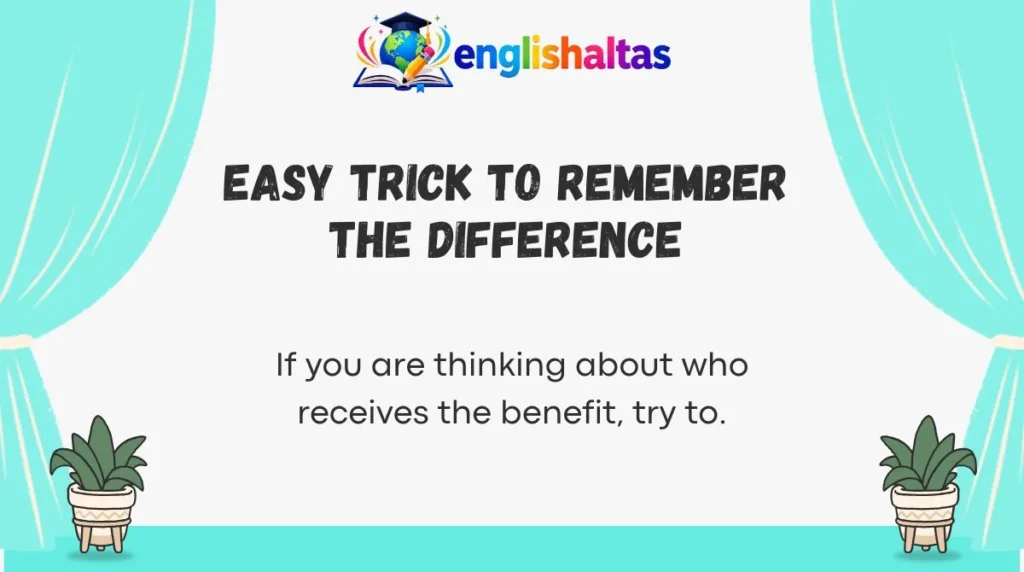
Here is a simple classroom trick:
TO = Who?
FOR = What purpose?
If you are thinking about who receives the benefit, try to.
helpful to me
helpful to Sarah
helpful to students
If you are thinking about what something is useful for, try for.
helpful for studying
helpful for work
helpful for beginners
helpful for solving the problem
You can remember it like this:
Helpful TO a person.
Helpful FOR a purpose.
This is not an absolute rule for every possible English sentence, but it is an excellent starting point for learners.
Real-Life Memory Trick
Imagine a teacher gives you a study guide.
Ask:
Who did the guide help?
It was helpful to me.
Now ask:
What was the guide useful for?
It was helpful for studying.
Same guide. Two different questions.
That is the key.
Daily Life Examples
Here are natural examples you may hear in school, at home, at work, or in normal conversation.
1. Talking about personal help
“Thanks for explaining that. Your answer was really helpful to me.”
The speaker focuses on the person who received the help.
2. Talking about students
“The teacher’s notes were very helpful to the students.”
The students benefited from the notes.
3. Talking about studying
“These videos are helpful for learning English.”
The focus is the activity of learning English.
4. Talking about exercise
Helpful to or Helpful for
The focus is the benefit or purpose.
5. Talking about work
Helpful to or Helpful for
The checklist is useful for that group.
6. Talking about a friend
Helpful to or Helpful for
The friend gave advice, and the speaker benefited from it.
7. Talking about a task
Helpful to or Helpful for
The purpose is saving time.
8. Talking about an English lesson
Helpful to or Helpful for
The students received the benefit.
9. Talking about practice
Helpful to or Helpful for
The activity helps with pronunciation.
10. Talking about a problem
Helpful to or Helpful for
The focus is the task of solving the problem.
Practice Section
Choose helpful to or helpful for in each sentence.
1. This advice was very helpful ___ me.
2. These exercises are helpful ___ improving your grammar.
3. The teacher’s comments were helpful ___ the students.
4. This website is helpful ___ beginners.
5. Flashcards are helpful ___ remembering new vocabulary.
Answers
1. helpful to
Helpful to or Helpful for
The focus is the person who received the benefit.
2. helpful for
Helpful to or Helpful for
The focus is the activity or purpose.
3. helpful to
Helpful to or Helpful for
The students received the benefit.
4. helpful for
Helpful to or Helpful for
The website is useful for that group.
5. helpful for
Helpful to or Helpful for
The focus is the activity of remembering vocabulary.
FAQs
What is the difference between “helpful to” and “helpful for”?
Helpful to often focuses on the person or group receiving the benefit. Helpful for often focuses on a purpose, activity, situation, or type of user.
For example, “The advice was helpful to me” focuses on me, while “The advice was helpful for solving the problem” focuses on the purpose.
Can we use “helpful to” in questions?
Yes. Helpful to can be used naturally in questions.
For example:
Helpful to or Helpful for
You can also ask:
Helpful to or Helpful for
The phrase works in questions just as it does in statements.
Is “helpful for” correct before a verb?
Yes, but when for is followed by a verb describing an activity, use the -ing form.
Correct:
Helpful to or Helpful for
Incorrect:
Helpful to or Helpful for
Remember: for + verb-ing when describing an activity.
Is “helpful to” formal or informal?
Helpful to is normal in both everyday and formal English.
You can say:
Helpful to or Helpful for
You can also use it in formal writing:
Helpful to or Helpful for
It does not sound unusually formal.
Is “helpful for me” grammatically correct?
Yes, helpful for me can be correct. The meaning depends on the context.
For example:
Helpful to or Helpful for
Here, the speaker is talking about what is useful or beneficial in a particular situation.
If you simply want to say that someone gave you useful help, helpful to me is often the clearer choice:
Helpful to or Helpful for
Can “helpful to” and “helpful for” both be correct?
Yes. Sometimes both are grammatically possible and have very similar meanings.
For example:
Helpful to or Helpful for
Helpful to or Helpful for
The first can emphasize the students as people who benefit. The second can emphasize the book’s usefulness for that group.
Context decides which sounds better.
Conclusion
The difference between helpful to and helpful for is much easier when you stop trying to memorize a long list of rules.
Think about the focus of your sentence.
Use helpful to when you want to point to the person or group that receives the benefit:
Helpful to or Helpful for
Use helpful for when you want to talk about a purpose, activity, situation, need, or general usefulness:
Helpful to or Helpful for
Also remember the special pattern helpful for + -ing:
helpful for studying
helpful for learning
Helpful to or Helpful for
And do not panic when you see both forms used with people. English sometimes allows both, especially when the meaning is close.
The best way to become comfortable with these expressions is to notice them in real sentences and practice making your own.
Ask “Who benefits?” for to and “What is it useful for?” for for. With a little practice, choosing the right phrase will start to feel natural.

Oliver Bennett is an English language educator and content writer passionate about simplifying grammar. He creates clear, practical lessons, writing tips, and learning resources that help readers improve their English with confidence.