May and can are two small English words that cause a lot of trouble for learners. They often appear in questions such as “May I come in?”
and “Can I come in?” At first, these sentences seem to have the same meaning. In everyday English, they often do. But there are some important differences between them.
The confusion becomes bigger because can has more than one common use. It can talk about ability, permission, or something that is possible.
May is mainly used for permission and possibility. It can also sound more polite or formal in some situations.
Knowing the difference is useful because these words appear everywhere: at school, at work, at home, in conversations, and in written English.
A small change from can to may can change the meaning or the tone of a sentence.
The good news is that the basic rule is easy. If you are talking about what someone is able to do, use can.
If you are asking for or giving permission, both words can sometimes work, but may is more formal. If you are talking about possibility, may is often the better choice.
By the end, you will know when to use may, when to use can, and how to avoid the mistakes that many English learners make.
What Does “May” Mean?
May is a modal verb. We commonly use it to talk about permission and possibility.
It is often used when someone asks politely for permission. For example:
- May I come in?
- May I use your phone?
- May I leave early today?
In these examples, the speaker is not asking whether they are able to do something. They are asking whether they have permission to do it.
May can also show that something is possible.
For example:
- It may rain tonight.
- She may be at home.
- We may go to the park later.
- He may arrive late.
Here, may means that something is possible, but it is not certain.
Grammar Rule for “May”
After may, use the base form of the verb.
Subject + may + base verb
Examples:
- I may go.
- She may come.
- They may stay.
- He may call.
Do not add to after may.
Incorrect: She may to come.
Correct: She may come.
Do not add -s to the verb after may.
Incorrect: He may goes home.
Correct: He may go home.
Examples of “May”
- May I ask you a question?
- May I sit here?
- You may leave now.
- We may visit them tomorrow.
- She may be busy right now.
- It may snow tonight.
- He may not understand the question.
- They may come to the party.
Notice that the meaning depends on the sentence. In the first three examples, may is connected with permission. In the later examples, it expresses possibility.
A Common Confusion About “May”
Many students think may is always more correct than can when asking permission.
That is not quite true.
For example, both of these are normal:
Can I borrow your pen?
May I borrow your pen?
The second sentence sounds more formal or polite. The first is very common in everyday conversation.
So, you do not need to use may every time you ask for permission. Your choice can depend on the situation and the level of formality.
What Does “Can” Mean?
Can is also a modal verb, but it has several important uses. The most common ones are ability, permission, and possibility.
The clearest use is ability.
When you want to say that someone knows how to do something or has the ability to do something, use can.
For example:
- I can swim.
- She can drive.
- He can speak English.
- They can solve the problem.
Here, can means “be able to.”
Can is also commonly used to ask for or give permission.
Examples:
- Can I come with you?
- Can I use your computer?
- You can sit here.
- You can take one piece of cake.
In modern everyday English, this use is extremely common.
Can can also describe general possibility.
For example:
- It can get very cold here in winter.
- Driving at night can be dangerous.
- Mistakes can happen.
These sentences describe something that is possible in general.
Grammar Rule for “Can”
Like may, can is followed by the base form of a verb.
Subject + can + base verb
Examples:
- I can help.
- She can dance.
- We can wait.
- They can come.
Do not use to after can.
Incorrect: I can to swim.
Correct: I can swim.
Do not use -s after can.
Incorrect: She can speaks English.
Correct: She can speak English.
Examples of “Can”
- I can help you.
- Can I open the window?
- She can play the piano.
- Can we meet tomorrow?
- You can use my chair.
- He can run very fast.
- This road can become busy in the evening.
- Anyone can make a mistake.
A Common Confusion About “Can”
A common mistake is thinking that can only means ability.
That is not true.
Look at these three sentences:
I can swim. → ability
Can I swim here? → permission
This road can be dangerous. → general possibility
The same word has different meanings depending on the context.
Difference Between May and Can
The easiest way to understand may vs can is to look at what the speaker wants to express.
Can is strongly connected with ability. It is also very common for permission and general possibility.
May is strongly connected with permission and possibility. It does not normally express ability.
Comparison Table
| Use | May | Can |
|---|---|---|
| Ability | Usually not used | Yes |
| Asking permission | Yes | Yes |
| Giving permission | Yes | Yes |
| Possibility | Yes | Yes, especially general possibility |
| Formal permission | Common | Less formal |
| Everyday permission | Common | Very common |
| Base verb after it | Yes | Yes |
1. Ability
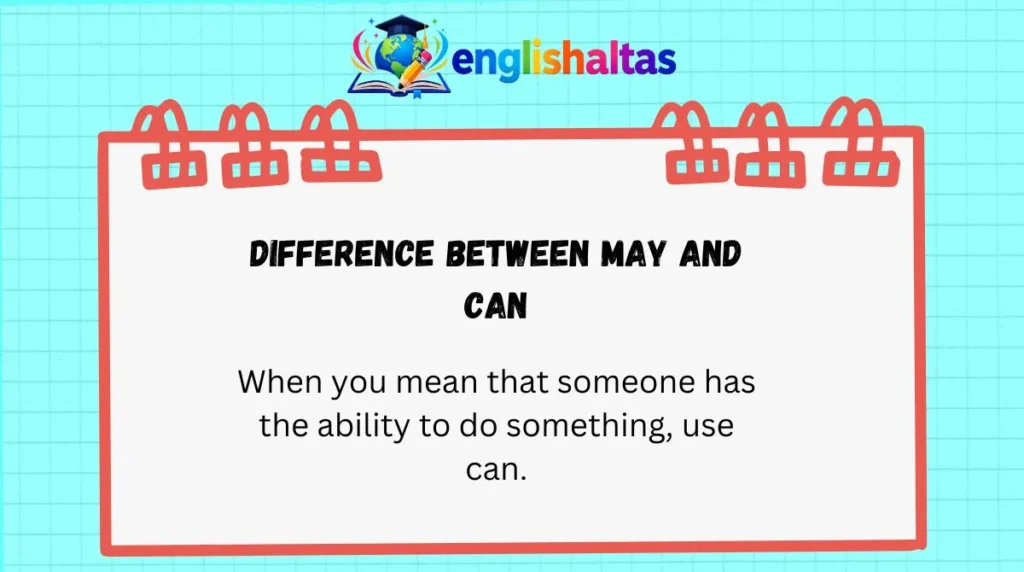
When you mean that someone has the ability to do something, use can.
Correct: I can drive.
Incorrect: I may drive.
The second sentence does not normally mean “I have the ability to drive.” It usually suggests that driving is possible or that the speaker might drive.
Compare:
I can drive.
= I know how to drive / I am able to drive.
I may drive.
= Perhaps I will drive.
That is a major difference.
2. Asking for Permission
Both words can be used to ask for permission.
Can I leave now?
May I leave now?
Both can be understood as a request for permission. However, may traditionally sounds more formal and polite.
You might hear “May I come in?” in a classroom, office, or formal situation.
You are very likely to hear “Can I come in?” in casual everyday conversation.
3. Giving Permission
Both words can also give permission.
You can go now.
You may go now.
The meaning is similar, but the tone can be different.
You can go now sounds natural and conversational.
You may go now can sound more formal, official, or authoritative.
For example, a teacher or official might say:
You may begin the test.
4. Possibility
Both can talk about possibility, but they do not always express the same kind of possibility.
She may come later.
This means there is a possibility that she will come later.
Traffic can be heavy on Fridays.
This means heavy traffic is something that can happen in general.
So, a useful beginner rule is:
May = perhaps this particular thing will happen.
Can = this is possible in general / this is something that can happen.
Sentence Structure
Both are modal verbs, so their basic structure is similar:
Subject + may/can + base verb
Examples:
- She may come.
- She can come.
- They may stay.
- They can stay.
For questions, place the modal before the subject:
May + subject + base verb?
May I come in?
Can + subject + base verb?
Can I come in?
For negative sentences:
Subject + may not + base verb
Subject + cannot/can’t + base verb
Examples:
- She may not come.
- She cannot come.
- He may not know.
- He can’t swim.
The negative forms can have different meanings, so context matters.
Grammar Rules You Must Remember
Rule #1: Use “Can” for Ability
When you mean “be able to,” use can.
I can speak English.
This means the person has the ability to speak English.
Do not use may when you simply want to describe someone’s ability.
Rule #2: Use “May” for Formal Permission
May I enter the room?
This is a polite and formal request for permission.
However, Can I enter the room? is also normal in everyday English.
The difference is mainly about tone and formality, not always about basic meaning.
Rule #3: Use “May” for a Possible Future Event
Use may when you are not sure whether something will happen.
We may visit our grandparents this weekend.
The visit is possible, but the speaker has not decided or is not certain.
Compare:
We can visit our grandparents this weekend.
This usually means the visit is possible because there is an opportunity, ability, or plan that allows it.
Rule #4: Use the Base Verb After Both Words
Never add to or -s to the main verb after can or may.
Correct:
She can sing.
He may come.
Incorrect:
May vs Can
May vs Can
This rule is simple but very important.
Common Mistakes Students Make
Mistake 1: Using “May” for Ability
Incorrect:
May vs Can
If you mean that you have the ability to swim well, say:
May vs Can
If you say “I may swim,” you are more likely to mean “Perhaps I will swim.”
Mistake 2: Thinking “Can I?” Is Always Wrong
Some learners are taught that “May I?” is the only correct way to ask permission.
That is too strict for modern everyday English.
Can I use your phone? is completely natural in ordinary conversation.
May I use your phone? is also correct and sounds more formal or polite.
Mistake 3: Adding “To”
Incorrect:
May vs Can
Correct:
I can help you.
Incorrect:
May vs Can
Correct:
May vs Can
Modal verbs such as can and may are followed directly by the base verb.
Mistake 4: Adding “-s”
Incorrect:
He can speaks English.
May vs Can
He can speak English.
May vs Can
She may goes home.
May vs Can
She may go home.
Even when the subject is he, she, or it, the verb after a modal stays in its base form.
Mistake 5: Confusing “Can” and “May” for Possibility
Consider:
It may rain tomorrow.
This is a prediction about a possible event.
Now consider:
It can rain heavily here.
This talks about something that can happen in this place or situation.
A useful question is:
Am I talking about a specific possibility or something that is generally possible?
For a specific possibility, may is often a good choice.
For general possibility, can is often natural.
Easy Trick to Remember the Difference
Here is a simple memory trick:
CAN = capability
Think of can as the word for what a person is able to do.
May vs Can
I can cook.
May vs Can
Now remember:
MAY = maybe
The words are not related in origin, but this is a useful memory trick for learners.
When you see may, think:
Maybe it will happen.
- May vs Can
- May vs Can
- It may rain.
- May vs Can
Of course, may also asks for permission:
May vs Can
So your quick classroom rule can be:
May vs Can
May vs Can
And remember that can is also widely used for everyday permission.
Daily Life Examples
Real conversations make the difference easier to remember.
Example 1: At School
Student: May I come in, sir?
May vs Can
This sounds polite and formal.
May vs Can
Student: Can I come in?
Example 2: Talking About Ability
Friend: Can you drive?
You: Yes, I can.
Here, can means ability. You are asking whether the person knows how to drive.
May vs Can
May you drive?
That does not express the same idea.
Example 3: Asking to Borrow Something
Ali: Can I borrow your pen?
Hamza: Sure, you can.
May vs Can
A more formal version would be:
May I borrow your pen?
Example 4: Talking About Tomorrow
Sara: Are you coming to the party?
Mina: I may come. I’m not sure yet.
Here, may means there is a possibility.
Example 5: Talking About General Danger
Parent: Be careful on this road.
Child: Why?
Parent: Cars can move very fast here.
The speaker is talking about something that can happen generally.
Example 6: At Work
Employee: May I leave a little early today?
Manager: Yes, you may.
The use of may makes the request sound polite and professional.
Example 7: Making Plans
John: What are you doing this evening?
Mike: I may watch a movie.
Mike is not certain. Watching a movie is only a possibility.
Example 8: Talking About Skill
Teacher: Can you answer this question?
Student: Yes, I can.
Here, can clearly expresses ability.
Example 9: Giving Permission
Mother: Can I use your laptop?
Son: Yes, you can.
This is a natural informal conversation.
Example 10: Talking About a Possible Problem
Teacher: Take an umbrella.
Student: Why?
Teacher: It may rain later.
The teacher thinks rain is possible, but does not know for certain that it will happen.
Practice Section
Choose can or may to complete each sentence.
1. _____ I use your phone?
2. She _____ speak three languages.
3. We _____ go to the beach tomorrow, but we are not sure.
4. This road _____ be dangerous at night.
5. _____ I come into your office?
Answers
1. Can / May
Both are possible. May I use your phone? sounds more formal, while Can I use your phone? is very common in everyday speech.
2. Can
She can speak three languages.
May vs Can
3. May
We may go to the beach tomorrow, but we are not sure.
May vs Can
4. Can
This road can be dangerous at night.
May vs Can
5. May
May I come into your office?
This is a polite and formal request for permission. Can I come into your office? is also natural in less formal speech.
FAQs
What is the main difference between “may” and “can”?
The biggest difference is that can commonly expresses ability, while may commonly expresses possibility or permission.
For example, “I can swim” means I have the ability to swim. “I may swim” usually means perhaps I will swim.
Can we use “can” to ask for permission?
Yes. Can I use your phone? is very common and natural in everyday English.
Some traditional grammar lessons prefer “May I?” for permission, especially in formal situations. In modern spoken English, “Can I?” is widely accepted.
Is “may” more formal than “can”?
When asking for permission, may often sounds more formal or polite than can.
For example, “May I speak to the manager?” has a more formal tone. “Can I speak to the manager?” sounds more casual.
Can “may” describe ability?
Normally, no. If you want to say that someone has the ability to do something, use can.
May vs Can
She may swim usually means it is possible that she will swim.
Can “may” and “can” both express possibility?
Yes, but they often describe different kinds of possibility.
May commonly describes a particular possibility: It may rain tonight.
May vs Can
Context is important.
Which is correct: “May I go?” or “Can I go?”
Both can be correct, but the tone is different.
May vs Can
Can I go? is very common in everyday conversation.
If you are speaking casually with friends or family, can is completely natural. In a formal situation, may can be a better choice.
Conclusion
Understanding may vs can becomes much easier when you focus on the meaning behind the sentence.
Use can when you are talking about ability: I can swim. Use can very naturally for everyday permission too:
Can I sit here? It can also describe things that are generally possible: Mistakes can happen.
Use may when you are talking about possibility: She may come later. It is also a traditional and polite choice for asking or giving permission: May I come in?
The most useful beginner rule is simple: can often means “be able to,” while may often means “perhaps” or shows formal permission.
Do not worry if the difference feels confusing at first. Pay attention to real conversations, notice why the speaker chose each word, and practice making your own sentences.
With a little practice, choosing between may and can will become much more natural.

Oliver Bennett is an English language educator and content writer passionate about simplifying grammar. He creates clear, practical lessons, writing tips, and learning resources that help readers improve their English with confidence.