English has many words that sound exactly the same but have completely different meanings.
This can make learning English confusing, especially when you hear a word in a conversation and need to write it correctly later.
For, four, and fore are a good example. The words for and four are common in daily English.
Fore is less common, but you may still see it in sports, formal writing, or special expressions.
The word “forel” is not normally used as the standard English word in this comparison, so many learners who search for for vs four vs forel are usually looking for the difference between for, four, and fore.
These words are called homophones when they have the same sound but different meanings. If you say them aloud, they can sound very similar.
However, their spelling and grammar use are not the same.
The good news is that the difference is simple once you learn the basic idea.
After reading this guide, you will understand when to use for for a purpose, person, or length of time; when to use four for the number 4;
and when fore is used for “front” or as a warning in golf. You will also learn easy grammar rules, common mistakes, daily conversation examples, and a simple memory trick that makes these words much easier to remember.
What Does “For” Mean?
For is a very common English word. It is usually a preposition, but it can also appear in other grammar structures.
The basic meaning of for is often connected to purpose, benefit, reason, or time.
When do we use “for”?
We use for when we talk about:
- The person who receives something
- The purpose of something
- A reason
- A period of time
- Support or agreement
- The use of something
Grammar rule
For + noun or pronoun is a common pattern.
Examples:
- for me
- for your brother
- for school
- for two hours
- for a reason
Here are some simple sentences:
- This gift is for you.
- I bought a pen for my sister.
- We waited for the bus.
- He studied for three hours.
- This room is for guests.
- Thank you for your help.
- She went to the shop for milk.
- Are you for or against the plan?
Look at the first sentence: This gift is for you. The word for shows the person who will receive the gift.
In I studied for three hours, the word for shows the length of time.
A common learner confusion
Many students see the sound “for” and think about the number four. This is especially common in listening practice.
For example:
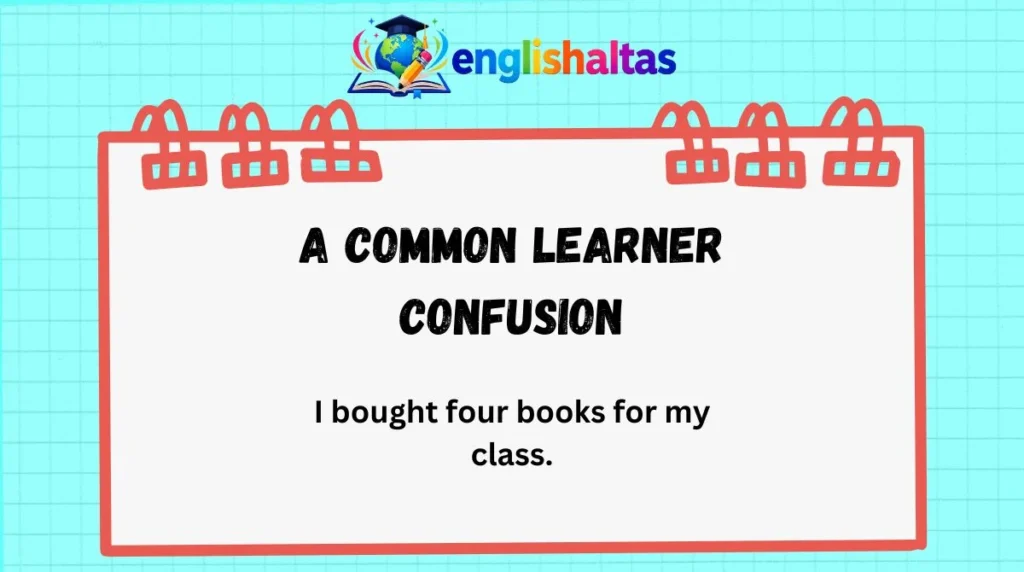
I bought four books for my class.
The first word four means the number 4. The second word for shows purpose or use.
Four books for my class.
The sound may confuse you, but the meaning and spelling are different.
Another problem happens in texting. Some people write 4 instead of for in informal messages. That may be acceptable in very casual texting, but it is not correct for school, exams, or formal writing.
What Does “Four” Mean?
Four is a number. It means the number 4.
We use four when we count people, things, or amounts.
When do we use “four”?
Use four when you mean:
- The number 4
- Four people
- Four things
- Four units of something
Grammar rule
Four + plural countable noun is a very common structure.
Examples:
- four books
- four students
- four apples
- four chairs
Here are eight examples:
- I have four brothers.
- There are four chairs in the room.
- She bought four apples.
- We need four tickets.
- The class has four groups.
- He waited for four minutes.
- I can see four birds.
- Four students answered the question.
The important thing is simple: four always talks about a number.
If you can replace the word with 4, you probably need four.
For example:
I have four pencils.
You can write:
I have 4 pencils.
The meaning stays the same.
A common learner confusion
The biggest problem is that four sounds like for.
Consider these sentences:
- I have four pens.
- This pen is for you.
When you hear them, the words can sound very similar. But the first sentence talks about quantity. The second sentence talks about the person receiving something.
Four = number 4.
For = purpose, person, reason, or time.
This small difference can help you choose the correct spelling.
What Does “Fore” Mean?
Fore is a real English word, but it is much less common than for and four.
It has two main uses.
1. “Fore” means the front part
In some words and expressions, fore relates to the front or the part that comes before.
For example:
- forehead = the front part of the head
- foreleg = a front leg of an animal
- forearm = the part of the arm between the elbow and wrist
In these words, fore gives the idea of front.
2. “Fore!” is a warning in golf
In golf, a player may shout “Fore!” when a golf ball could hit someone.
It is a warning word.
Example:
“Fore!” shouted the golfer.
The people nearby hear this warning and know they should be careful.
Grammar rule
Fore is not normally used like for.
You do not write:
This gift is fore you.
That is incorrect.
You also do not write:
I have fore books.
That is incorrect if you mean the number 4.
Here are some examples of fore:
- The golfer shouted, “Fore!”
- The horse lifted its foreleg.
- The word “forehead” contains the idea of the front part of the head.
- The animal injured its foreleg.
- The forearm is part of the human arm.
- The warning “Fore!” made everyone look up.
Common learner confusion
Some learners think fore is simply another spelling of for. It is not.
Fore has a special meaning connected with the front or a golf warning.
Also, if you searched for “for vs four vs forel,” remember that forel is not the normal word in this basic English comparison. The standard word is fore.
Difference Between For, Four, and Fore
The easiest way to understand these words is to focus on their meaning, not just their sound.
Comparison Table
| Word | Meaning | Grammar/Use | Example |
|---|---|---|---|
| for | purpose, person, reason, or time | Usually a preposition | This is for you. |
| four | the number 4 | Number/determiner | I have four books. |
| fore | front or a golf warning | Noun/adjective idea or warning | “Fore!” shouted the golfer. |
Usage difference
For is used in normal sentences very often.
Four is used when you are counting.
Fore is used in special situations and is much less common.
Compare these three examples:
This cake is for four people.
Here, for shows the intended people or purpose.
Four shows the number.
Now imagine a golf course:
“Fore!”
Here, fore is a warning.
Grammar logic
The grammar gives you a helpful clue.
If the word is followed by a person or purpose, you may need for.
- for me
- for school
- for your mother
If the word tells you how many, you need four.
- four students
- four days
- four chairs
If the word is connected to front or a golf warning, you may need fore.
Sentence structure difference
Look at the sentence patterns:
For + person or purpose
This present is for my mother.
Four + plural noun
I bought four presents.
Fore! as a warning
“Fore!” shouted the golfer.
The sentence structure makes the meaning clear.
Meaning comparison
Think about this short story:
I bought four sandwiches for my friends.
- Four = how many sandwiches?
- For = who are the sandwiches intended for?
The word fore does not fit this sentence.
This is a useful lesson: the sound may be similar, but the sentence meaning tells you the correct word.
Grammar Rules You Must Remember
Rule #1: Use “for” for a person, purpose, or reason
For often tells us who something is intended for or why something happens.
Example:
I made this card for my teacher.
The card is intended for the teacher.
Another example:
Thank you for your kindness.
Here, for introduces the reason for the thanks.
Rule #2: Use “for” with a period of time
When you talk about how long something happens, use for.
Example:
She slept for eight hours.
Other examples:
- for two days
- for ten minutes
- for a year
- for a long time
Important: This is about the length of time.
I have lived here for five years.
Rule #3: Use “four” when you mean 4
If you can replace the word with the number 4, use four.
Example:
We need four eggs.
You can write:
We need 4 eggs.
The meaning is the same.
This is the easiest rule for beginners.
Rule #4: Use “fore” only for its special meanings
Fore is not a general replacement for for or four.
Use it when you mean front in certain words or when someone shouts “Fore!” as a golf warning.
Example:
“Fore!” shouted the player.
Do not use fore in normal phrases such as:
This is for you.
I have four pencils.
Common Mistakes Students Make
Mistake 1: Writing “four” for “for”
Wrong: This present is four you.
Correct: This present is for you.
Why does this happen? The words sound similar when spoken.
Easy correction tip: Ask, “Does this mean the number 4?”
If the answer is no, four is probably wrong.
Mistake 2: Writing “for” for “four”
Wrong: I have for books.
Correct: I have four books.
The sentence is talking about quantity.
Easy correction tip: Replace the word with 4.
I have 4 books.
If the sentence still makes sense, use four.
Mistake 3: Using “fore” in normal sentences
Wrong: This letter is fore you.
Correct: This letter is for you.
Wrong: I bought fore apples.
Correct: I bought four apples.
Fore has special uses. It is not a common spelling choice for the other two words.
Mistake 4: Confusing “for” with “since”
Students sometimes use for and since incorrectly when talking about time.
For shows a length of time:
Four vs Forel
Since shows the starting point:
Four vs Forel
This is a different grammar point, but it is a common problem for English learners.
Mistake 5: Using “4” in formal writing
In casual texting, some people write:
Four vs Forel
However, for school or professional writing, write:
Four vs Forel
Numbers and words are not always interchangeable in formal English.
Easy Trick to Remember the Difference
Here is a very simple memory trick:
For = purpose
Think:
Four vs Forel
This gift is for Ali.
Ask: For whom? Ali.
Four = 4
The word four has four letters.
F-O-U-R = 4 letters.
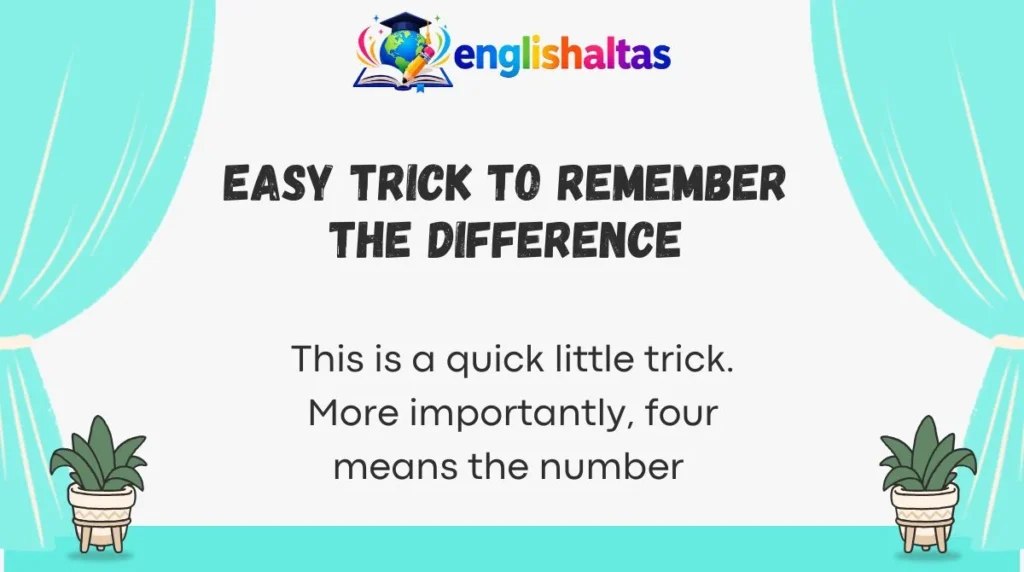
This is a quick little trick. More importantly, four means the number 4.
Four vs Forel
Fore = front or warning
Think of forehead.
Your forehead is at the front of your head.
So fore can help you remember the idea of front.
You can also remember a golf player shouting:
Four vs Forel
The three-second test
When you are unsure, ask yourself:
1. Does it mean 4?
→ four
2. Does it show a person, purpose, reason, or time?
→ for
3. Does it mean front or relate to a golf warning?
→ fore
This small test works very well for beginners.
Daily Life Examples
These examples sound like real English conversations.
1. Talking about a gift
A: Who is this gift for?
B: It is for my sister.
Here, for shows the person who will receive the gift.
2. Talking about a number
A: How many people are coming?
B: Four people.
Here, four means the number 4.
3. Talking about time
A: How long did you wait?
B: I waited for four minutes.
Notice both words in one sentence:
- Four vs Forel
- four = number 4
4. Talking about school
A: What did you buy?
B: I bought four notebooks for school.
Again, the two words have different jobs.
5. Talking about a friend
A: Is this letter for Sara?
B: Yes, it is for her.
The word for shows the person who will get the letter.
6. Talking about food
A: How many sandwiches do we need?
B: We need four sandwiches.
The number is four.
7. Talking about time
A: How long have you lived here?
B: I have lived here for four years.
This sentence uses both words naturally.
8. On a golf course
Player: “Fore!”
This is a warning. The word is fore, not for or four.
9. Talking about a purpose
A: Why did you go to the shop?
B: I went for some milk.
Here, for shows the purpose of the trip.
10. Counting objects
A: How many chairs are in the room?
B: Four vs Forel
The word four tells us the quantity.
Practice Section
Choose the correct word: for, four, or fore.
- I bought ___ apples.
- This message is ___ you.
- Four vs Forel
- The golfer shouted, “___!”
- She has ___ brothers.
Answers
- four — I bought four apples.
- Four vs Forel
- for — We waited for ten minutes.
- Fore — The golfer shouted, “Fore!”
- four — She has four brothers.
A quick challenge
Can you understand this sentence?
Four vs Forel
It may look funny, but the grammar is correct.
- for four hours = length of time
- four friends = number of friends
- for four friends = intended for those friends
The meaning becomes much clearer when you look at each word’s job.
FAQs
What is the difference between for and four?
For is used for purpose, a person, a reason, or a period of time. Four is the number 4. They sound similar, but their spelling and meaning are different.
Can we use “for” in questions?
Yes. For is very common in questions.
Examples include: “Who is this for?” and “How long have you waited for?” The exact sentence structure depends on the meaning.
Is “fore” formal or informal?
Fore is not simply a formal version of for. It is a different word. It is used in special meanings, such as a golf warning or in words connected with the front.
Is “forel” the correct spelling of “four”?
No. Forel is not the standard spelling for the number 4. The correct word is four. In the common homophone comparison, the words are for, four, and fore.
Why do “for” and “four” sound the same?
They are commonly pronounced the same in English. This makes them homophones. Their meanings are different, so you must use the sentence meaning to choose the correct spelling.
How can I remember for and four easily?
Use this simple trick: four = 4. If you can replace the word with the number 4, use four. Use for when you mean purpose, a person, a reason, or a length of time.
Conclusion
The difference between for, four, and fore becomes much easier when you focus on meaning instead of sound.
The words may sound alike, but they do very different jobs in English.
For is used for a person, purpose, reason, or period of time. Four means the number 4. Fore is a less common word connected with the idea of front or used as a warning in golf.
Remember the quick test: 4 = four, purpose or time = for, and front or golf warning = fore.
Do not worry if you mix these words up at first. Many English learners make the same mistake because the pronunciation is so similar.
Read the whole sentence and ask what the word means. With a little practice, you will choose the correct spelling naturally.
Try writing five sentences with for and five with four today. That small practice can make a big difference in your English writing.

Oliver Bennett is an English language educator and content writer passionate about simplifying grammar. He creates clear, practical lessons, writing tips, and learning resources that help readers improve their English with confidence.