Root vs route is a common English confusion, especially for students and non-native speakers.
The two words look and sound quite different when you see them on paper, but the problem begins when learners hear them in spoken English.
In some accents, root and route can even sound very similar. This makes simple sentences feel confusing.
You may hear someone say, “Which route should we take?” Then you may wonder, “Did they say root?”
The confusion becomes even bigger because root and route have completely different meanings.
The word root is often connected with plants, basic causes, or the main part of a word. For example, a tree has roots, and the root of a problem is its main cause.
The word route, on the other hand, means a way or path from one place to another.
These words are important in daily English, school English, travel conversations, and writing.
After reading this guide, you will clearly understand the meaning of root and route, how to use each word, their grammar patterns, and the easy difference between them.
You will also see simple examples, common mistakes, and a memory trick that can help you remember the difference for a long time.
What Does “Root” Mean?
The word root usually means the basic or main part of something. Its most common meaning is the part of a plant that grows under the ground and takes in water and nutrients.
Simple definition:
Root = the underground part of a plant or the basic cause or origin of something.
When do we use “root”?
We use root in several common situations:
- To talk about plants
- To talk about the main cause of a problem
- To talk about the origin of something
- To talk about the basic form of a word in grammar or language
As a noun, root names a thing, cause, or basic part.
Grammar rule for “root”
Root is usually a countable noun when we mean a plant part.
- a root
- the root
- roots
When we talk about the main cause of a problem, we often use the root of.
The root of the problem is poor planning.
The word root can also be used as a verb. As a verb, it can mean to establish or grow roots.
Examples of “root”
- The tree has deep roots.
- I pulled the root out of the soil.
- The root of the problem is a lack of communication.
- We need to find the root cause of this mistake.
- Her family has roots in a small village.
- The teacher explained the root of the word.
- These plants grow strong roots in wet soil.
- Fear was at the root of his decision.
Notice that root does not mean a road or path. It talks about a basic part, beginning, or cause.
A common learner confusion with “root”
Many students see the word root and think only about plants. That is understandable because this is the first meaning most learners learn.
However, English often uses root in an abstract way.
For example:
The root of the problem is poor communication.
Here, nobody is talking about a plant. Root means the main cause.
Another example is:
This word has Latin roots.
This means the word comes from or has an origin in Latin.
So, when you see root, ask yourself:
“Is this about a plant, a cause, or an origin?”
If the answer is yes, root is probably the correct word.
What Does “Route” Mean?
The word route means a way, path, or direction used to travel from one place to another.
Simple definition:
Route = the way or path from one place to another.
When do we use “route”?
We use route when talking about:
- Travel
- Roads
- Bus or train journeys
- Directions
- Delivery paths
- A planned way to reach a place
For example:
Which route should we take to the airport?
The speaker is asking about the way to travel.
Grammar rule for “route”
Route is a countable noun.
We can say:
- a route
- the route
- different routes
- the shortest route
The word is often used with to, from, or through.
route to + place
We found a faster route to the city.
route from + place
This is the route from Lahore to Islamabad.
route through + place
The bus takes a route through several villages.
Examples of “route”
- This is the fastest route to the airport.
- Which route should we take?
- The bus follows the same route every day.
- We chose a different route because of traffic.
- The delivery driver changed his route.
- This route passes through the mountains.
- Can you show me the route on the map?
- The train route is very popular with tourists.
The meaning is always connected to a way or path.
A common learner confusion with “route”
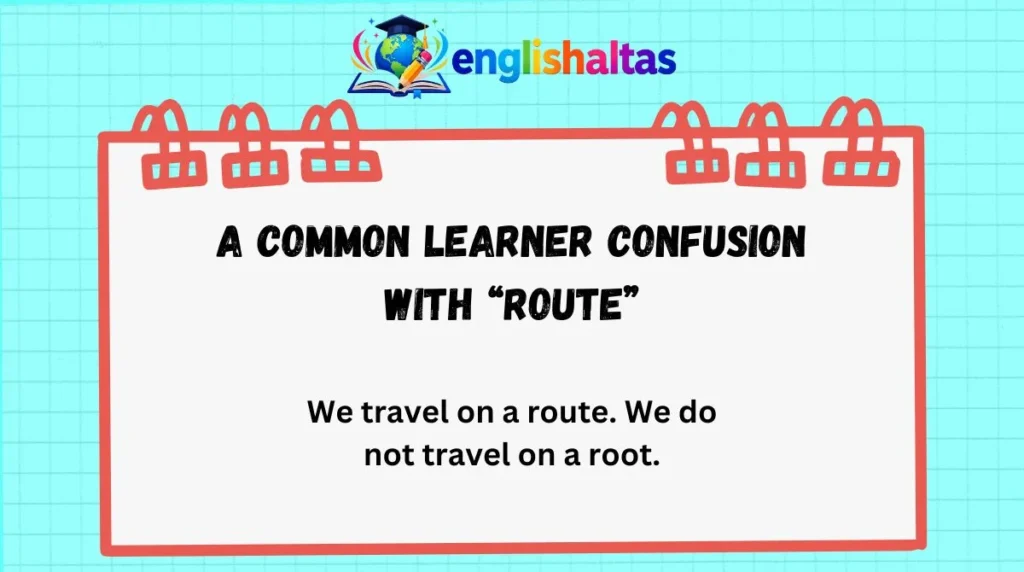
The biggest problem is pronunciation.
In American English, route is often pronounced like “root” or “rout.” In British English, it is commonly pronounced like “root,” although pronunciation can vary by speaker and region.
This means you may hear:
“Take this route.”
and think:
“Did the speaker say root?”
The meaning gives you the answer.
If the sentence is about travel, a road, or a way, the word is route.
Remember:
We travel on a route. We do not travel on a root.
Difference Between Root and Route (Detailed)
The main difference between root and route is their meaning.
Root means a basic part, origin, or main cause.
Route means a path or way used to travel.
Root vs Route comparison table
| Word | Main Meaning | Common Use | Example |
|---|---|---|---|
| Root | Basic part, cause, or origin | Plants, problems, language | The root of the problem is stress. |
| Route | Way or path | Travel and directions | Which route goes to the station? |
Usage difference
Use root when you are talking about the deep or basic part of something.
The roots of the tree are very strong.
Use route when you are talking about moving from one place to another.
This route takes us to the city center.
A simple way to compare them is:
Root = where something begins or what supports it.
Route = the way you go.
Grammar logic
Both root and route are nouns, but they are used in different situations.
Root often appears in phrases such as:
- the root of the problem
- root cause
- plant roots
- family roots
- word root
Route often appears in phrases such as:
- route to the airport
- bus route
- train route
- travel route
- shortest route
Look at the grammar pattern:
the root of + problem/cause
The root of the problem is money.
But:
route to + place
The route to the hotel is easy.
The words after them can help you choose the correct word.
Sentence structure difference
Here are two simple structures:
Root + of + problem or issue
The root of the problem is poor planning.
Route + to/from/through + place
We took a route through the forest.
The word root is often connected to causes and origins.
The word route is often connected to places and movement.
Meaning comparison
Consider these two sentences:
Root vs Route
This means we need to find the main cause.
Root vs Route
This means we need to find the way to travel to a place.
The spelling and sound may confuse you, but the meanings are completely different.
Root is about the base. Route is about the way.
Grammar Rules You Must Remember
Rule #1: Use “root” for a plant’s underground part
When you talk about the part of a plant under the soil, use root.
The plant has long roots.
Do not use route here.
❌ The plant has long routes.
✅ The plant has long roots.
A route is a way to travel. A plant does not travel on a route.
Rule #2: Use “root of” for the main cause
When you mean the basic or main cause of a problem, use the root of.
The root of the problem is poor communication.
You can also use root cause.
Root vs Route
Here, root means deep or basic cause.
Rule #3: Use “route” for a way or path
When you are talking about a road, path, or way to reach a place, use route.
Root vs Route
This word is useful in travel English and direction conversations.
Rule #4: Use “route to” when talking about a destination
The phrase route to is very common.
Root vs Route
You can also say:
Root vs Route
or:
Root vs Route
Remember this easy pattern:
route + to/from/through + place
Common Mistakes Students Make
Many mistakes happen because root and route may sound similar in spoken English. Students hear the word first and try to guess the spelling later.
The best solution is to understand the meaning and sentence context.
Mistake 1: Using “root” for a road
❌ Which root should we take?
✅ Which route should we take?
Why does the mistake happen?
The speaker may pronounce route like “root.” The student hears the sound and writes root.
Easy correction tip:
If the sentence is about travel or directions, choose route.
Mistake 2: Using “route” for a problem’s cause
❌ We must find the route of the problem.
✅ We must find the root of the problem.
Why?
The phrase root of the problem means the main cause.
Easy correction tip:
Ask: “Am I looking for a road or a cause?”
- Road = route
- Cause = root
Mistake 3: Confusing “root cause” and “route”
Some learners write:
❌ The route cause of the issue is poor training.
The correct phrase is:
✅ The root cause of the issue is poor training.
This is a very common spelling mistake.
Root cause is a fixed and useful English phrase.
Mistake 4: Thinking “root” only relates to plants
A student may say:
Root vs Route
This can be correct if the speaker means the basic reason or main idea.
For example:
Root vs Route
Here, root means the main cause.
Correction tip:
Remember that English uses many plant words in an abstract way.
Mistake 5: Choosing spelling from pronunciation
This is especially common in listening exercises.
You may hear:
Root vs Route
If the speaker says route like “root,” do not choose the spelling based only on sound.
Listen to the meaning.
Is the person talking about a way to go? Then the word is route.
Easy Trick to Remember the Difference
Here is a simple memory trick:
ROOT = BASE
Think of a tree.
A tree has roots at its base. The roots are deep and support the tree.
Now use the same idea for other meanings:
- root of a problem = the basic cause
- root of a word = the basic part
- family roots = family origin
So remember:
Root vs Route
ROUTE = ROAD
The word route sounds like a way or path in your mind.
Think:
Root vs Route
You can remember this short line:
“Roots are deep. Routes help you go.”
That is the easiest difference.
When you are unsure, ask yourself one question:
“Am I talking about a cause or a way?”
- Cause or base → root
- Way or path → route
Daily Life Examples of Root and Route
These examples show how root and route sound in natural, everyday English.
1. Asking for directions
A: Which route should I take to the mall?
B: Take the main road and turn left.
Here, route means the way to travel.
2. Talking about a problem
A: Why is the project always late?
B: We need to find the root of the problem.
Here, root means the main cause.
3. Talking about a plant
A: Why is this plant falling over?
B: Its roots are not strong enough.
The word root means the underground part of a plant.
4. Talking about a bus
A: Does this bus go to the city center?
B: Yes, it follows that route every morning.
Here, route means the bus’s regular way.
5. Talking about a mistake
A: We made the same mistake again.
B: We should find the root cause.
Root cause means the basic reason for the mistake.
6. Using a map
A: Can you show me the route on your phone?
B: Sure. The blue line is the fastest way.
The route is the path shown on the map.
7. Talking about family history
A: Where is your family from?
B: My family has roots in a small village.
Here, roots means family origin or connection.
8. Talking about traffic
A: Why are you taking this road?
B: The usual route is blocked today.
The word route means the normal way of traveling.
9. Understanding an argument
A: Why are they still arguing?
B: The root of the problem is a misunderstanding.
The word root means the real cause.
10. Planning a trip
A: Have you planned our route?
B: Yes. We will travel through three towns.
The route is the planned path.
Practice Section: Choose Root or Route
Choose the correct word in each sentence: root or route.
- What is the fastest ___ to the airport?
- The ___ of the problem is poor communication.
- This tree has very deep ___.
- We changed our ___ because of heavy traffic.
- The teacher explained the ___ of the word.
Answers
- route
- root
- roots
- route
- root
Quick check
If you chose route for sentences about travel, you understood the main rule.
If you chose root for causes, plants, or word origins, you are on the right track.
FAQs
1. What is the difference between root and route?
Root means a basic part, origin, or main cause. Route means a path or way from one place to another. For example, “the root of the problem” means the main cause, while “the route to school” means the way to school.
2. Do root and route sound the same?
They can sound very similar in some English accents. Route is often pronounced like “root,” especially by many American and British English speakers. The sentence meaning helps you understand which word is being used.
3. Can “root” be used for a problem?
Yes. Root can mean the main or basic cause of a problem. The common phrase is the root of the problem or root cause. Example: “We need to find the root cause of the mistake.”
4. Is “route” used in questions?
Yes, route is very common in questions. You can ask, “Which route should we take?” or “What is the best route to the station?” It is often used when asking for directions or planning travel.
5. Is route formal or informal English?
Route is used in both formal and informal English. You can use it in daily conversations, travel situations, school writing, and professional communication. It is a normal and useful English word.
6. How can I easily remember root vs route?
Remember this simple idea: root = base or cause, route = way or path. A plant has roots, and a traveler uses a route. You can also remember: “Roots are deep; routes help you go.”
Conclusion
Understanding root vs route becomes easy when you focus on meaning instead of sound. Root is connected to a base, cause, or origin.
It can describe a plant part, the main cause of a problem, or the basic part of a word. Route means a way, path, or direction used to travel from one place to another.
The most important memory trick is simple: root = base or cause, route = road or way.
If you sometimes confuse these words, do not worry. Many English learners have the same problem because route can sound like root in spoken English.
Just look at the sentence and ask yourself, “Is this about a cause or a path?”
Read the daily examples again, practice writing your own sentences, and listen carefully when native speakers use these words.
With a little practice, you will quickly know whether root or route is the right choice.

Oliver Bennett is an English language educator and content writer passionate about simplifying grammar. He creates clear, practical lessons, writing tips, and learning resources that help readers improve their English with confidence.