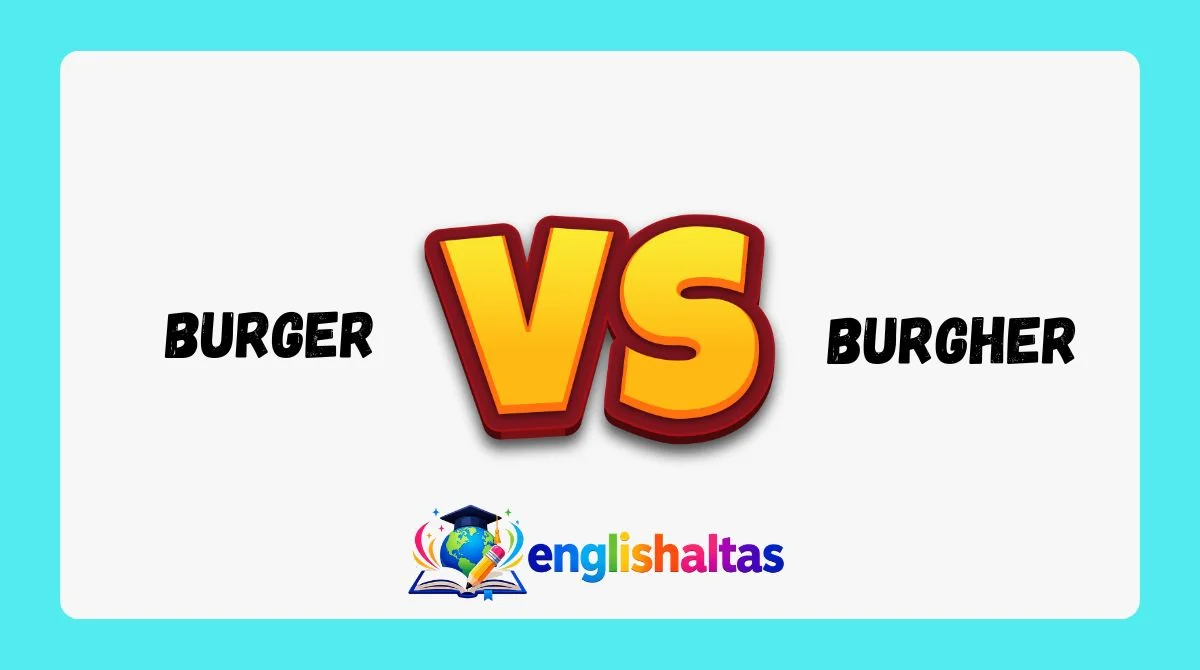
Burger vs burgher can confuse English learners because the two words look almost the same.
They both contain the letters “burg”, and they sound quite similar in some accents. But their meanings are very different.
You may already know the word burger. You see it on menus, hear it in restaurants, and use it in daily conversation.
For example, someone may say, “I want a chicken burger.” But burgher is a much less common word.
It is an old or formal word for a citizen of a town or city, especially in historical English.
This small spelling difference can create a big meaning difference. If you use burgher when you mean food, your sentence may sound very strange.
If you use burger when talking about a historical town citizen, your meaning will be wrong.
The good news is that the difference is easy to understand.
After reading this guide, you will know exactly what burger and burgher mean, when to use each word, how their grammar works, and why students often mix them up. You will also see simple daily examples and practice questions.
So, if you have ever wondered about burger vs burgher, you are in the right place. Let’s make this confusing word pair simple.
What Does “Burger” Mean?
A burger is a type of food. It usually has a cooked piece of meat, chicken, fish, or a plant-based food inside a round bread roll called a bun.
The word burger is a common noun.
When should you use “burger”?
Use burger when you are talking about food or a sandwich-style meal. It is a very common word in modern English.
You can use it in restaurants, at home, in school conversations, and in casual spoken English.
For example:
- I want a burger for lunch.
- She ordered a cheese burger.
- This burger is very tasty.
- Would you like a chicken burger?
- He ate two burgers after the game.
- We made vegetable burgers at home.
- That restaurant sells amazing beef burgers.
- My brother does not eat burgers.
The word burger can also be part of a longer food name. We often hear words such as cheeseburger, hamburger, chicken burger, fish burger, and veggie burger.
The grammar rule for “burger”
Burger is a countable noun.
This means you can count it.
- one burger
- Burger vs Burgher
- three burgers
For one burger, use a or the when the grammar needs it.
- I bought a burger.
- The burger is on the table.
For more than one, use the plural form burgers.
- Burger vs Burgher
A common learner confusion
Many learners think burger always means hamburger. In everyday English, people sometimes use the words in a similar way, but burger is a wider word.
A hamburger is a burger traditionally linked with beef. However, modern English uses burger for many different types of food.
So, a chicken burger is still a burger, but it is not a beef hamburger.
Remember this simple idea: burger = food.
What Does “Burgher” Mean?
A burgher is a citizen or resident of a burgh. A burgh was a town or city, especially in older British history.
In simple English, a burgher was a town citizen.
The word is mostly used in historical, formal, or literary English. You will not usually hear it in a normal conversation about modern city life.
For example:
- Burger vs Burgher
- Each burgher paid taxes to the city.
- The king gave the burghers special rights.
- A wealthy burgher owned a shop near the market.
- The old law protected every burgher.
- The burghers met to discuss the town’s future.
- He was a respected burgher of the medieval city.
- Burger vs Burgher
When should you use “burgher”?
Use burgher when you are talking about a historical citizen of a town or city.
You may see this word in:
- History books
- Historical novels
- Academic writing
- Old legal or political texts
It is not normally used for a modern citizen.
For example, you would not usually say:
She is a burgher of London.
That sentence sounds old-fashioned and unusual.
Instead, say:
Burger vs Burgher
The grammar rule for “burgher”
Burgher is also a countable noun.
You can say:
- a burgher
- one burgher
- two burghers
The plural form is burghers.
- The burghers supported the new law.
You can use a with one person:
- He was a burgher of the old town.
A common learner confusion
The biggest confusion is the spelling. Burgher looks like burger, but the meaning is completely different.
A burger is something you eat.
A burgher is a person connected with an old town or city.
The extra letters “h” and “r” are not just small spelling details. They change the word and its meaning.
Remember: burgher = historical town citizen.
Difference Between Burger and Burgher
The main difference between burger and burgher is their meaning and use.
Burger is a common modern word for food. Burgher is a less common historical word for a citizen of a town.
Burger vs Burgher comparison table
| Word | Meaning | Word Type | Common Use | Example |
|---|---|---|---|---|
| Burger | A type of food | Countable noun | Daily English | I ordered a burger. |
| Burgher | A citizen of an old town or city | Countable noun | Historical/formal English | The burgher lived near the market. |
Usage difference
The word burger is used in normal daily life.
You may say:
Burger vs Burgher
The word burgher is mostly connected with history.
You may read:
The burghers of the town had special rights.
The first sentence is a natural modern conversation. The second sentence sounds like a history book.
Grammar logic
Both words are countable nouns. This means both can have a plural form.
- burger → burgers
- Burger vs Burgher
Both can also use a or an?
Use a with both because both begin with a consonant sound.
- a burger
- a burgher
However, the words are used in completely different situations.
Grammar does not tell you the meaning. Context does.
For example:
I bought a burger.
The word bought and the food context clearly show that burger means food.
The burgher owned a shop.
The words owned a shop and the historical context help us understand that burgher means a town citizen.
Sentence structure difference
The sentence structure is usually very similar because both words are nouns.
Subject + verb + noun
- I ate a burger.
- The man was a burgher.
Determiner + noun
- The burger was hot.
- The burgher was wealthy.
The real difference is not the sentence structure. The real difference is what the noun refers to.
Meaning comparison
Think of the two words like this:
Burger = food
Burgher = person
This is the easiest basic difference.
One is connected with eating. The other is connected with history and town life.
Do not confuse the two just because they look similar.
Grammar Rules You Must Remember
Rule #1: “Burger” is a food noun
Use burger when you mean a type of food.
Example:
I ordered a burger for dinner.
Do not use burgher for food.
Wrong: I ordered a burgher.
Correct: I ordered a burger.
Rule #2: “Burgher” means a historical town citizen
Use burgher for a citizen or resident of an old town or city, especially in historical writing.
Example:
The burgher owned a small shop.
The word is connected with old town life, not modern fast food.
Rule #3: Both words are countable nouns
You can count both words.
Burger:
I ate one burger.
Burgher:
The king spoke to one burgher.
Their plural forms are:
- burger → burgers
- burgher → burghers
Rule #4: Check the context before choosing the word
Ask yourself a simple question:
Am I talking about food or a person from history?
Example:
We ate a burger.
Food? Yes. Use burger.
The burghers gathered in the old town.
Historical citizens? Yes. Use burghers.
Context can help you choose the correct word quickly.
Common Mistakes Students Make
Students usually make mistakes with burger vs burgher because the spelling is very similar.
They see burg in both words and remember only the general shape. Then they choose the word quickly without checking the meaning.
Mistake 1: Using “burgher” for food
Wrong:
I want a burgher with cheese.
Correct:
I want a burger with cheese.
Why does this mistake happen?
The extra h in burgher is easy to miss. The learner may think both words are different spellings for the same food.
Easy tip: If you can eat it, use burger.
Mistake 2: Using “burger” for a historical person
Wrong:
The burger had special rights in the old city.
Correct:
The burgher had special rights in the old city.
Why does this mistake happen?
Burger is much more common. Your brain may automatically choose the word it knows best.
Easy tip: If the sentence is about an old town citizen, choose burgher.
Mistake 3: Thinking “burgher” is a modern word for citizen
Wrong idea:
A burgher is simply a modern citizen.
Better understanding:
A burgher is mainly a historical term for a citizen of an old town or city.
For modern English, use citizen, resident, or townsperson, depending on the meaning.
Mistake 4: Spelling “burgher” as “burger”
Wrong:
The burgher owned a shop.
If you mean the historical person, the spelling must be:
The burgher owned a shop.
The h is important.
Mistake 5: Using “burgher” in casual speech
A learner may say:
My friend is a burgher of Karachi.
This sounds very unusual in modern English.
A natural sentence would be:
My friend is a citizen of Karachi.
Use burgher mainly when the historical meaning is important.
Easy Trick to Remember the Difference

Here is a simple memory trick:
BURGER = BITE
A burger is food. You can bite a burger.
BURGHER = HISTORY
A burgher is connected with an old town and history.
You can also remember the extra H in burgher.
Think of the H as a Historical H.
Burgher = Historical H + town citizen.
This is not a real grammar rule. It is just a memory trick to help you remember the spelling.
Imagine two pictures in your mind.
In the first picture, you are sitting in a restaurant and eating a burger.
In the second picture, you are looking at an old town with a market, stone buildings, and a burgher walking through the town.
The pictures are completely different.
Food? Burger.
Old town citizen? Burgher.
This simple real-life logic makes the difference much easier for students.
Daily Life Examples
Here are some simple examples to show how burger and burgher work in real sentences.
1. At a restaurant
A: What do you want to eat?
B: I’ll have a burger, please.
This is a normal modern conversation. The word is burger because we are talking about food.
2. Talking about lunch
I had a chicken burger for lunch.
The word burger is part of the food name.
3. Ordering food online
My sister ordered two burgers and some fries.
Again, the word means food.
4. Talking about a meal
This burger is bigger than I expected.
The sentence is about food.
5. Reading history
The burghers of the town paid a special tax.
This sentence is about historical citizens.
6. Talking about an old market
The wealthy burgher owned a shop near the market.
The word burgher refers to a person in an old town setting.
7. Reading a historical story
Every burgher had to follow the town’s laws.
The historical context makes the meaning clear.
8. Comparing modern and old English
Today we say citizen, but old books may use burgher.
This is a useful way to understand the word.
9. A simple spelling reminder
I can eat a burger, but I cannot eat a burgher.
This sentence is funny, but it is a great way to remember the difference.
10. Talking about history and food
We ate a burger while reading about medieval burghers.
Both words can appear in the same sentence, but they have completely different meanings.
Practice Section: Choose the Correct Word
Choose burger or burgher in each sentence.
- I would like a cheese ______ for dinner.
- The old ______ owned a shop in the town.
- We ordered three ______ for the family.
- The king gave the ______ special rights.
- She made a vegetable ______ at home.
Answers
- burger
- burgher
- burgers
- burgher
- burger
Quick check
If your answer is burger, the sentence should be about food.
If your answer is burgher, the sentence should usually be about an old town citizen or history.
FAQs
What is the difference between burger and burgher?
A burger is a type of food, usually served in a bun. A burgher is a historical word for a citizen of an old town or city. The words look similar but have completely different meanings.
Can we use “burger” in questions?
Yes, absolutely. Burger is a common noun and can be used in many questions.
For example: “Would you like a burger?” or “Which burger do you want?” It is very common in daily English.
Is “burgher” a formal or informal word?
Burgher is a formal, old-fashioned, or historical word. It is not common in everyday modern conversation. You are more likely to see it in history books, novels, or academic writing.
Is a burgher another word for a burger?
No. Burgher is not another spelling of burger. A burger is food, while a burgher was a citizen of an old town or city. The extra letters change the word and its meaning.
Can “burgher” mean a modern citizen?
Usually, no. In modern English, citizen or resident is more natural. Burgher is mainly used for historical town citizens or in old-fashioned contexts.
Why do burger and burgher look so similar?
The words share similar letters and historical spelling patterns, so they can look confusing. However, modern English uses them for different ideas: burger for food and burgher for a historical town citizen.
Final Conclusion
The difference between burger vs burgher is simple once you focus on the meaning.
A burger is food. You can eat it, order it, and talk about it in daily English. A burgher is a historical word for a citizen of an old town or city.
You will mostly see it in history books or formal writing.
Remember the easiest trick: burger = bite. If you can eat it, it is a burger. The extra H in burgher can remind you of history.
Do not worry if these words confused you before. Many English learners mix up words that look almost the same.
The best way to learn is to notice the meaning and practice a few simple sentences.
Burger means food. Burgher means an old-town citizen.
Keep these two meanings clear, and you will never confuse burger and burgher again.

Oliver Bennett is an English language educator and content writer passionate about simplifying grammar. He creates clear, practical lessons, writing tips, and learning resources that help readers improve their English with confidence.