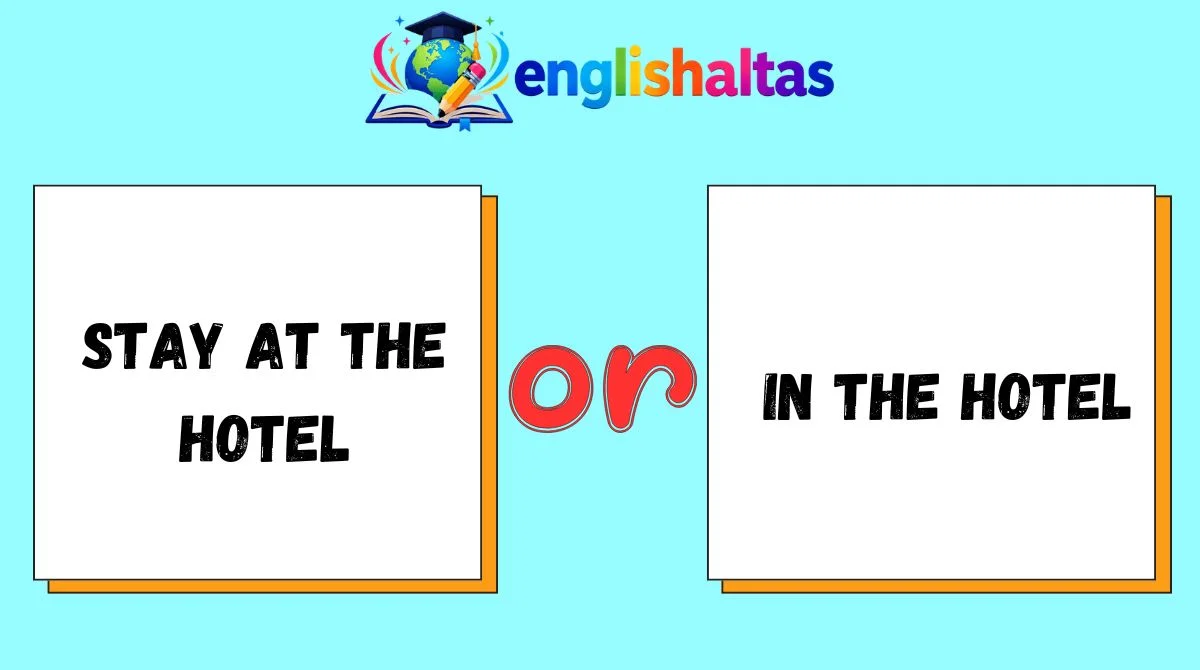
Stay at the hotel or in the hotel? This is a small English question, but it can make many learners stop and think.
Both sentences sound possible, and both use the preposition at or in with the word hotel. So, which one should you choose?
The confusion happens because at and in can both talk about a place. However, they do not always show the same idea.
The word at usually points to a place as a location or stop. The word in often shows that someone is inside a place. This small difference can change the focus of your sentence.
You may hear people say, “I am staying at the hotel,” or “I am staying in the hotel.” Both can be correct, but the meaning and natural use are slightly different. This matters in daily English, especially when you talk about travel, holidays, business trips, and hotel bookings.
By the end of this guide, you will clearly understand stay at the hotel or in the hotel, know the grammar behind both phrases, and learn when native speakers normally use each one.
You will also see simple examples, common mistakes, and real conversations.
What Does “Stay at the Hotel” Mean?
Stay at the hotel means to live or sleep at a particular hotel for a period of time.
Here, at treats the hotel as a place or destination. The main idea is not strongly focused on the inside of the building. Instead, you are talking about the hotel where you are staying.
Simple meaning
Stay at the hotel = spend time or sleep at a hotel.
This is the most common and natural phrase when you talk about accommodation.
For example:
- We are staying at the hotel for three nights.
- I stayed at the hotel during my business trip.
- She is staying at the hotel near the airport.
The phrase stay at is very common with hotels, resorts, and other places where people spend time.
When should you use “stay at the hotel”?
Use stay at the hotel when you want to say where you are staying.
The hotel is your accommodation or temporary place to live.
Grammar rule
The basic structure is:
Subject + stay/stayed/is staying + at + the hotel
Look at these examples:
- I am staying at the hotel tonight.
- They stayed at the hotel last weekend.
- We will stay at the hotel after the wedding.
- My parents are staying at the hotel near the beach.
- Did you stay at the hotel?
- She usually stays at a small hotel when she travels.
- He is staying at the hotel with his friends.
- We stayed at the hotel for five days.
Why is “at” so natural here?
Think of at as pointing to a location on a map.
If your friend asks, “Where are you staying?”, you can answer:
I am staying at the hotel.
You are simply naming the place. You are not explaining where you are sitting or what room you are inside.
A common learner confusion
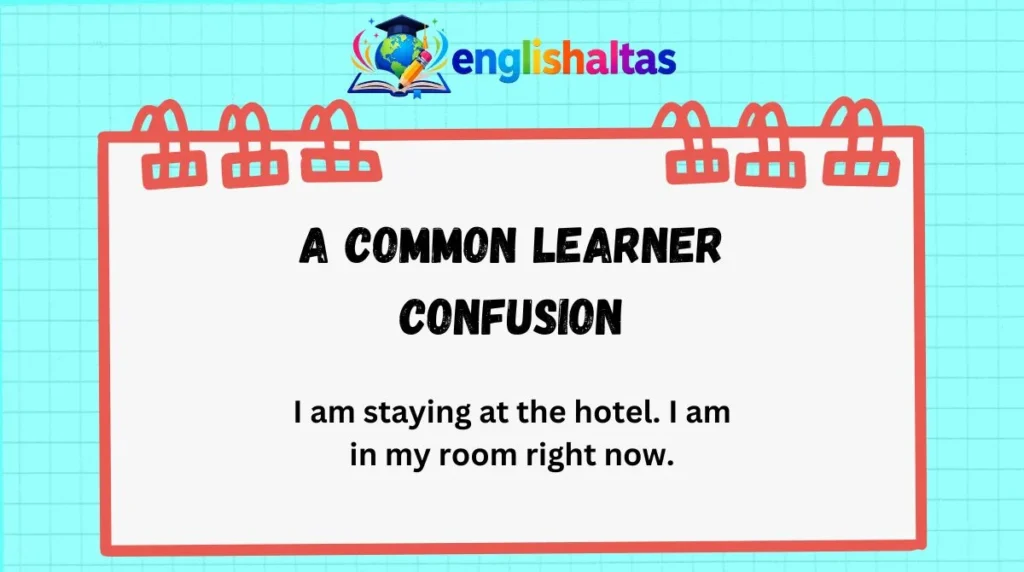
Many students think at means a person is outside the hotel. That is not true.
I am staying at the hotel does not mean you are standing outside the building. It simply means the hotel is the place where you are staying.
For example:
I am staying at the hotel. I am in my room right now.
Both ideas can be true at the same time.
What Does “Stay in the Hotel” Mean?
Stay in the hotel means to remain inside the hotel building or spend time inside it.
The preposition in focuses more on the idea of being inside a place.
Simple meaning
Stay in the hotel = remain inside the hotel.
The phrase can be correct, but it is usually used when the speaker wants to focus on the inside location or the fact that someone is not going outside.
When should you use “stay in the hotel”?
Use stay in the hotel when the main idea is being inside the hotel.
For example:
It is raining, so we decided to stay in the hotel.
Here, the important idea is that you will remain indoors instead of going outside.
Grammar rule
The basic structure is:
Subject + stay/stayed/is staying + in + the hotel
Examples:
- We stayed in the hotel all day because of the rain.
- The children stayed in the hotel while their parents went shopping.
- I decided to stay in the hotel tonight.
- They stayed in the hotel during the storm.
- She is staying in the hotel until the weather improves.
- The guests stayed in the hotel after the power problem.
- We spent the afternoon staying in the hotel.
- He chose to stay in the hotel instead of going to the beach.
Why use “in”?
The word in creates a picture of someone inside the building.
Imagine a hotel. You can see the doors, rooms, hallways, and lobby. If you say in the hotel, you are looking at the inside area.
For example:
The tourists stayed in the hotel because it was too cold outside.
The focus is on the tourists remaining inside.
A common learner confusion
Some learners think stay in the hotel is always wrong. It is not wrong.
The phrase is perfectly correct when you want to show the idea of remaining inside the hotel.
Compare these two sentences:
- We stayed at the hotel for three nights.
- We stayed in the hotel all day because of the rain.
The first sentence talks about accommodation.
The second sentence focuses on being inside.
Difference Between “Stay at the Hotel” and “Stay in the Hotel”
The easiest way to understand the difference is to look at the main idea of the sentence.
Stay at the hotel usually talks about the hotel as your place of accommodation.
Stay in the hotel usually focuses on being inside the hotel.
Comparison table
| Phrase | Main idea | Common use | Example |
|---|---|---|---|
| Stay at the hotel | The hotel is your place to stay | Travel and accommodation | We stayed at the hotel for a week. |
| Stay in the hotel | Remain inside the hotel | Indoor location or contrast | We stayed in the hotel because it was raining. |
1. The difference in usage
When talking about a hotel booking or travel plan, stay at the hotel is normally the better choice.
We are staying at the hotel near the station.
This tells the listener where you will live temporarily.
But when you are talking about not leaving the hotel, stay in the hotel can be more natural.
We stayed in the hotel all morning.
The sentence tells us that you remained inside.
2. The grammar logic
The prepositions give us a small clue.
At often points to a place or location.
Examples:
- at school
- at work
- at the airport
- at the hotel
In often shows something is inside a space.
Examples:
- in the room
- in the building
- in the house
- in the hotel
This is not a perfect rule for every English sentence, but it is a very useful guide.
3. The sentence structure difference
The structure is almost the same:
stay + at + the hotel
stay + in + the hotel
The main difference is the preposition.
That small preposition changes the focus of the sentence.
4. Meaning comparison
Look at this example:
I am staying at the hotel.
The listener understands that the hotel is your accommodation.
Now look at:
I am staying in the hotel.
The listener may understand that you are inside the hotel, especially if the sentence has more context.
For example:
I am staying in the hotel because I do not feel well.
Here, in clearly gives the idea of remaining indoors.
Which one is more common?
For normal travel English, stay at the hotel is generally the more natural and common choice.
If you are talking about a hotel as your place to sleep or live temporarily, choose at.
Use in when the idea of inside the hotel is important.
Grammar Rules You Must Remember
Rule #1: Use “stay at the hotel” for accommodation
When you mean sleep or live temporarily at a hotel, use at.
We stayed at the hotel for four nights.
The hotel is your temporary place of accommodation.
This is the rule you will use most often in travel conversations.
Rule #2: Use “stay in the hotel” for the idea of being inside
If you want to say that someone remained inside the hotel, use in.
It was cold, so we stayed in the hotel.
The sentence contrasts staying indoors with going outside.
Rule #3: “At” does not mean outside
This is an important point for English learners.
She is staying at the hotel.
This does not mean she is standing outside the hotel.
She could be in her hotel room, in the lobby, or at the hotel restaurant. The phrase simply identifies the hotel as her place of stay.
Rule #4: Context decides the best preposition
English is not always about memorizing one word.
Look at the meaning of the whole sentence.
We stayed at the hotel for our vacation.
Here, at is natural.
We stayed in the hotel while the storm passed.
Here, in is natural because the focus is on remaining indoors.
Ask yourself: Am I talking about accommodation or being inside?
Common Mistakes Students Make
Many students make mistakes with this phrase because they try to translate directly from their first language. English prepositions often do not match word for word.
Mistake 1: Thinking “stay in the hotel” is always wrong
Wrong idea: “Only at can be used with hotel.”
That is not correct.
Stay in the hotel can be completely correct.
Stay at the Hotel or in the Hotel
Correction tip: Think about the meaning. If you mean inside, in may be the right choice.
Mistake 2: Using “in” for every hotel sentence
Some learners say:
Stay at the Hotel or in the Hotel
This sentence is possible, but it may not be the most natural choice if you simply mean you booked and lived at the hotel.
A more natural sentence is:
Stay at the Hotel or in the Hotel
Correction tip: For accommodation, remember stay at.
Mistake 3: Thinking “at” means only a point
Students often learn that at means a very exact point.
Then they become confused by at the hotel.
English uses at with many places when the place is viewed as a location or destination.
Stay at the Hotel or in the Hotel
This does not describe a tiny point. It simply tells us your location.
Mistake 4: Choosing a preposition without checking the meaning
A student may memorize:
Stay at the Hotel or in the Hotel
But English needs more than a memorized list.
Compare:
- We stayed at the hotel during our holiday.
- We stayed in the hotel during the storm.
Correction tip: First decide what you want to say. Then choose the preposition.
Mistake 5: Confusing “stay in a hotel” and “stay at the hotel”
There is also a small difference between a hotel and the hotel.
Stay at the Hotel or in the Hotel
This means you stayed at one hotel, but the listener may not know which one.
Stay at the Hotel or in the Hotel
This usually refers to a specific hotel known from the conversation or situation.
For example:
Where are your parents?
Stay at the Hotel or in the Hotel
Both speakers understand which hotel is meant.
Easy Trick to Remember the Difference
Here is a simple trick:
AT = accommodation
IN = inside
Just remember the first letters:
AT → Accommodation
When you talk about a hotel as the place where you are sleeping or living temporarily, think:
Stay at the Hotel or in the Hotel
Now remember:
IN → Inside
When you want to show that someone is inside the hotel and not outside, think:
We stayed IN the hotel because of the rain.
Real-life logic
Imagine you are on holiday.
Your friend asks:
Stay at the Hotel or in the Hotel
You answer:
I am staying at the hotel.
The question is about your accommodation.
Now imagine your friend asks:
Stay at the Hotel or in the Hotel
You answer:
Stay at the Hotel or in the Hotel
The focus is now on remaining inside.
That’s the whole idea. AT tells us the place. IN shows the inside space.
Daily Life Examples
Here are some natural examples you may hear in real conversations.
1. Talking about a holiday
We are staying at the hotel near the beach.
The hotel is your holiday accommodation.
2. Talking about a rainy day
We stayed in the hotel all afternoon because it rained.
The focus is on remaining indoors.
3. Asking about a trip
Where did you stay during your trip?
I stayed at the hotel near the airport.
This is a normal accommodation question.
4. Talking about a sick person
Ali stayed in the hotel because he was not feeling well.
The idea is that Ali remained inside.
5. Talking about a business trip
I am staying at the hotel for two nights.
This sounds natural when discussing travel plans.
6. Talking about bad weather
The tourists stayed in the hotel until the storm ended.
The hotel is an indoor place of safety or comfort in the sentence.
7. Talking about a booking
We stayed at the hotel you recommended.
The speaker is talking about a particular hotel.
8. Talking about going outside
We decided to stay in the hotel instead of going shopping.
The contrast is between staying inside and going out.
9. Talking about a family trip
My family is staying at the hotel next to the museum.
The hotel is the family’s temporary accommodation.
10. A natural spoken conversation
Where are you staying?
At the hotel on King Street.
Oh, nice! Are you going out tonight?
No, we might stay in the hotel and watch a movie.
Notice how at and in both work naturally because the meaning changes.
Practice Section
Choose at or in to complete each sentence.
- We are staying ___ the hotel for a week.
- It was raining, so we stayed ___ the hotel.
- Where did you stay ___ your holiday?
- The children stayed ___ the hotel all day.
- My uncle is staying ___ the hotel near the airport.
Answers
- at — We are staying at the hotel for a week.
- in — We stayed in the hotel because the focus is on remaining inside.
- at — You are asking about accommodation.
- in — The sentence focuses on staying inside.
- at — The hotel is the uncle’s accommodation.
FAQs
What is the difference between “stay at the hotel” and “stay in the hotel”?
Stay at the hotel usually talks about the hotel as your accommodation. Stay in the hotel focuses more on remaining inside the hotel. Both can be correct, but the context decides which one sounds more natural.
Can we use “stay at the hotel” in questions?
Yes, absolutely. You can ask, “Are you staying at the hotel?” or “Did you stay at the hotel?” These questions are very common when asking about someone’s travel or accommodation.
Is “stay in the hotel” grammatically correct?
Yes. Stay in the hotel is grammatically correct. Use it when the idea of being inside the hotel is important, such as when someone stays indoors instead of going outside.
Is “stay at the hotel” more common than “stay in the hotel”?
For normal travel and accommodation, stay at the hotel is usually more common and natural. English speakers often use at when naming the place where someone is staying.
Should I say “I stayed at a hotel” or “I stayed in a hotel”?
Both can be used. I stayed at a hotel focuses on the hotel as your place of accommodation. I stayed in a hotel can also mean you lived there temporarily, but the choice may depend on the wider sentence and context.
Which is correct: “Where are you staying at?” or “Where are you staying?”
The standard question is “Where are you staying?” You do not need at at the end. The answer can be “I am staying at the hotel.” In some informal speech, people may add at, but it is better for learners to use the standard form.
Final Conclusion
The difference between stay at the hotel or in the hotel is small, but it becomes easy when you focus on the meaning.
Use stay at the hotel when the hotel is your place of accommodation. This is the usual choice for holidays, business trips, and travel plans.
Use stay in the hotel when you want to focus on being inside the hotel, especially when someone remains indoors instead of going outside.
A simple memory trick can help: AT = accommodation, IN = inside.
Don’t worry if these prepositions feel confusing at first. Even small words can take time to learn. Listen to real English, notice the context, and try making your own sentences.
After a little practice, choosing between at the hotel and in the hotel will feel much more natural.

Oliver Bennett is an English language educator and content writer passionate about simplifying grammar. He creates clear, practical lessons, writing tips, and learning resources that help readers improve their English with confidence.