Relate to or relate with? This small grammar question can cause a lot of confusion for English learners.
Both phrases look almost the same, and both use the verb relate. So, it is natural to wonder if they have the same meaning or if one of them is wrong.
You may hear someone say, “I can relate to you,” while another person says, “I can relate with you.”
Which sentence sounds correct? The answer depends on the meaning and the kind of English you are using.
This topic is important because relate is common in daily English.
We use it when we talk about understanding someone’s feelings, connecting with an experience, or showing a relationship between ideas.
A small preposition can change the natural sound of a sentence.
After reading this guide, you will clearly understand the difference between relate to and relate with.
You will learn the main grammar rule, see real-life examples, understand common mistakes, and discover an easy trick to remember the correct phrase.
The short answer is simple: “Relate to” is the standard and most common phrase when you mean “understand or connect with someone or something.”
However, “relate with” can appear in some varieties of English and special contexts. So, knowing the difference will help you speak and write more naturally.
What Does “Relate To” Mean?
Relate to usually means to understand, connect with, or feel that you have something in common with a person, feeling, or experience.
This is the phrase native speakers use most often in everyday English when they talk about personal connection.
The basic grammar rule
relate + to + person or thing
For example:
- I can relate to you.
- She relates to the character in the movie.
- Many students can relate to this problem.
Here, to connects the person or thing with the feeling of understanding or connection.
When do we use “relate to”?
We use relate to in several common situations.
1. Understanding someone’s feelings
If you have experienced a similar feeling, you can say that you relate to someone.
Example:
I really relate to what you are feeling.
This means, “I understand your feeling because I have felt something similar.”
2. Connecting with an experience
You can relate to a story, situation, or experience.
Example:
I can relate to that experience.
Maybe you had a similar experience in your own life.
3. Feeling connected to a character
People often use relate to when talking about books, movies, or television shows.
Example:
I really relate to the main character.
The character may think or feel in a way that seems familiar to you.
4. Showing a connection between things
Relate to also has a more formal meaning. It can mean to be connected with or connected to something.
Example:
This rule relates to online safety.
Here, the sentence means the rule is connected with online safety.
8 example sentences with “relate to”
- I can really relate to your story.
- She relates to people who feel nervous in public.
- Many young learners can relate to this problem.
- I don’t relate to that character at all.
- He could relate to the singer’s difficult childhood.
- This question relates to the topic we studied yesterday.
- I can relate to how tired you feel after a long day.
- The lesson relates to basic English grammar.
A common learner confusion
Many learners think relate to means only “understand.” That is not always true.
For example:
This document relates to the new school policy.
Here, relates to means is connected with.
So, the meaning of relate to can change slightly depending on the sentence. The main idea is always connection.
What Does “Relate With” Mean?
Relate with is less common in standard everyday English when you mean “understand or connect with someone.”
This is the part that confuses many learners.
In some English varieties, especially in certain regional or informal uses, people may say relate with. You may also see it used when someone wants to express a relationship or interaction with another person.
However, for most learners, “relate to” is the safer and more natural choice.
The basic grammar pattern
When relate with is used, the pattern is:
relate + with + person or group
For example:
He relates with the local community.
However, many native English speakers would prefer a different phrase depending on the meaning:
He connects with the local community.
Or:
He relates to the local community.
Why does “relate with” sound unusual to many speakers?
English has many verbs that naturally take certain prepositions. We cannot always choose a preposition just because it seems logical.
For example, we say:
- listen to music
- depend on someone
- believe in something
We do not normally change these prepositions freely.
The same idea applies here. Relate to is the established phrase for personal understanding and emotional connection.
6 example sentences showing possible use of “relate with”
- The leader relates with people from different backgrounds.
- The teacher tries to relate with her students.
- He finds it easy to relate with older people.
- The company wants to relate with its customers.
- She relates with people who share her interests.
- The speaker tried to relate with the audience.
These sentences may be understood, but “relate to” or “connect with” often sounds more natural in standard English.
For example:
The teacher tries to relate to her students.
Or:
The teacher tries to connect with her students.
Common learner confusion
The biggest mistake is thinking that relate with is simply another form of relate to.
It is better not to treat them as equal choices.
If you want to say “I understand your feelings”, use:
I can relate to you.
Do not normally say:
I can relate with you.
The first sentence is the natural choice for standard English.
Difference Between “Relate To” and “Relate With” (Detailed)
The main difference is usage and naturalness.
| Phrase | Main use | Common in standard English? | Example |
|---|---|---|---|
| Relate to | Understand or connect with someone/something | Yes | I can relate to you. |
| Relate with | A less common regional or alternative use | Less common | He relates with the community. |
1. “Relate to” is the standard choice
When you want to say that you understand someone’s feelings or experience, use relate to.
Relate To or Relate With
This sounds natural and clear.
The phrase is very common in conversations, social media, books, and everyday English.
2. “Relate with” is not usually the best choice
Although some speakers use relate with, it is not normally the first choice for standard English learners.
If you write:
I can relate with you.
People may understand your meaning. However, many speakers will feel that the sentence sounds unnatural or nonstandard.
The better sentence is:
I can relate to you.
3. The grammar logic is about a connection
The preposition to often shows a connection or direction toward a person or thing.
Think of the feeling as moving toward the experience or person.
I relate to your feelings.
You are connecting your own experience to their feelings.
This is not a perfect rule for every English verb, but it can help you remember this phrase.
4. “Relate to” has more than one meaning
This is an important point.
Relate to can mean:
- understand someone
- feel connected to something
- have something in common with a person
- be connected with a topic or subject
Examples:
I relate to her.
Relate To or Relate With
This article relates to grammar.
This article is connected with grammar.
5. Sentence structure is different in real use
The most common structure is:
Subject + relate(s) + to + object
Examples:
I relate to him.
She relates to the character.
They relate to the problem.
With relate with, the same basic structure is possible, but the phrase is much less common:
Subject + relate(s) + with + object
Because of this, learners should not simply replace to with with.
6. Meaning comparison
Compare these sentences:
I can relate to you.
This means I understand your feelings or experience.
I can relate with you.
This may be understood, but it sounds unusual to many standard English speakers.
Now compare:
This lesson relates to pronunciation.
This means the lesson is connected with pronunciation.
You would not normally say:
This lesson relates with pronunciation.
So, relate to is much more flexible and natural.
Grammar Rules You Must Remember
Rule #1: Use “relate to” for feelings and experiences
When you understand or connect with someone’s feelings, use relate to.
Relate To or Relate With
Not:
I can relate with your feelings.
Easy tip: Personal understanding usually takes to.
Rule #2: Use “relate to” for people and characters
If you feel connected to a person, fictional character, or group, use relate to.
Many students relate to this character.
Relate To or Relate With
The person or character is the thing you connect to.
Rule #3: Use “relate to” for topics and subjects
When something is connected to a subject, relate to is the normal choice.
This question relates to grammar.
The rule relates to workplace safety.
This is common in both everyday and formal English.
Rule #4: Do not freely replace “to” with “with”
English prepositions are often fixed by common usage.
Relate To or Relate With
I can relate with you. ⚠️ Less natural in standard English
When you are unsure, choose relate to.
Common Mistakes Students Make
Mistake 1: Saying “I can relate with you”
This is probably the most common mistake.
Wrong or less natural:
I can relate with you.
Better:
Relate To or Relate With
Why does this mistake happen?
Learners often think about the meaning of with. If two people share feelings, it seems logical to use with.
That logic makes sense in your own language. But English uses relate to for this meaning.
Correction tip: Memorize the full phrase, not just the verb.
Do not learn only:
relate = connect
Learn:
Relate To or Relate With
Mistake 2: Using “relate to” when “connect with” is better
Sometimes learners force relate to into every sentence.
For example:
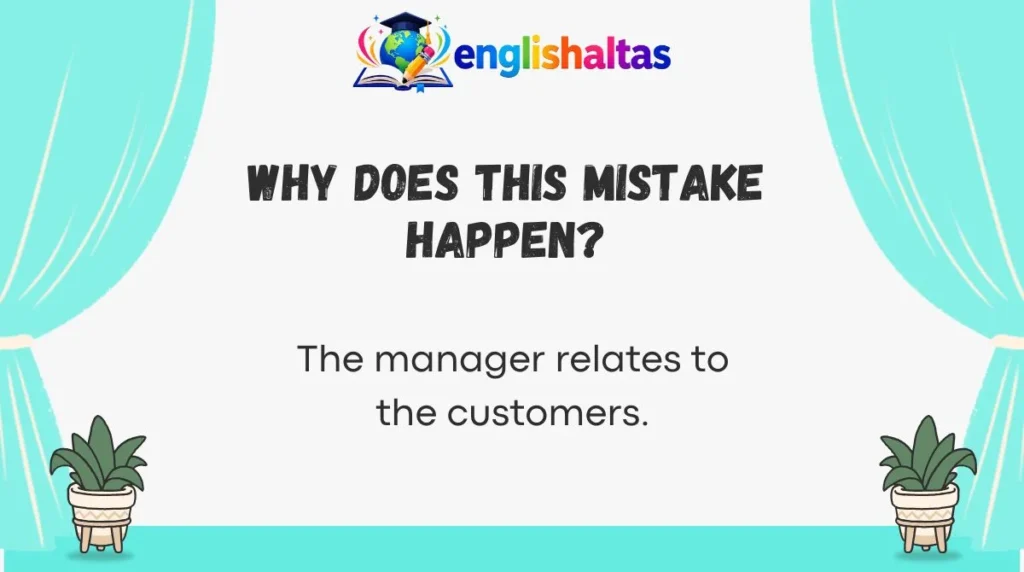
The manager relates to the customers.
This can be correct, but perhaps the speaker means the manager communicates well with customers.
In that case, connects with may be clearer:
The manager connects with the customers.
Mistake 3: Confusing “relate to” with “agree with”
Look at this sentence:
Relate To or Relate With
It does not necessarily mean:
Relate To or Relate With
It means:
I understand your feelings or experience.
You can relate to someone even when you have a different opinion.
Mistake 4: Forgetting the “s” with he or she
Relate is a regular verb.
I relate to her.
She relates to me.
Do not say:
Relate To or Relate With
The correct form is relates.
Mistake 5: Thinking “relate” always means emotional connection
Sometimes relate to simply means be connected with.
This information relates to your application.
This sentence is not about feelings.
Easy Trick to Remember the Difference
Here is a simple memory trick:
Feelings and connections go TO something.
Think of to as a bridge.
Your experience connects to another person’s experience.
Relate To or Relate With
You connect your feelings to their feelings.
If you want a very short classroom rule, remember this:
“Relate to” is the normal phrase.
When you mean “I understand,” “I feel connected,” or “this is connected with that,” choose relate to.
A real-life memory example
Imagine your friend says:
Relate To or Relate With
You also had the same experience.
You can say:
I can relate to you.
The word to helps show the connection between your experience and your friend’s experience.
If you are talking about communication or a friendly relationship, connect with may often be a better choice than relate with.
For example:
The teacher connects with her students.
This sounds very natural.
Daily Life Examples
Here are some simple examples you may hear in real conversations.
1. Talking about a difficult experience
A: I was so nervous during my first job interview.
B: I can relate to that.
Here, B has had a similar experience.
2. Understanding a friend
I can really relate to what you are saying.
This means, “I understand because I have felt something similar.”
3. Talking about a movie character
I relate to the main character because she is very shy.
The speaker feels connected to the character.
4. Talking about school
Many students can relate to exam stress.
Many students understand this experience.
5. Talking about a subject
This lesson relates to English pronunciation.
The lesson is connected with pronunciation.
6. Talking about a personal problem
I can relate to your problem. I had the same problem last year.
This is a very natural use of relate to.
7. Talking about a book
I really related to the story in that book.
The story felt familiar to the speaker.
8. Talking about a teacher
Our teacher relates to students very well.
The teacher understands students and connects with them.
9. Choosing a more natural phrase
The speaker connected with the audience.
This is often more natural than “related with the audience.”
10. Talking about a rule
This rule relates to online classes.
The rule is connected with online classes.
Practice Section
Choose the correct option: relate to or relate with.
- I can really ______ your feelings.
- This rule ______ school safety.
- She ______ the main character in the movie.
- I had the same experience, so I can ______ you.
- The teacher tries to ______ her students.
Answers
- relate to
- relates to
- relates to
- relate to
- relate to
Quick check: In all five sentences, relate to is the natural standard choice.
FAQs
What is the difference between “relate to” and “relate with”?
Relate to is the standard and much more common phrase. It means to understand, connect with, or have something in common with someone or something. Relate with is less common and may sound unusual in standard English.
Can we use “relate to” in questions?
Yes, absolutely. You can ask, “Can you relate to this?” or “Do you relate to the character?” These questions ask if someone understands or feels connected to an experience, person, or idea.
Is “relate to” formal or informal?
Relate to is used in both informal and formal English. For example, “I can relate to you” is common in conversation, while “This research relates to education” can appear in formal writing.
Is “I can relate with you” grammatically correct?
Some English speakers may use relate with, and the meaning can often be understood. However, “I can relate to you” is the natural and safer choice in standard English, especially for learners and formal writing.
Should I say “relate to” or “connect with” people?
Both can be correct, but they are not always exactly the same. Relate to often means you understand someone’s feelings or experience. Connect with often focuses more on building a relationship or feeling a strong connection.
What is the easiest way to remember “relate to”?
Remember this simple rule: “I relate TO you.” Use relate to when you mean understand, feel connected, or be connected with a person, experience, or topic.
Final Conclusion
The difference between relate to and relate with is easier than it first seems. In most standard English situations, relate to is the correct and natural choice.
Use relate to when you understand someone’s feelings, connect with an experience, feel connected to a character, or show that one subject is connected to another.
For example:
I can relate to you.
This topic relates to grammar.
Although you may hear or see relate with in some English varieties, it is less common and often sounds unnatural to standard English speakers.
If you are learning English, the safest choice is to remember relate to.
Try to notice this phrase in conversations, movies, and English lessons. The more you hear it, the more natural it will feel.
And remember: when you want to say, “I understand your experience,” simply say, “I can relate to you.”

Oliver Bennett is an English language educator and content writer passionate about simplifying grammar. He creates clear, practical lessons, writing tips, and learning resources that help readers improve their English with confidence.