
Last updated on November 7th, 2026 at 07:07 am
Altogether and all together look almost the same, but they do not mean the same thing. This small space between the two words can change the meaning of a sentence.
In this altogether vs all together guide, you will see why that small space matters so much.
For English learners, this is a common problem. When we hear these expressions in conversation, they can sound very similar.
That makes it easy to choose the wrong form when writing. That is why the altogether vs all together difference confuses so many learners at first.
The good news is that the difference is quite simple once you understand the basic idea. Altogether is normally one word.
It often means completely, in total, or when everything is considered. For example, “The trip cost $500 altogether” means the total cost was $500.
Once you see the altogether vs all together rule clearly, choosing the right form becomes much easier.
All together, on the other hand, means everyone or everything in one group or place. For example, “The children stood all together” means the children stood as one group.
This difference matters in school writing, emails, conversations, exams, and everyday English. Using the wrong form may make your sentence unclear or change its meaning.
In short, the altogether vs all together choice can change what your sentence really means.
By the end of this guide, you will know when to use altogether, when to use all together, how their grammar works, and how to avoid common mistakes.
You will also see simple examples from daily life so the difference becomes easy to remember. By then, the altogether vs all together distinction should feel natural, not confusing.
What Does “Altogether” Mean?
Altogether is an adverb. It is written as one word.
It has several related meanings, but the most common ones are completely, in total, and when everything is considered. Learning these meanings is the first step in the altogether vs all together comparison.
1. Altogether means “in total”
We often use altogether when we want to talk about a total amount, number, cost, or result.
For example:
- We invited twenty people altogether.
- The books cost $45 altogether.
- There were five mistakes altogether.
- She has three brothers altogether.
- We spent two hours there altogether.
- The company has 100 employees altogether.
- I bought six notebooks altogether.
- The repairs cost £300 altogether.
In these examples, altogether means that all the separate parts are added or counted to give one total. This total idea is central to the altogether vs all together difference.
Consider this sentence:
The three meals cost $30 altogether.
The meals may have different prices, but their combined price is $30.
2. Altogether means “completely”
Altogether can also mean completely or entirely.
For example:
- I am not altogether sure about that.
- The plan was altogether different from ours.
- His explanation was altogether reasonable.
- The situation is altogether too complicated.
- She stopped smoking altogether.
- The old system has disappeared altogether.
Here, the word does not mean a numerical total. Instead, it shows the idea of something being complete or entire. Even here, the altogether vs all together contrast is clear: only altogether can mean completely.
For example, if someone says:
“She stopped eating sugar altogether.”
It means she stopped eating sugar completely.
3. Altogether can mean “considering everything”
Sometimes altogether means something like when everything is considered or on the whole.
For example:
- Altogether, it was a good experience.
- The job is difficult, but altogether it is rewarding.
- Altogether, I think we made the right decision.
At the beginning of a sentence, this use is often followed by a comma.
Grammar rule for “altogether”
Because altogether is an adverb, it describes an action, situation, amount, or idea.
A useful question to ask is:
Does the sentence mean “in total,” “completely,” or “on the whole”?
If the answer is yes, altogether is usually the correct choice. That simple question settles many altogether vs all together doubts.
A common learner confusion
Learners sometimes use all together when they mean “in total.”
For example:
❌ We spent $100 all together.
This sentence may be understood, especially in casual speech, but if you mean the total amount, altogether is the clearer standard form:
✅ We spent $100 altogether.
Remember that altogether talks about a total or complete idea, not necessarily people standing in one group. Keeping that in mind makes the altogether vs all together choice much simpler.
What Does “All Together” Mean?
All together is a two-word expression.
It contains the word all, meaning the whole number or group, and together, meaning in the same place, at the same time, or as one group.
The easiest meaning is:
All together = everyone or everything in one group.
1. All together means “as one group”
For example:
- The students stood all together.
- We sat all together at the same table.
- The family traveled all together.
- Put the books all together on this shelf.
- The children sang all together.
- The players walked onto the field all together.
- We took a photo with everyone all together.
- The team celebrated all together after the game.
In these sentences, separate people or things are being treated as one group. That group idea is the heart of the altogether vs all together difference.
Imagine ten students standing in different places. The teacher says:
“Come all together for a photo.”
The teacher wants everyone to gather into one group.
2. All together can describe simultaneous action
The phrase can also suggest that people do something at the same time.
For example:
“Say the sentence all together.”
This means everyone should say it at the same time.
Another example:
“The children shouted all together.”
The children did the action as a group at the same time.
3. All together can be separated in a sentence
This is an important grammar point. It also explains why the altogether vs all together spelling changes the meaning.
Because all together is made from two separate words, other words can sometimes appear between them.
For example:
They were all sitting together.
Here, all and together are separated.
The sentence means the whole group was sitting together.
Compare that with:
They were altogether different.
This has a completely different meaning. Here, altogether means completely or entirely.
Grammar rule for “all together”
Use all together when you can replace it with an expression such as:
- as a group
- everyone together
- everything together
- at the same time
For example:
The children stood all together.
You can understand this as:
The children stood as one group.
That is a strong sign that all together is correct. The same test helps with every altogether vs all together decision.
A common learner confusion
The most common mistake is using altogether when the sentence is talking about people or things being in one group.
For example:
❌ The whole family sat altogether at the table.
If the intended meaning is that everyone sat together as one group, the clearer form is:
✅ The whole family sat all together at the table.
The first sentence may sometimes be understood differently depending on context, but all together clearly shows the group meaning. Still, in the altogether vs all together pair, only all together clearly shows the group meaning.
Difference Between Altogether and All Together
The main difference is simple:
Altogether is one word and usually means in total, completely, or on the whole. That is one side of the altogether vs all together contrast.
All together is two words and means everyone or everything in one group or at the same time. That is the other side of the altogether vs all together contrast.
Comparison Table
| Point | Altogether | All together |
|---|---|---|
| Spelling | One word | Two words |
| Main meaning | In total; completely; on the whole | As one group; everyone/everything together |
| Grammar | Adverb | Phrase made from “all” + “together” |
| Talks about a total? | Yes | Usually no |
| Talks about a group? | Usually no | Yes |
| Example | We paid $80 altogether. | We went all together. |
| Can mean “completely”? | Yes | No |
| Can mean “as one group”? | Usually no | Yes |
Usage difference
Look at these two sentences:
We spent $200 altogether.
This means the total amount was $200.
Now look at:
We went to the restaurant all together.
This means everyone went as one group.
The words sound similar, but the ideas are different. That is why the altogether vs all together pair needs careful attention.
Grammar logic
A useful way to think about the grammar is this:
Altogether works like a single adverb.
The work is altogether impossible.
Here, it modifies the idea of “impossible” and means completely or entirely.
All together keeps the meanings of its two words.
The workers stood all together.
“all” refers to the whole group, while “together” describes their position or action.
Sentence structure difference
With altogether, you can often use the word near a verb, adjective, or total amount:
We paid $50 altogether.
She left altogether.
The idea is altogether different.
With all together, the expression usually relates to a group:
They stood all together.
We ate all together.
The children played all together.
A quick test is to replace the expression. Use this test whenever an altogether vs all together choice feels uncertain.
If “in total” works, choose altogether.
We had ten guests altogether.
We had ten guests in total.
Both express the same basic idea.
If “as one group” works, choose all together.
We walked all together.
We walked as one group.
Again, the basic meaning remains. The altogether vs all together meaning stays the same in both versions.
Grammar Rules You Must Remember
Rule #1: Use “altogether” for a total
When you are adding or counting separate things and giving one final number, amount, or result, use altogether. This is the most common altogether vs all together situation in everyday writing.
There were 25 students altogether.
Think:
25 students in total.
Another example:
The three tickets cost $150 altogether.
The word connects the separate ticket prices to one total cost.
Rule #2: Use “altogether” for “completely”
When you mean completely or entirely, use the one-word form.
He quit the job altogether.
This means he quit the job completely.
Another example:
The old building has been removed altogether.
It has been removed completely.
Rule #3: Use “all together” for a group
When people or things are gathered in the same place or act as one group, use all together. That group situation is the clearest altogether vs all together case for all together.
The students sat all together.
The students were sitting as one group.
Another example:
We should go all together.
Everyone should go as one group.
Rule #4: Try the replacement test
When you are unsure, replace the expression.
If “in total” makes sense, use altogether.
The bill was $75 altogether.
→ The bill was $75 in total.
If “as a group” makes sense, use all together.
The family traveled all together.
→ The family traveled as a group.
This simple test can help you make the right choice quickly. With practice, the altogether vs all together test takes only a second.
Common Mistakes Students Make
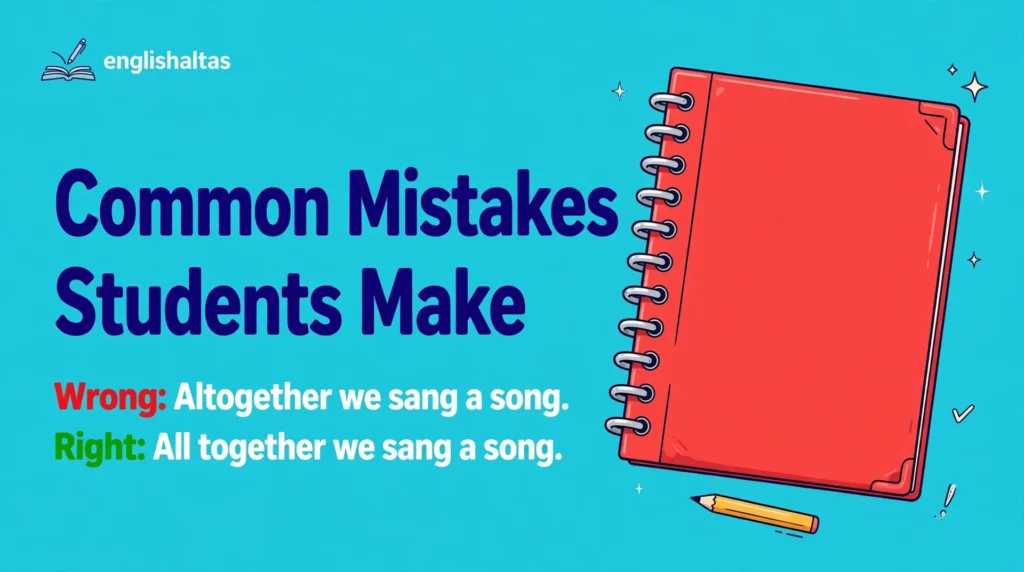
These mistakes happen because altogether and all together sound almost identical when people speak quickly. Most altogether vs all together errors come from that similar sound.
Mistake 1: Using “all together” for a total
❌ There were 50 people all together.
If the intended meaning is simply “50 people in total,” standard written English normally uses:
✅ There were 50 people altogether.
However, context matters. In informal speech, you may sometimes hear “all together” used with a total meaning. For careful writing, altogether is the safer choice when you mean “in total.”
Mistake 2: Using “altogether” for a group
❌ The children stood altogether for the picture.
If you mean that the children gathered into one group, write:
✅ The children stood all together for the picture.
The word all points to the whole group.
Mistake 3: Thinking the two forms are interchangeable
They are not always interchangeable.
Compare:
We paid $60 altogether.
This is about money and the total cost.
Now:
We paid the bill all together.
This can mean the group paid the bill as one group rather than separately.
The small space can change the meaning. That is the whole point of the altogether vs all together lesson.
Mistake 4: Forgetting that “all together” can be separated
Students sometimes think “all together” must always appear next to each other.
But English can place other words between them:
We were all working together.
Here, all refers to everyone, and together describes how they worked.
The important idea is still the same: the whole group acted together.
Easy correction tip
Ask yourself:
Am I talking about a total, or am I talking about a group?
- Total → altogether
- Group → all together
This is much easier than trying to memorize many complicated grammar rules. It also works for every altogether vs all together question in this guide.
Easy Trick to Remember the Difference
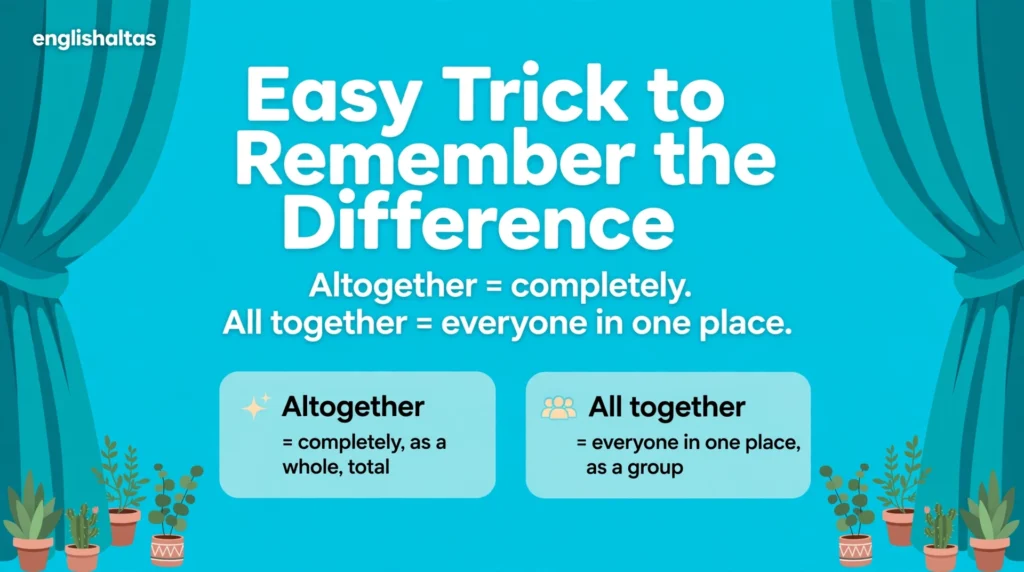
Here is a simple memory trick:
“Altogether” = “Add it all”
Think about adding numbers.
$10 + $20 + $30 = $60 altogether.
You are bringing separate amounts into one total.
The word is joined together because the separate amounts make one total idea.
“All together” = “All are together”
Look at the two parts:
ALL + TOGETHER
“All” means everyone or everything.
“Together” means in one group or at the same time.
So:
The students are all together.
This is about people being together, not about adding their numbers.
Another quick test
Ask:
Can I replace it with “in total”?
Yes → altogether
Can I replace it with “as a group”?
Yes → all together
For example:
We bought eight gifts altogether.
“Eight gifts in total” works.
So use altogether.
Now:
We opened the gifts all together.
“Opened the gifts as a group” works.
So use all together.
Once you get used to this test, the difference becomes almost automatic. After that, the altogether vs all together choice will feel automatic too.
Daily Life Examples
These examples show how the two forms appear in normal spoken English.
Example 1: Shopping
A: How much did everything cost?
B: About $120 altogether.
Here, the speaker means the total price.
Example 2: Family trip
A: Did you travel separately?
B: No, we went all together.
Here, the family traveled as one group.
Example 3: School
Teacher: How many students are in the class altogether?
Student: There are 28.
The teacher wants the total number.
Example 4: Taking a photo
Friend: Where should we stand?
Other friend: Come all together. I want everyone in the picture.
The group needs to gather in one place.
Example 5: Time
A: How long did you wait?
B: Around forty minutes altogether.
The speaker is giving the total waiting time.
Example 6: Dinner
Mother: Should we go separately?
Son: No, let’s go all together.
The family will travel as one group.
Example 7: Completely stopping something
I decided to stop using that app altogether.
Here, altogether means completely.
The person did not simply reduce their use. They stopped using it entirely.
Example 8: Group activity
The children sang all together during the school show.
The children sang as a group.
Example 9: Counting objects
I have twelve pens altogether.
The speaker is giving a total number.
Example 10: Working as a group
We all worked together to finish the project.
This sentence naturally separates all and together, but the group meaning remains clear.
Practice Section
Choose altogether or all together in each sentence.
1.
There were 35 people __________ at the event.
2.
The students stood __________ for the class photograph.
3.
The meal cost $90 __________.
4.
She stopped drinking coffee __________.
5.
The family decided to travel __________.
Answers
1. altogether
There were 35 people altogether at the event.
The sentence gives the total number.
2. all together
The students stood all together for the class photograph.
The students formed one group.
3. altogether
The meal cost $90 altogether.
This means the total cost was $90.
4. altogether
She stopped drinking coffee altogether.
This means she stopped completely.
5. all together
The family decided to travel all together.
The family decided to travel as one group.
FAQs About Altogether vs All Together
What is the difference between “altogether” and “all together”?
Altogether is one word and usually means in total, completely, or on the whole. All together is two words and usually means as one group or at the same time. For example, “The books cost $50 altogether” gives a total, while “The students sat all together” describes a group.
Can we use “altogether” in questions?
Yes. Altogether is commonly used in questions when asking for a total.
For example:
How many people were there altogether?
This means, “What was the total number of people?”
You can also ask:
How much did everything cost altogether?
Here, you are asking for the total cost.
Is “altogether” formal or informal?
Altogether is a normal English word that works in both everyday and formal writing. It is not especially formal or informal. You can use it in conversation, school assignments, business writing, and general English.
Is “all together” always about people?
No. It can describe people or things that are together as one group.
For example:
Put all the books together.
You can also say:
The children stood all together.
The key idea is that separate people or things are being considered as one group or collection.
Can “altogether” mean “completely”?
Yes. This is one of its important meanings.
For example:
He gave up the idea altogether.
This means he gave up the idea completely.
Another example is:
The old machine stopped working altogether.
It stopped working entirely.
Which is correct: “all together” or “altogether”?
Both are correct, but they are used for different meanings.
Use altogether for ideas such as in total or completely.
Use all together when you mean everyone or everything as one group.
The sentence meaning should decide which form you choose.
Final Conclusion
The difference between altogether and all together is small in spelling but important in meaning.
Use altogether when you mean in total, completely, or sometimes on the whole. For example, “The tickets cost $200 altogether” means the total cost was $200. “She quit the job altogether” means she quit completely.
Use all together when you mean everyone or everything in one group or when people do something at the same time. For example, “The children sat all together” means they sat as one group.
When you are unsure, use two simple questions. Can you replace the word with “in total”? If yes, choose altogether. Can you replace it with “as a group”? If yes, choose all together.
A little practice will make this difference easy. Pay attention to how the words are used in conversations, books, and your own writing. Soon, choosing the correct form will feel natural.

Oliver Bennett is an English language educator and content writer passionate about simplifying grammar. He creates clear, practical lessons, writing tips, and learning resources that help readers improve their English with confidence.