Last updated on November 7th, 2026 at 06:59 am
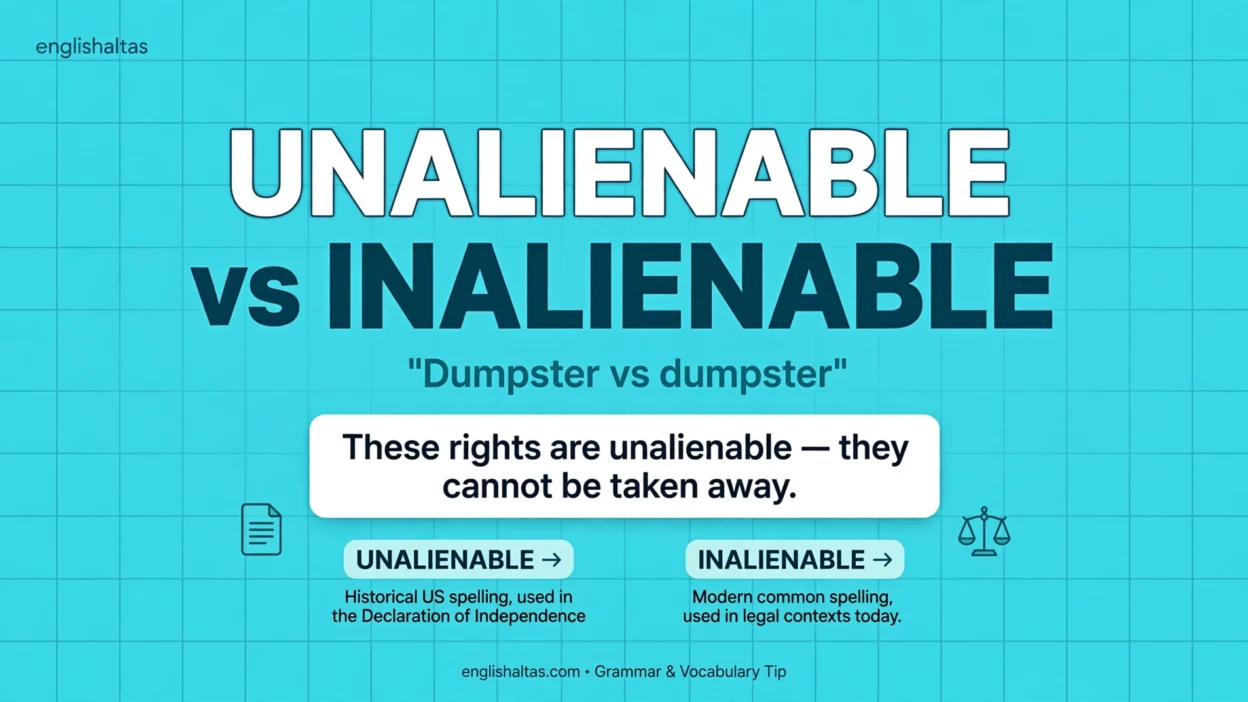
English has many words that look almost the same but make learners stop and think. Unalienable vs inalienable is a good example.
They have nearly the same letters, nearly the same pronunciation, and, in modern English, almost exactly the same meaning.
Then there is Dumpster vs dumpster, which creates a different kind of confusion.
The two forms look identical except for the capital letter, but capitalization can tell us something about the word’s history and use.
These small differences matter because English is not always as simple as “one spelling = one meaning.”
A word can have a historical spelling, a modern spelling, a brand-name history, or a special use in a certain country.
Unalienable and inalienable are adjectives. They describe something that cannot be taken away, denied, surrendered, or transferred.
Today, inalienable is the more common choice, while unalienable is especially familiar from the famous phrase “unalienable rights” in the U.S. Declaration of Independence.
Dumpster, meanwhile, is the usual North American word for a large container used for rubbish or waste.
The word originally came from a proprietary name connected with the Dempster-Dumpster waste-handling system.
Modern dictionaries often retain the trademark-style spelling Dumpster™, while ordinary use may simply write dumpster in lowercase.
By the end, you should know which spelling to choose, why the forms exist, how capitalization works, and how to use each word naturally in everyday English.
You will see how the unalienable vs inalienable choice works in real sentences.
What Does “Unalienable” Mean?
Unalienable is an adjective. It means something that cannot be taken away, denied, surrendered, or transferred to another person.
The word is most often used when talking about rights, freedoms, dignity, or important principles. It is closely related in meaning to inalienable. (Dictionary.com)
Think about a right that a person is believed to have simply because they are a person. If that right cannot properly be given away or taken away, it can be called unalienable.
For example:
- Human dignity is an unalienable part of every person.
- The document describes several unalienable rights.
- They believed freedom was an unalienable right.
- The speaker talked about the unalienable rights of citizens.
- Some people see basic human rights as unalienable.
- The Constitution was written to protect important freedoms.
- The writer argued that personal dignity is unalienable.
- They described liberty as an unalienable human value.
When should you use “unalienable”?
Use unalienable when you want to say that something cannot properly be transferred, removed, denied, or surrendered.
It is especially common in historical, legal, political, and formal writing.
However, there is an important point for learners: unalienable is not usually the first word people choose in modern everyday English. The form inalienable is more common today. (Dictionary.com)
Grammar rule
Because unalienable is an adjective, it normally describes a noun.
You can put it before a noun:
an unalienable right
Or after a linking verb:
The right is unalienable.
You should not use unalienable as a noun by itself when you mean “a right.”
For example:
Correct: Freedom is an unalienable right.
Not natural: Freedom is an unalienable.
The adjective needs something to describe, either directly or through the sentence structure.
Why do students find “unalienable” confusing?
The main problem is the prefix un-. Students know that un- often means “not,” so the word looks logical: un + alienable = not alienable.
That is correct.
In the unalienable vs inalienable pair, the confusion starts when learners see inalienable, which means the same thing. They may think one must be correct and the other must be wrong.
That is not the case for unalienable vs inalienable.
Unalienable is a real English word. It is a variant of inalienable. However, inalienable is now the more common form. (Dictionary.com)
What Does “Inalienable” Mean?
Inalienable is also an adjective. It means something that cannot be taken away, denied, surrendered, or transferred to another person.
It is particularly common with words such as rights, freedom, liberty, dignity, and principles.
For example:
- Everyone should have inalienable rights.
- Freedom is an inalienable right.
- The law protects certain inalienable rights.
- Human dignity is often described as inalienable.
- She believes education is an inalienable part of human development.
- The group defended the inalienable rights of its members.
- They argued that liberty is inalienable.
- The constitution recognizes certain inalienable freedoms.
Modern dictionaries generally identify inalienable as the standard or more common form. Oxford describes it as formal and notes unalienable as a less frequent variant. (Oxford Learner’s Dictionaries)
When should you use “inalienable”?
Use inalienable when you want to describe something that cannot be transferred or taken away.
It is especially useful in formal English:
Everyone has an inalienable right to personal dignity.
You may also see it in legal, political, academic, and human-rights writing.
Grammar rule
Inalienable is an adjective, so it modifies a noun.
Common patterns include:
inalienable + noun
an inalienable right
noun + be + inalienable
The right is inalienable.
You can also use it with plural nouns:
inalienable rights
The word is not normally used as an ordinary verb or noun.
Why does “inalienable” have “in-” instead of “un-”?
English has several prefixes that can create a negative meaning. Un- is one of them. In- can also have a negative meaning in certain words.
For example:
- visible → invisible
- complete → incomplete
- expensive → inexpensive
- alienable → inalienable
So inalienable essentially means not alienable.
The root alienable has a legal meaning: something that can be sold, transferred, or given to another owner. Inalienable means that it cannot be transferred in that way. (Dictionary.com)
What Does “Dumpster” Mean?
A dumpster is a large container used for collecting rubbish, trash, or waste.
The word is especially common in North American English. In British English, a similar large waste container is often called a skip. Oxford lists Dumpster as North American English and gives skip as the British equivalent. (Oxford Learner’s Dictionaries)
Examples:
- The old furniture was placed in the dumpster.
- Please put the boxes in the dumpster.
- The restaurant has a large dumpster behind the building.
- Someone left a bicycle beside the dumpster.
- The workers emptied the dumpster this morning.
- Don’t leave bags outside the dumpster.
- The apartment building needs a larger dumpster.
- The garbage truck came to empty the dumpster.
Is “dumpster” a normal noun?
Yes. In modern English, people commonly use dumpster as a noun for a large waste container.
You can use it as a singular countable noun:
a dumpster
You can use the plural:
dumpsters
You can also use an article:
The dumpster is full.
or:
There is a dumpster behind the store.
Why do some dictionaries write “Dumpster™”?
There is an interesting history behind this word.
The term originally came from the Dempster-Dumpster system developed for waste collection. The name was associated with the Dempster Brothers company and its waste-handling equipment. The word later became widely used as a general term for a large waste container. (Etymonline)
That is why you may see Dumpster™ in dictionary entries or formal descriptions.
But ordinary speakers do not normally stop and think about the trademark history when they say:
Put it in the dumpster.
What Does “dumpster” Mean?
In ordinary modern writing, dumpster is simply the lowercase form of the common noun.
The meaning is the same: a large waste container.
For everyday sentences, lowercase is normally natural:
The dumpster is full.
We need to empty the dumpster.
There are three dumpsters behind the building.
The capitalized form Dumpster may appear when the word is being treated as a brand or trademark name, or when a dictionary chooses to preserve its historical proprietary form.
So the important difference is not really a difference in the physical object.
It is mainly a question of capitalization, trademark history, and writing style.
Unalienable vs Inalienable: Key Differences
The simplest answer is:
Unalienable vs inalienable mean essentially the same thing.
In the unalienable vs inalienable comparison, both describe something that cannot be transferred, taken away, or denied. The main difference is modern usage and historical preference.
In the history of unalienable vs inalienable, unalienable was once more common. Over time, inalienable became the more common form. Today, inalienable is generally the safer choice for ordinary modern writing. (Dictionary.com)
| Feature | Unalienable | Inalienable |
|---|---|---|
| Part of speech | Adjective | Adjective |
| Basic meaning | Cannot be taken or transferred | Cannot be taken or transferred |
| Meaning difference | Almost none | Almost none |
| Modern frequency | Less common | More common |
| Common context | Historical/formal | Modern formal/general |
| Famous association | U.S. Declaration of Independence | Modern legal/formal English |
| Example | unalienable rights | inalienable rights |
| Safe modern choice | Yes | Yes, and usually preferred |
Usage difference
Suppose you write:
Every person has an unalienable right to dignity.
That is correct.
You could also write:
Every person has an inalienable right to dignity.
That is also correct.
The second sentence will usually sound more natural in modern English.
In the unalienable vs inalienable pair, the two forms developed from different negative prefixes attached to alienable. Historical usage changed over time, and inalienable eventually became dominant. (Dictionary.com)
Grammar logic
In unalienable vs inalienable, both words work in exactly the same grammatical way.
Adjective + noun:
an inalienable right
an unalienable right
Subject + linking verb + adjective:
The right is inalienable.
The right is unalienable.
With unalienable vs inalienable, the grammar does not change simply because the prefix changes.
Difference Between Dumpster and dumpster
This comparison is different.
Dumpster and dumpster usually refer to the same type of waste container. The main issue is capitalization.
In modern everyday English, dumpster is normally written with a lowercase d when it is being used as a common noun.
Dumpster™ can be used when referring specifically to the trademarked name or when following a dictionary’s trademark notation. Oxford, for example, gives the entry as Dumpster™ and explains its North American use. (Oxford Learner’s Dictionaries)
| Form | Typical use | Example |
|---|---|---|
| dumpster | Common noun | The dumpster is full. |
| Dumpster | Brand/trademark-style form | The company used the Dumpster™ system. |
| dumpster | Everyday American English | Put the box in the dumpster. |
| Dumpster™ | Dictionary/trademark context | Dumpster™ is a proprietary name historically connected with Dempster. |
Sentence structure
There is no special grammar difference between the two.
Both can function as nouns:
The dumpster is outside.
The Dumpster is outside.
The capitalization changes how the reader may understand the word, but it does not change the basic object being discussed.
Meaning comparison
Think of Google and google as a rough comparison.
A capitalized form can point to a specific brand or proper name, while lowercase can become a general word.
With dumpster, the historical brand name became widely used as a general term. The everyday word is now commonly written dumpster.
Grammar Rules You Must Remember
Rule #1: Use “inalienable” as the normal modern choice
For unalienable vs inalienable, if you are writing a normal modern sentence and you need this adjective, inalienable is usually the best choice.
Everyone has an inalienable right to dignity.
Unalienable is not wrong, but it is less common today. (Oxford Learner’s Dictionaries)
Rule #2: “Unalienable” is not incorrect
Do not mark unalienable as a spelling mistake.
In the unalienable vs inalienable pair, it is a genuine English adjective and has the same basic meaning as inalienable.
They believed liberty was an unalienable right.
This is grammatically correct.
Rule #3: “Dumpster” and “dumpster” are not different objects
Capitalization does not create a completely different type of container.
In everyday writing, use:
The dumpster is full.
A capitalized form is more likely when discussing the trademark or preserving a trademark-style name.
Rule #4: Use articles correctly with “dumpster”
Because dumpster is a countable noun, singular use normally needs a determiner.
I saw a dumpster.
The dumpster is full.
We need another dumpster.
Do not normally write:
I saw dumpster.
For general plural use, no article is needed:
The building has three dumpsters.
Common Mistakes Students Make
Mistake 1: Thinking “unalienable” is wrong
Some learners see inalienable more often and assume unalienable must be a spelling error. Both forms belong to the unalienable vs inalienable pair, and neither one is a mistake.
Wrong idea: “Unalienable is always incorrect.”
Better understanding: Both words exist and have essentially the same meaning. Inalienable is simply more common today. (Dictionary.com)
Mistake 2: Thinking the two words have opposite meanings
The prefixes un- and in- can look different, but here they perform a similar negative function.
Unalienable ≈ inalienable
In unalienable vs inalienable, both mean that something cannot be transferred or taken away.
Mistake 3: Using “alienable” when you mean “inalienable”
Alienable has the opposite idea. It describes something that can be transferred, sold, or given to another person, especially in legal contexts. (Dictionary.com)
Compare:
The property is alienable.
The right is inalienable.
The first says transfer is possible. The second says it is not.
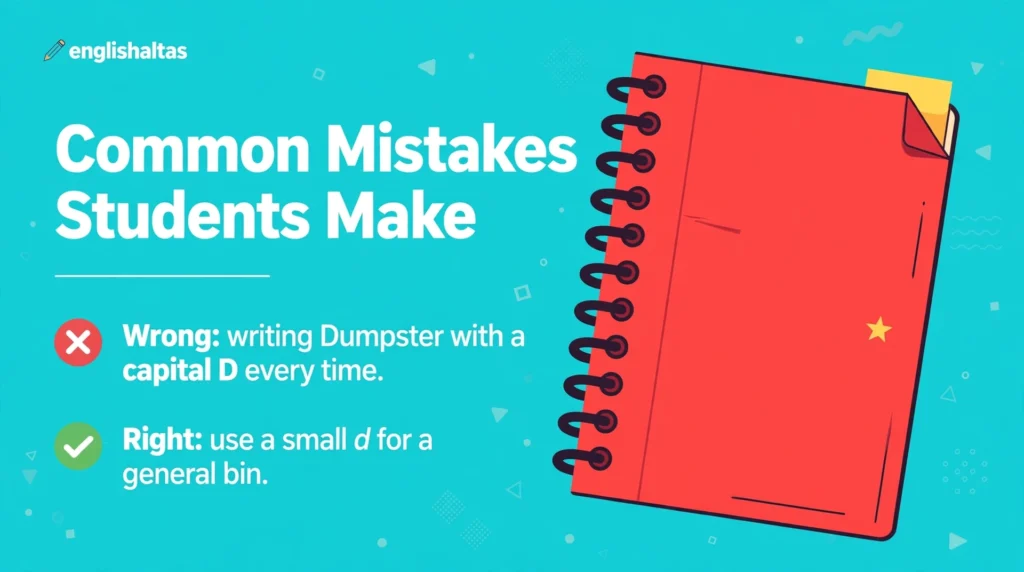
Mistake 4: Capitalizing every “dumpster”
A common noun does not need a capital letter simply because it once came from a brand name.
For everyday writing:
The workers emptied the dumpster.
is natural.
Mistake 5: Thinking “Dumpster” is always a proper noun
Modern English often treats dumpster as a general noun.
The historical trademark background explains the capitalized form you may see in dictionaries, but everyday writing normally does not require you to capitalize it.
Easy Trick to Remember the Difference
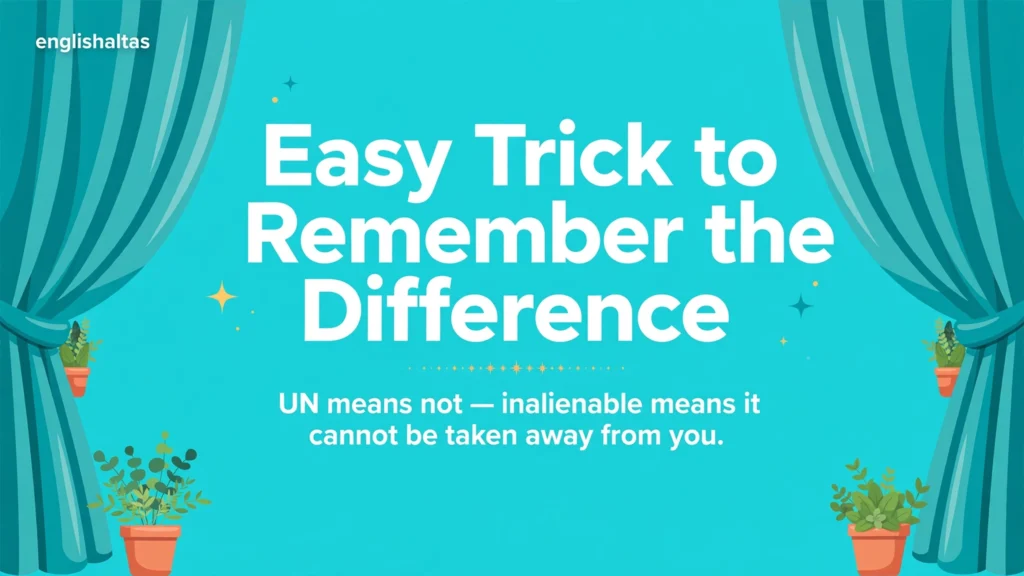
For unalienable vs inalienable, remember:
INalienable = IN modern English
In unalienable vs inalienable, when you are unsure, choose inalienable. It is the more common modern form.
You can also connect the word to the phrase:
inalienable rights
That is a very common combination in formal English.
For Dumpster vs dumpster, use a different trick:
Small d = everyday container.
If you are simply talking about a large rubbish container, write:
dumpster
If you are specifically discussing the trademark or a dictionary’s trademark-style name, you may see:
Dumpster™
There is no need to make the capitalization more complicated than that.
Daily Life Examples
Here are some natural examples you may hear or read.
1. Talking about rights
Everyone should have inalienable rights.
For unalienable vs inalienable, this is formal but common in discussions about human rights.
2. Using the less common variant
The speaker called freedom an unalienable right.
This is correct, although inalienable would be more common today.
3. Talking about freedom
She believes freedom is an inalienable part of human dignity.
The adjective describes part.
4. Asking about rubbish
Where is the dumpster?
This is a normal everyday question in North American English.
5. Giving an instruction
Please put the empty boxes in the dumpster.
Here, dumpster is an ordinary countable noun.
6. Talking about a building
Our apartment building has two dumpsters.
The plural form is dumpsters.
7. Talking about something being full
The dumpster is already full.
This is a simple spoken-English sentence.
8. Comparing American and British English
Americans often say “dumpster,” while British speakers often use “skip” for a similar container. (Oxford Learner’s Dictionaries)
9. Using the words in formal writing
The law recognizes certain inalienable rights.
This sounds much more natural than using inalienable in casual conversation about rubbish.
10. Using both ideas in one sentence
The speaker argued that human dignity is inalienable, while the old boxes were simply thrown into a dumpster.
The two words belong to completely different vocabulary areas, but both can appear naturally in the same sentence.
Practice Section
Choose the correct option. In some questions, both choices may be grammatically possible.
1. Everyone should have ______ rights.
A. inalienable
B. alienable
2. The old furniture is in the ______.
A. dumpster
B. inalienable
3. Which word is more common in modern English?
A. unalienable
B. inalienable
4. Which sentence is correct?
A. The dumpster is full.
B. The dumpster is full.
5. Which statement is correct?
A. Unalienable vs inalienable have essentially the same meaning.
B. Unalienable means the opposite of inalienable.
Answers
1. A — inalienable
An inalienable right is a right that cannot properly be taken away or transferred.
2. A — dumpster
A dumpster is a large waste container.
3. B — inalienable
Inalienable is the more common modern form. (Dictionary.com)
4. Both are visually identical choices.
The natural everyday spelling is dumpster with a lowercase d. A capitalized Dumpster may appear when the trademark name is intended.
5. A
In the unalienable vs inalienable pair, the two adjectives have essentially the same meaning.
FAQs
Unalienable vs Inalienable: What Is the Difference?
In the unalienable vs inalienable pair, there is very little difference in meaning. Both describe something that cannot be taken away, denied, surrendered, or transferred.
In unalienable vs inalienable, inalienable is more common in modern English, while unalienable is strongly associated with historical and formal language, especially the phrase “unalienable rights.” (Dictionary.com)
Is unalienable a correct word?
Yes. Unalienable is a correct English word.
It is an adjective meaning essentially the same as inalienable. However, it is less common in modern general use, so learners will usually find inalienable the safer everyday choice. (Dictionary.com)
Is inalienable formal or informal?
Inalienable is mainly formal.
You are likely to see it in writing about rights, law, government, philosophy, freedom, and human dignity. It is not a word most people need in casual conversation every day.
What does dumpster mean?
A dumpster is a large container for rubbish or waste, especially in North American English.
In British English, a similar container is often called a skip. The word Dumpster has a historical connection with the Dempster-Dumpster waste-collection system. (Oxford Learner’s Dictionaries)
Should dumpster be capitalized?
Usually, no.
When you are using dumpster as an ordinary common noun, lowercase is natural:
The dumpster is behind the store.
You may see Dumpster™ when the word is being presented as a trademark or in a dictionary entry that preserves its trademark history. (Oxford Learner’s Dictionaries)
Is Dumpster a brand name?
The word originated as part of the Dempster-Dumpster name for a waste-handling system. Over time, dumpster became widely used as a general noun for this kind of container.
Conclusion
Unalienable vs inalienable are much easier to understand once you know that they are basically synonyms. Both describe something that cannot be taken away, denied, surrendered, or transferred.
Unalienable is a valid word, but inalienable is the more common modern choice. If you are writing a normal article, essay, or formal sentence, inalienable will usually be the better option.
Dumpster and dumpster are a different case. The main issue is capitalization rather than meaning. In everyday English, dumpster is normally a common noun for a large waste container.
The capitalized or trademark-style Dumpster™ form reflects the word’s history as a proprietary name.
The best way to remember both pairs is simple: choose inalienable for modern general use, and choose dumpster when you are talking about the container in ordinary English.
That is the key point of this unalienable vs inalienable guide.
A few examples and a little reading practice will make these forms feel natural very quickly.

Oliver Bennett is an English language educator and content writer passionate about simplifying grammar. He creates clear, practical lessons, writing tips, and learning resources that help readers improve their English with confidence.