Last updated on October 11th, 2026 at 04:21 pm
Flammable and inflammable are two English words that confuse many learners because they look like opposites.
When students see the prefix in-, they often think it means “not.” For example, inactive means “not active,” and inaccurate means “not accurate.”
So, it is natural to think that inflammable means “not flammable.”
But English has a surprise here: flammable and inflammable mean the same thing. Both words describe something that can catch fire easily and burn quickly.
This is more than a vocabulary puzzle. You can see these words on warning labels, cleaning products, fuel containers, clothing, chemicals, and other everyday items.
Understanding them can help you read safety information correctly.
There is also an important reason why flammable is usually the better word today. The word inflammable can look as if it means “not flammable,” even though that is not its meaning.
For this reason, flammable is now more common, especially in safety language.
By the end, you will know exactly what both words mean, why they look confusing, how their grammar works, which word you should normally choose, and how to use them naturally in everyday English.
What Does “Flammable” Mean?
Flammable is an adjective. It describes something that can catch fire easily and burn quickly.
For example:
- Gasoline is highly flammable.
- Keep flammable materials away from the fire.
If something is flammable, fire or heat can make it burn. The word is often used for liquids, gases, materials, chemicals, clothing, and other objects.
Cambridge defines flammable as something that burns easily, while Oxford gives the simple meaning “that can burn easily.”
When should you use “flammable”?
Use flammable when you want to say that something can catch fire easily.
It is especially useful in:
- Safety instructions
- Warning labels
- Everyday conversations
- School science
- Workplace instructions
- Product descriptions
- Emergency information
For example, you might see:
Warning: Flammable liquid
This tells you that the liquid can catch fire easily.
You can also use flammable before a noun:
- flammable gas
- flammable liquid
- flammable material
- flammable clothing
- flammable chemical
- flammable substance
You can also use it after a linking verb:
- The liquid is flammable.
- This material is highly flammable.
Grammar rule for “flammable”
Flammable is an adjective.
A simple pattern is:
Subject + be + flammable
Examples:
- This liquid is flammable.
- The gas is highly flammable.
- These chemicals are flammable.
- The old curtains are flammable.
- Some cleaning products are flammable.
- Is this material flammable?
- Keep flammable objects away from the heater.
- The label says that the product is flammable.
Notice that flammable does not change for singular or plural nouns.
We say:
- The liquid is flammable.
- The liquids are flammable.
Not:
- The liquids are flammables.
The adjective stays the same.
A common learner confusion
Some learners think flammable means “already burning.” It does not.
If something is flammable, it has the ability to catch fire easily. It does not mean that it is currently on fire.
Compare:
- The paper is flammable. → It can burn easily.
- The paper is burning. → It is burning right now.
That small difference is important.
What Does “Inflammable” Mean?
Inflammable is also an adjective. In the context of fire, it means able to catch fire easily or burn easily.
That means:
Inflammable = flammable
This may sound strange at first, but it is correct. Cambridge lists inflammable as describing a substance or material that burns very easily.
Examples include:
- Petrol is highly inflammable.
- The building contains inflammable materials.
- Keep inflammable liquids away from flames.
- The gas is inflammable.
- Workers must handle inflammable substances carefully.
- Is this chemical inflammable?
- The old fabric was extremely inflammable.
- The warning sign mentions inflammable materials.
Why does “inflammable” not mean “not flammable”?
This is the most interesting part.
In many English words, in- means “not.”
For example:
- inactive = not active
- incorrect = not correct
- invisible = not visible
- inexpensive = not expensive
So, a learner may look at inflammable and think:
in- + flammable = not flammable
But that is not how the word was formed.
The in- in inflammable has a different history. It comes from Latin inflammare, meaning “to set on fire” or “to inflame.” It is not the negative prefix found in words such as inactive. (Merriam-Webster)
The word inflammable is much older than flammable. Merriam-Webster records inflammable from around 1605, while flammable entered English later, in 1813. (Merriam-Webster)
Grammar rule for “inflammable”
Just like flammable, inflammable is an adjective.
You can put it before a noun:
- inflammable material
- inflammable liquid
- inflammable gas
- inflammable substance
Or after a linking verb:
- The material is inflammable.
- These chemicals are inflammable.
There is no special grammar rule that makes inflammable different from flammable.
The main difference is usage and clarity, not grammar.
Another meaning of “inflammable”
There is one more meaning worth knowing.
Inflammable can also describe a person, situation, or feeling that is easily excited, angered, or made intense. Merriam-Webster lists this figurative meaning as well. (Merriam-Webster)
For example:
- The speaker created an inflammable political situation.
- He has an inflammable temper.
This figurative use is less important for beginners, but it can appear in books and formal writing.
Difference Between Flammable and Inflammable
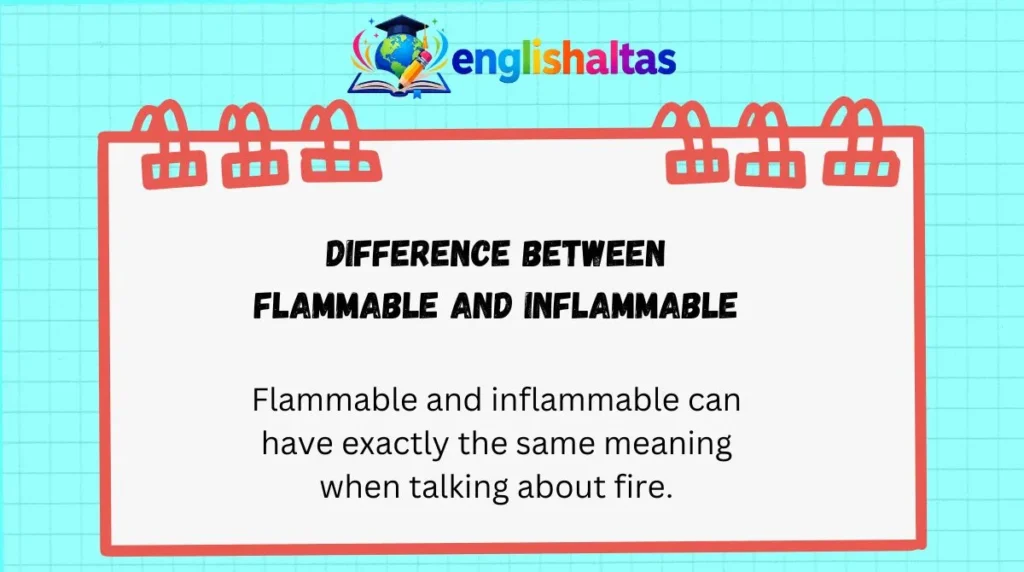
The biggest fact to remember is simple:
Flammable and inflammable can have exactly the same meaning when talking about fire.
Both describe something that catches fire easily.
| Feature | Flammable | Inflammable |
|---|---|---|
| Part of speech | Adjective | Adjective |
| Fire meaning | Burns or catches fire easily | Burns or catches fire easily |
| Meaning | Easily ignited | Easily ignited |
| Opposite | Nonflammable | Nonflammable |
| Common today | Very common | Less common |
| Safety labels | Preferred | Can cause confusion |
| Can describe materials? | Yes | Yes |
| Can describe liquids/gases? | Yes | Yes |
| Negative prefix “in-”? | No | No, not in this sense |
Usage difference
Although the two words can mean the same thing, flammable is usually the safer choice in modern English.
Why?
Because inflammable looks like it should mean “not flammable.” Someone who does not know the history of the word might misunderstand an important warning.
That is why flammable became preferred in safety language. Merriam-Webster notes that flammable is now the preferred general term for things that can catch fire, while inflammable is still used sometimes. (Merriam-Webster)
Oxford also says that flammable is much more frequent and carries less risk of confusion. (Oxford Learner’s Dictionaries)
What about “nonflammable”?
If you mean that something does not catch fire easily, use:
nonflammable
This is much clearer than trying to treat inflammable as the opposite of flammable.
For example:
- This material is flammable.
- This material is nonflammable.
These two clearly express opposite ideas.
Do not use inflammable to mean “not flammable.”
Sentence structure
The grammar is almost identical:
Flammable:
This liquid is flammable.
Inflammable:
This liquid is inflammable.
Both sentences say that the liquid can catch fire easily.
Before a noun:
This is a flammable liquid.
This is an inflammable liquid.
Again, the meaning concerning fire is essentially the same.
Grammar Rules You Must Remember
Rule #1: Both words are adjectives
Both flammable and inflammable describe nouns.
Examples:
- flammable material
- inflammable material
- flammable gas
- inflammable gas
They can also come after be:
- The gas is flammable.
- The gas is inflammable.
Rule #2: “Inflammable” does not mean “not flammable”
This is the most important rule.
The in- in inflammable is not the normal negative prefix meaning “not.” Its history comes from Latin and is connected with the idea of setting something on fire. (Merriam-Webster)
So:
inflammable = flammable
Not:
inflammable = nonflammable
Rule #3: Use “nonflammable” for the opposite meaning
When you want to say that something is not easily burned, nonflammable is clear.
Example:
- The container is made from nonflammable material.
The word nonflammable removes the confusion.
Rule #4: “Highly flammable” is a natural phrase
English commonly uses adverbs such as highly, very, and extremely with flammable.
Examples:
- The liquid is highly flammable.
- This gas is extremely flammable.
- The material is very flammable.
The phrase highly flammable is especially common in safety warnings and product information. (Cambridge Dictionary)
Common Mistakes Students Make
Mistake 1: Thinking “inflammable” means “not flammable”
This is the biggest mistake.
Wrong idea:
inflammable = cannot burn
Correct idea:
inflammable = can burn easily
Remember that the prefix has a different history here.
Mistake 2: Saying “inflammable” when they mean “safe from fire”
If you want to say something does not burn easily, use nonflammable.
Incorrect meaning:
This box is inflammable, so it cannot burn.
Better:
This box is nonflammable, so it does not catch fire easily.
Mistake 3: Assuming only one of the words is correct
Both words are real English words.
You can correctly say:
- The liquid is flammable.
- The liquid is inflammable.
However, flammable is usually the clearer and more common choice today. (Oxford Learner’s Dictionaries)
Mistake 4: Using “flammable” as a verb
Flammable is an adjective, not a verb.
Do not say:
The fire flammable the material.
Instead:
The material is flammable.
You can use the related verb burn or ignite:
- The material can burn easily.
- The material can ignite easily.
Mistake 5: Confusing “flammable” with “flaming”
These words are related, but they do not mean exactly the same thing.
- flammable = able to catch fire easily
- flaming = burning with flames now
For example:
The paper is flammable.
This means it can burn easily.
The paper is flaming.
This means it is actually burning with flames.
Easy Trick to Remember the Difference

Here is the easiest memory trick:
Think: “Flammable = FIRE”
When you see flammable, immediately think:
Flammable vs Inflammable
Then remember:
Flammable vs Inflammable
The confusing part is the in-.
Do not treat every in- in English as meaning “not.” English has many words with similar-looking parts that come from different histories.
For this particular pair, the safest memory rule is:
Flammable vs Inflammable
Flammable vs Inflammable
Flammable vs Inflammable
That gives you a very simple three-word system.
You can also remember this sentence:
Flammable vs Inflammable
If you remember that one sentence, you will avoid the most common mistake.
For everyday English, choose flammable when you can. It is common, clear, and less likely to be misunderstood.
Daily Life Examples
Here are some simple examples that sound natural in everyday English.
1. Talking about gasoline
A: Is gasoline dangerous near a fire?
B: Yes. Gasoline is highly flammable.
The speaker uses flammable because gasoline catches fire easily.
2. Reading a warning label
A: Why does this bottle have a warning sign?
B: It contains a flammable liquid.
Here, flammable describes the liquid.
3. Talking about clothing
Flammable vs Inflammable
B: Be careful. The material may be flammable.
Flammable vs Inflammable
4. Talking about cleaning products
Flammable vs Inflammable
Flammable vs Inflammable
This is a normal safety instruction.
5. Asking a question
A: Is this chemical flammable?
Flammable vs Inflammable
Flammable vs Inflammable
6. Talking about a warehouse
Flammable vs Inflammable
7. Using “inflammable”
B: There are many flammable materials here.
The adjective comes before the plural noun materials.
Flammable vs Inflammable
B: It says the material is inflammable.
Flammable vs Inflammable
8. Talking about the opposite
A: Is this fabric safe near a heater?
B: It is made from nonflammable material.
Flammable vs Inflammable
9. Giving a warning
A: Should I put this can near the stove?
B: No. It is highly flammable.
Flammable vs Inflammable
10. Explaining the confusing word
A: Does “inflammable” mean it cannot burn?
Flammable vs Inflammable
This is a useful sentence to remember when teaching the difference to another English learner.
Practice Section
Choose the correct word: flammable, inflammable, or nonflammable.
1.
Gasoline is highly ________, so keep it away from fire.
2.
The box is made from ________ material and is designed to resist fire.
3.
The old warning label says that the liquid is ________.
4.
Does “inflammable” mean “unable to burn”?
5.
This chemical is ________, so do not store it near a heat source.
Answers
1. flammable
Gasoline can catch fire easily, so flammable is the natural choice.
2. nonflammable
Here, the sentence means the material does not catch fire easily.
3. inflammable
Inflammable can correctly mean “flammable,” although flammable is more common today.
4. No
Inflammable does not mean “unable to burn.” It can mean “able to burn easily.”
5. flammable
The chemical can catch fire easily, so flammable is correct.
FAQs
What is the difference between flammable and inflammable?
When talking about fire, there is no difference in basic meaning. Both words describe something that can catch fire easily and burn.
However, flammable is more common today and is usually preferred because inflammable can look as though it means “not flammable.” (Merriam-Webster)
Can inflammable mean “not flammable”?
No.
This is a common misunderstanding. The in- in inflammable is not the negative prefix meaning “not.” Inflammable can mean “flammable,” or able to catch fire easily. Use nonflammable when you mean the opposite. (Merriam-Webster)
Is flammable more common than inflammable?
Yes. Flammable is generally more common in modern English, especially in safety information.
Oxford notes that flammable is much more frequent and less likely to be misunderstood. (Oxford Learner’s Dictionaries)
Can we use flammable in questions?
Yes. Flammable is an adjective, so you can easily use it in questions.
For example:
- Flammable vs Inflammable
- Flammable vs Inflammable
- Flammable vs Inflammable
These are all grammatically natural.
Is inflammable formal or informal?
Inflammable is a standard English word, not a slang word. However, it is less common than flammable in modern usage.
It may still appear in British English, technical writing, older texts, and figurative expressions. Oxford specifically notes its use, especially in British English. (Oxford Learner’s Dictionaries)
What is the opposite of flammable?
The clearest opposite is nonflammable.
You can also see non-combustible or incombustible in some contexts, depending on the material and technical meaning.
For simple everyday English, nonflammable is an easy and clear choice.
Conclusion
The words flammable and inflammable are a perfect example of why English can sometimes surprise learners.
Both words can mean “able to catch fire easily.” So, despite the word in- at the beginning of inflammable, it does not mean “not flammable.” That part of the word has a different history. (Merriam-Webster)
For modern everyday English, flammable is usually the best choice. It is common, easy to understand, and widely used in safety warnings. Inflammable is still correct when it has the fire-related meaning, but it can cause confusion.
The easiest rule is:
Flammable vs Inflammable
Flammable vs Inflammable
Flammable vs Inflammable
Once you remember these three meanings, the confusion becomes much easier.
Try using flammable in a few simple sentences of your own. When you see inflammable on a label or in a book, you will know exactly what it means.

Oliver Bennett is an English language educator and content writer passionate about simplifying grammar. He creates clear, practical lessons, writing tips, and learning resources that help readers improve their English with confidence.