Paste and paced are two English words that can easily confuse learners because they sound exactly the same in standard English.
If you hear someone say, “I paced around the room,” you may wonder whether they said paced or paste.
The spelling gives you an important clue, but when you are listening, the difference disappears.
This is a classic example of homophones: words that have the same pronunciation but different spellings and meanings.
Paste can be a noun or a verb, while paced is normally the past tense or past participle of the verb pace.
For example:
I used paste to fix the poster.
Here, paste refers to a sticky substance.
Now compare:
He paced around the room while waiting for the phone call.
Here, paced means that he walked back and forth, usually because he was nervous, worried, impatient, or thinking.
The difference becomes especially important in writing, spelling tests, captions, emails, and online communication.
In speech, both words sound the same, so context does most of the work.
By the end of this guide, you will know exactly what paste and paced mean, how they are pronounced, how their grammar differs, and how to choose the correct spelling without hesitation.
What Does “Paste” Mean?
Paste has two common grammatical uses. It can be a noun referring to a thick, soft substance, or a verb meaning to attach something using paste. In modern digital English, paste also means to insert copied text, an image, or other content into a document or application.
The word is pronounced /peɪst/, which sounds the same as paced.
“Paste” as a noun
As a noun, paste usually describes a thick, soft, sticky substance.
For example:
- The children used paste to make their paper crafts.
- Put some paste on the back of the label.
- This glue is thicker than ordinary paste.
- The recipe uses a small amount of tomato paste.
- She spread the paste evenly over the paper.
- The teacher gave each student a tube of paste.
- The wall was covered with a special adhesive paste.
- Add the curry paste before pouring in the coconut milk.
The exact type of paste depends on the context. It might be an adhesive used for crafts, a food product such as tomato paste, or another thick substance.
“Paste” as a verb
Paste can also mean to attach something with paste or glue.
She pasted the picture into her notebook.
It can also mean to put something onto a surface.
Examples:
- He pasted the poster on the wall.
- She pasted the photographs into an album.
- The students pasted colored paper onto the cardboard.
- They pasted the notice near the entrance.
In everyday modern English, however, many people encounter paste most often in a digital context.
“Paste” in computer and internet English
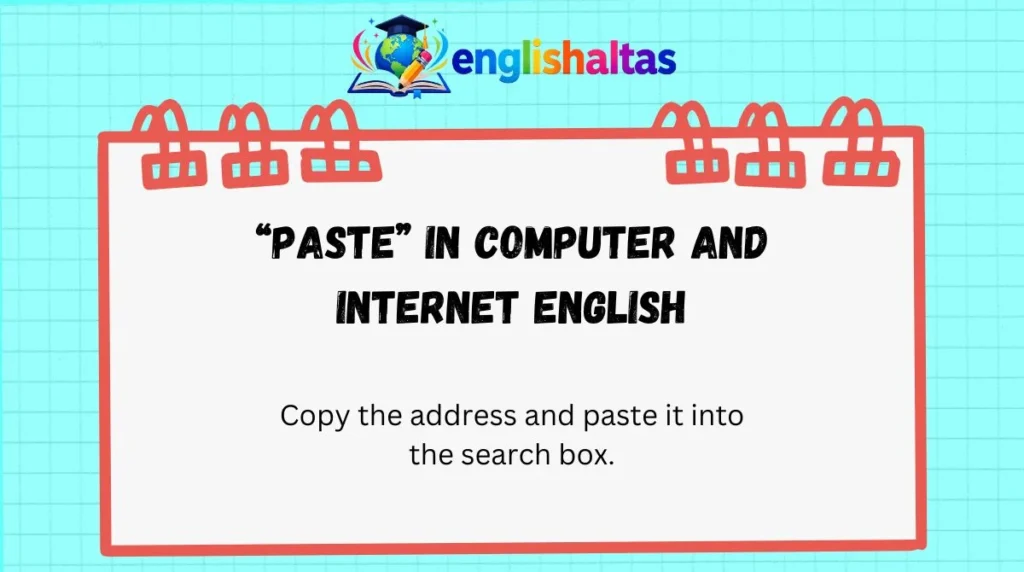
If you copy text from one place and insert it somewhere else, you paste it.
For example:
Copy the address and paste it into the search box.
You may also hear:
- Paste the link here.
- I copied the paragraph and pasted it into the document.
- Can you paste the information into the email?
- Paste the code into the editor.
- Just copy and paste the text.
Here, paste has nothing to do with glue. It describes a digital action.
Grammar rule for “paste”
As a verb, paste follows ordinary verb patterns:
- paste — present/base form
- pastes — third-person singular present
- pasted — simple past
- pasted — past participle
- pasting — -ing form
Examples:
I paste the text into the document.
She pastes the label onto the box.
He pasted the picture yesterday.
They have pasted the information into the form.
This is an important point: paste and paced are not different forms of the same verb. Paced comes from the verb pace, not paste.
Common learner confusion with “paste”
The biggest problem is pronunciation.
When you hear:
Please paste the link here.
you may not immediately know whether the speaker means paste or paced.
The answer comes from the sentence. A digital action involving copied material almost certainly requires paste.
For example:
Paste the URL into the box.
There is no walking involved, so paced would make no sense.
What Does “Paced” Mean?
Paced is the past tense and past participle of the verb pace.
The verb pace means to walk back and forth, usually over a relatively short distance. It often describes someone who is nervous, worried, impatient, excited, or deep in thought.
The word paced is pronounced /peɪst/, exactly like paste.
“Paced” as the past tense of “pace”
When someone walked back and forth in the past, we use paced.
Examples:
- He paced around the room while waiting for the results.
- She paced back and forth before the interview.
- The coach paced along the sideline during the match.
- I paced around the house because I couldn’t sleep.
- The manager paced across the office while talking on the phone.
- She paced nervously outside the doctor’s office.
- He paced the hallway for nearly an hour.
- The dog paced around the kitchen while waiting for dinner.
In these sentences, paced describes movement, especially repeated movement back and forth.
“Paced” can describe walking while thinking
People often pace when they are trying to solve a problem or make a decision.
For example:
He paced around his office while thinking about the proposal.
The person may not be walking for exercise. The movement is simply part of what he is doing while thinking.
You might also hear:
She paced back and forth while trying to remember the answer.
“Paced” can have another meaning
Paced is also used in expressions involving speed, rhythm, or progress.
For example:
The runner paced himself carefully during the race.
Here, paced does not mean that he simply walked back and forth. It comes from the idea of controlling the rate at which someone moves or performs.
Similarly:
The movie was paced well.
This means the movie’s events developed at a suitable speed.
Other examples include:
- The first half of the game was fast-paced.
- She paced herself during the long hike.
- The story was slowly paced at the beginning.
- He paced his presentation carefully.
Grammar rule for “paced”
The base verb is pace, and its regular past form is paced.
The pattern is:
pace → paced
Examples:
I pace around the room when I’m nervous.
Yesterday, I paced around the room.
She has paced the hallway several times.
Notice that paced is spelled with -ced, not -ste.
Common learner confusion with “paced”
Because paced sounds exactly like paste, learners sometimes choose the spelling based on pronunciation alone.
That does not work here.
Consider:
He paced around the room.
The word must be paced because the sentence describes walking.
Compare:
He pasted the picture onto the wall.
That word must be pasted because it describes attaching something.
The sounds are similar—or, in standard pronunciation, identical—but the meanings and spellings are completely different.
Difference Between Paste and Paced
The central difference is simple:
Paste can refer to a sticky substance or the action of attaching or inserting something. Paced is the past form of pace, meaning walked back and forth or controlled the rate of progress.
The words are homophones, so pronunciation alone does not distinguish them.
Comparison Table
| Feature | Paste | Paced |
|---|---|---|
| Pronunciation | /peɪst/ | /peɪst/ |
| Sounds like | “payst” | “payst” |
| Word family | paste, pasted, pasting | pace, paced, pacing |
| Common grammatical role | noun or verb | past tense/past participle |
| Main meaning | sticky substance; copy and insert; attach | walked back and forth; controlled speed |
| Example | Paste the link here. | He paced around the room. |
| Present form | paste | pace |
| Past form | pasted | paced |
| Related noun | paste | pace |
| Main clue | substance, attachment, copying | walking, movement, speed, progress |
Usage difference
The easiest way to distinguish them is to focus on what is happening in the sentence.
If the sentence involves:
- glue
- a sticky substance
- copying and inserting
- attaching something
- putting content somewhere
you probably need paste or pasted.
If it involves:
- walking back and forth
- nervous movement
- thinking while walking
- controlling speed
- the speed or rhythm of an activity
you probably need paced.
Grammar difference
This is perhaps the strongest clue.
Paste is a base verb:
Please paste the text here.
Its past form is:
I pasted the text here yesterday.
Paced, however, comes from a completely different verb:
He paced around the room yesterday.
So:
paste → pasted
but:
pace → paced
This distinction matters because paste and pace have different meanings even though their past forms can sound confusingly similar.
Sentence structure difference
Look at these patterns.
Paste + object
Paste the photo into the document.
Paste + object + place
Paste vs Paced
With paced, a location or movement phrase is common:
paced + around/back and forth + place
Paste vs Paced
Paste vs Paced
There is also another structure:
paced + himself/herself + adverb
Paste vs Paced
The grammar gives you a useful clue about which word you need.
Meaning comparison
Compare these two sentences:
Paste vs Paced
She attached a note to the door.
Paste vs Paced
She walked back and forth near the door.
One small spelling difference changes the entire action.
Grammar Rules You Must Remember
Rule #1: “Paste” can be a noun or a verb
When it refers to a substance, paste is a noun.
Paste vs Paced
When it describes an action, it is a verb.
Paste vs Paced
The context tells you which grammatical role it has.
Rule #2: “Paced” is the past form of “pace”
If someone walked back and forth in the past, use paced.
Paste vs Paced
The base form is:
Paste vs Paced
The past form is:
Paste vs Paced
Rule #3: Use “paste” for copying and inserting digital content
In computer English, paste is the correct word.
Paste vs Paced
You would never use paced for this action.
A useful phrase to remember is:
Paste vs Paced
Rule #4: Use “paced” for past movement or controlled speed
If someone walked back and forth, use paced.
Paste vs Paced
If someone controlled their speed, paced can also be correct:
Paste vs Paced
The surrounding words usually make the intended meaning obvious.
Common Mistakes Students Make
The confusion between these words is understandable because they sound identical. A learner listening to a conversation cannot rely on pronunciation alone.
Mistake 1: Writing “paced” when the meaning is “paste”
Incorrect:
Paste vs Paced
Correct:
Paste vs Paced
Why? The sentence describes a computer action, not walking.
Correction tip: If you see copy, link, text, image, document, or clipboard, think paste.
Mistake 2: Writing “paste” when the meaning is “paced”
Incorrect:
Paste vs Paced
Correct:
Paste vs Paced
The action happened in the past, and pace means walk back and forth.
Correction tip: If someone is walking, especially around a room or back and forth, think pace → paced.
Mistake 3: Confusing “pace” and “paste”
These are different verbs even before we reach the past tense.
Pace means to walk at a particular speed or walk back and forth.
Paste means to attach something or insert copied material.
Compare:
Paste vs Paced
Paste vs Paced
The meanings are completely different.
Mistake 4: Assuming identical pronunciation means identical spelling
English contains many homophones:
- right / write
- sea / see
- flower / flour
- brake / break
- paste / paced
The sound alone does not tell you the spelling.
Correction tip: First identify the meaning, then choose the spelling.
Mistake 5: Forgetting the verb forms
Learners sometimes write:
Paste vs Paced
and think paced is somehow related to paste.
It is not.
The verb forms are:
pace → paced → pacing
while:
paste → pasted → pasting
A quick look at the spelling of the base word helps.
Easy Trick to Remember the Difference

Here is a simple memory trick that works well.
Paste = put
Think:
Paste = put something somewhere.
You can paste:
- a photo
- a poster
- a link
- text
- an image
- a label
For example:
Paste vs Paced
Imagine physically putting something onto a surface or digitally putting copied material into a new location.
Paced = walked
Think:
Paced = moved.
If someone paced around the room, imagine them walking from one side to the other and then back again.
Paste vs Paced
A second memory trick is to connect paced with its base form:
Paste vs Paced
The word pace is related to speed or movement.
So if the sentence is about walking or speed, choose paced.
If it is about putting something somewhere, choose paste.
A quick classroom test
Ask yourself:
“Can I replace the word with ‘walked back and forth’?”
If yes, paced is probably correct.
Paste vs Paced
→ She walked back and forth outside the room.
If that replacement makes no sense, ask:
“Am I putting or inserting something?”
Paste vs Paced
→ Insert the paragraph here.
That points to paste.
Daily Life Examples
The difference becomes much clearer when you see the words in ordinary conversations.
1. Copying a website address
A: Where should I put this website address?
B: Just paste it into the search bar.
Here, paste means insert copied information.
2. Waiting for important news
A: Why is Tom walking around the room?
B: He’s nervous. He has paced around the room for the last twenty minutes.
Here, paced describes repeated movement.
3. Working on a school project
A: How did you attach the picture?
B: I used glue paste and put it on the cardboard.
Here, paste is a noun referring to a substance.
4. Sending information online
A: Can you send me the address?
B: Sure. I’ll paste it into the chat.
The word refers to a digital action.
5. Before a job interview
A: You look nervous.
B: I am. I paced around my apartment all morning.
The person walked back and forth because of nervousness.
6. Editing a document
A: Where did that paragraph come from?
B: I copied it from my notes and pasted it into the document.
This is the past form of paste.
Notice the spelling: pasted, not paced.
7. During a race
A: Why didn’t you run faster at the beginning?
B: I paced myself because I knew the race was long.
Here, paced means controlled the speed of the run.
8. Making a poster
A: Are you finished with the poster?
B: Almost. I just need to paste these pictures onto it.
The action involves attaching pictures.
9. Waiting for a phone call
A: Where was Sarah when you called?
B: She was pacing back and forth in the hallway.
The -ing form here comes from pace, not paste.
10. Sharing text
A: I can’t type all of that again.
B: Don’t worry. Copy and paste it.
This is one of the most common modern uses of paste.
Practice Section
Choose paste, paced, pasted, or pace to complete each sentence.
1.
Please ___ the copied text into the document.
2.
He ___ back and forth while waiting for the interview.
3.
I ___ the picture onto the poster yesterday.
4.
She tends to ___ around the room when she is worried.
5.
The runner ___ himself carefully during the race.
Answers
1. paste — This is a digital action involving copied text.
2. paced — The sentence describes past movement.
3. pasted — This is the past form of the verb paste.
4. pace — The sentence describes a repeated habit, so the base form follows tends to.
5. paced — Here, paced himself means controlled his speed during the race.
FAQs
What is the difference between “paste” and “paced”?
Paste can mean a sticky substance, attaching something, or inserting copied content. Paced is the past tense and past participle of pace, meaning walked back and forth or controlled the rate of movement.
They sound the same but have different spellings and meanings.
Are “paste” and “paced” pronounced the same?
Yes. In standard English, paste and paced are homophones and are normally pronounced /peɪst/.
Because they sound identical, you need to use the context and meaning to understand which word a speaker means.
Can “paste” be used as a verb?
Yes. Paste is commonly used as a verb.
You can say:
Paste vs Paced
It can also describe attaching something to a surface:
Paste vs Paced
Is “paced” the past tense of “pace”?
Yes.
The verb forms are:
Paste vs Paced
For example:
Paste vs Paced
Paste vs Paced
The word paced is unrelated to the verb paste.
Is “paste” formal or informal?
Paste is a standard English word used in formal and informal situations.
It is common in everyday language, academic writing, crafts, cooking, and especially computer terminology.
Why do learners confuse “paste” and “paced”?
The main reason is pronunciation. The two words sound the same, so a listener cannot identify the spelling from sound alone.
Learning the meanings of the base verbs—paste and pace—makes the distinction much easier.
Conclusion
Paste and paced are easy to mix up because they sound exactly the same, but they belong to different word families and describe completely different ideas.
Paste can be a noun meaning a thick or sticky substance, or a verb meaning to attach something or insert copied content.
You might paste a photo onto a poster, paste a link into a message, or use paste for a craft project.
Paced, meanwhile, comes from the verb pace. It describes something that happened in the past, usually involving walking back and forth or controlling the speed of an activity.
You might say, “He paced around the room,” or “She paced herself during the race.”
When you hear these words, pronunciation will not help because both sound like “payst.” Instead, focus on the meaning and the surrounding words.
If the sentence is about putting, attaching, copying, or inserting, think paste. If it is about walking, movement, or speed, think paced.
A little attention to context will make this spelling difference much easier to handle in everyday English.

Oliver Bennett is an English language educator and content writer passionate about simplifying grammar. He creates clear, practical lessons, writing tips, and learning resources that help readers improve their English with confidence.