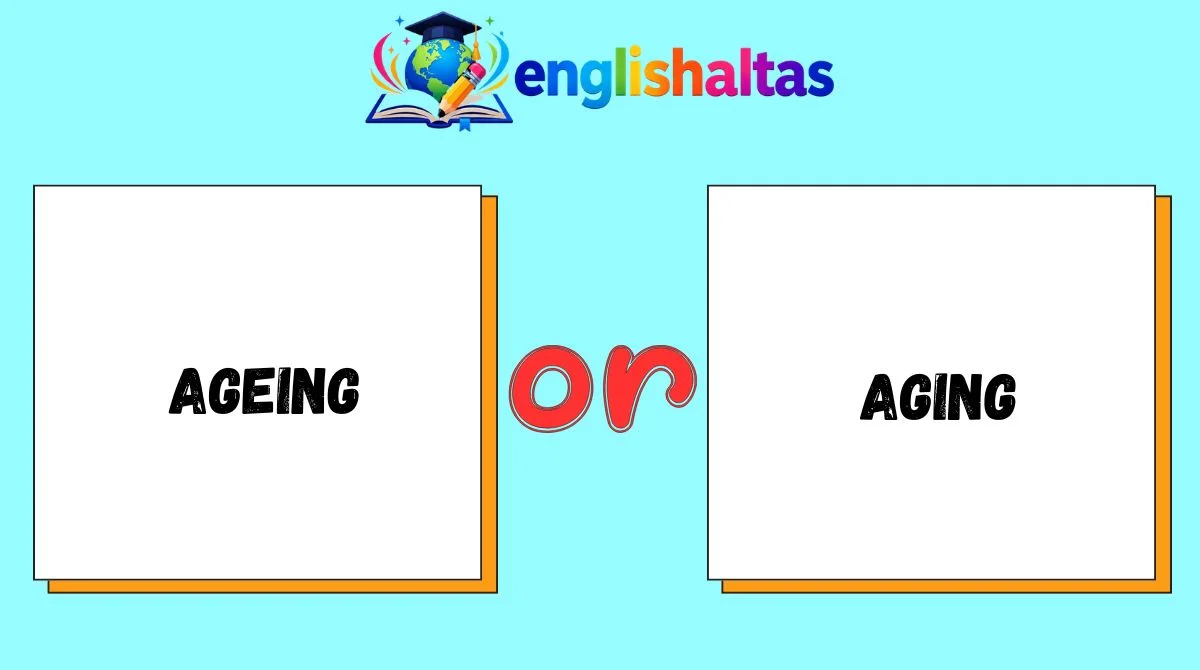
Ageing and aging are two spellings of the same English word, and both are correct.
The difference is mainly connected to British English and American English, not to a difference in meaning.
This can be confusing because English learners often expect one spelling to be correct and the other to be wrong.
You may see ageing in British books, newspapers, websites, and school materials, while aging is much more common in American English.
Both forms describe the natural process of becoming older or something gradually becoming older or less new.
For example:
The population is ageing rapidly.
and
The population is aging rapidly.
Both sentences are grammatically correct. The choice depends largely on the variety of English being used.
There is also an important spelling pattern behind the difference. American English generally prefers aging, dropping the final e before adding -ing.
British English traditionally uses ageing, keeping the e. However, British English also uses aging in some contexts, particularly under American influence and in certain technical or specialized settings.
So, which spelling should you use?
The answer depends on your audience, country, publication style, and consistency.
This guide explains the difference between ageing and aging, shows how each is used, clears up common spelling mistakes, and gives you practical examples for everyday and professional English.
What Does “Ageing” Mean?
Ageing is the traditional British English spelling of the present participle and gerund of the verb age.
The verb age means to become older or to make something older through the passage of time.
For example:
People naturally change as they age.
When we form the -ing form in British English, we commonly write:
age → ageing
The word can describe people, animals, materials, products, buildings, populations, and many other things.
When do we use “ageing”?
Use ageing when writing primarily for a British English audience or when following a style guide that prefers British spelling.
It is particularly common in the United Kingdom and is also widely encountered in other varieties of English influenced by British spelling.
Examples:
- The ageing population is creating new challenges for healthcare systems.
- She is ageing gracefully.
- The building is showing signs of ageing.
- Scientists are studying the ageing process.
- Ageing can affect the strength of some materials.
- The company has an ageing workforce.
- He is concerned about the effects of ageing.
- The ageing infrastructure needs urgent attention.
In each example, ageing refers to the process of becoming older or the effects associated with becoming older.
“Ageing” as a noun
Ageing can also function as a noun when referring to the process of getting older.
For example:
Healthy ageing is an important public concern.
Other examples include:
- The study focuses on healthy ageing.
- Ageing is a natural part of life.
- Researchers are investigating biological ageing.
- The course discusses ageing and nutrition.
In these examples, ageing names a process rather than simply describing an action.
“Ageing” as an adjective
The word can also appear before a noun:
an ageing population
Here, ageing describes a population that is becoming older.
You may also see:
- an ageing actor
- an ageing building
- an ageing workforce
- ageing equipment
- ageing infrastructure
- ageing technology
A common learner confusion
Many learners believe that ageing is always the correct spelling because the base word is age.
That is not quite right.
Ageing is correct, but aging is also correct. The choice largely depends on the variety of English.
A British publication might prefer:
an ageing population
An American publication would normally use:
an aging population
Neither is automatically a spelling error.
What Does “Aging” Mean?
Aging is the standard spelling used in American English for the -ing form of age.
It has exactly the same basic meaning as ageing: becoming older, developing characteristics associated with age, or causing something to become older over time.
For example:
The population is aging rapidly.
This means the same thing as:
The population is ageing rapidly.
The difference is spelling rather than meaning.
When do we use “aging”?
Use aging when following American English spelling conventions.
It is especially common in American newspapers, websites, academic publications, business writing, government materials, and everyday communication.
Examples:
- The aging population needs better access to healthcare.
- She is aging naturally.
- Scientists are studying the aging process.
- The building is showing signs of aging.
- The company has an aging workforce.
- Researchers are investigating healthy aging.
- The aging infrastructure requires investment.
- He is interested in the science of aging.
These sentences are completely standard in American English.
“Aging” as a noun
Just like ageing, aging can refer to the process of becoming older.
For example:
Healthy aging is becoming an important area of research.
You may also encounter:
- healthy aging
- biological aging
- successful aging
- aging research
- aging process
- aging population
“Aging” as an adjective
Aging can describe something that is becoming older:
The city has an aging infrastructure problem.
Other examples include:
- an aging population
- an aging workforce
- an aging building
- aging equipment
- aging technology
A common learner confusion
Some learners think aging is an informal American spelling and ageing is the “proper” spelling.
That is incorrect.
Aging is the standard American spelling. It is not a slang form or a spelling mistake.
Likewise, ageing is not an inferior version of aging. It is the standard traditional spelling in British English.
Difference Between Ageing and Aging
The most important fact is simple:
Ageing and aging have the same meaning.
The main difference is regional spelling preference.
| Feature | Ageing | Aging |
|---|---|---|
| Meaning | Becoming older | Becoming older |
| Main spelling tradition | British English | American English |
| Used as a verb form | Yes | Yes |
| Used as a noun | Yes | Yes |
| Used as an adjective | Yes | Yes |
| Pronunciation | Usually the same | Usually the same |
| Meaning difference | None | None |
| Common in UK English | Yes | Less common |
| Common in US English | Less common | Yes |
British English vs American English
If you are writing for readers in the United Kingdom, ageing is generally the safer choice.
For example:
The UK has an ageing population.
If you are writing for an American audience:
The U.S. has an aging population.
Both sentences communicate the same idea.
The spelling simply matches the preferred variety of English.
Why does the spelling change?
The difference comes from a broader spelling pattern.
When adding -ing to a verb ending in a silent e, English spelling rules often remove the final e:
- make → making
- write → writing
- take → taking
- come → coming
But age has traditionally behaved differently in British spelling:
age → ageing
American English generally follows the shorter form:
age → aging
This gives us the two accepted spellings.
Is one spelling more correct?
No.
It is better to think of them as regional variants.
Writing:
aging
does not make your English incorrect if you are using American English.
Writing:
ageing
does not make your English incorrect if you are using British English.
The important thing is to choose the spelling that fits your intended variety and then use it consistently.
Meaning comparison
Consider these pairs:
The population is ageing.
The population is aging.
Same meaning.
Healthy ageing is important.
Healthy aging is important.
Same meaning.
The ageing workforce needs support.
The aging workforce needs support.
Same meaning.
There is no difference in the underlying concept.
Grammar Rules You Must Remember
Rule #1: Both forms come from the verb “age”
The base verb is:
age
Its -ing form can be written as:
ageing — British English
aging — American English
For example:
The population is ageing.
or:
The population is aging.
Both are grammatically correct.
Rule #2: Match the spelling to your audience
If your website, school, company, or publication follows British English, choose ageing.
The report examines the effects of ageing.
If it follows American English, choose aging.
The report examines the effects of aging.
This is particularly important in professional and SEO writing because inconsistent spelling can make a website appear less carefully edited.
Rule #3: Keep the same spelling throughout a document
Avoid switching randomly between forms.
For example, this looks inconsistent:
The article discusses healthy aging. The ageing population is growing. Researchers are studying the aging process.
Choose one variety and stay with it.
British style:
The article discusses healthy ageing. The ageing population is growing. Researchers are studying the ageing process.
American style:
The article discusses healthy aging. The aging population is growing. Researchers are studying the aging process.
Consistency makes your writing look more professional.
Rule #4: The pronunciation normally does not change
In ordinary English, ageing and aging are pronounced essentially the same.
The difference appears in the written form, not in the basic pronunciation.
This means that learners should focus more on spelling conventions and audience than on trying to hear a major pronunciation difference.
Common Mistakes Students Make
Mistake 1: Thinking “aging” is wrong
A learner may see:
aging population
and assume the writer forgot the e.
That is not necessarily a mistake.
In American English, aging is the standard spelling.
Correct:
Ageing or Aging
American English uses this form naturally.
Mistake 2: Thinking “ageing” is wrong
The opposite mistake is also common.
A student may learn American spelling and then see:
Ageing or Aging
in a British publication.
There is nothing wrong with it.
Correct:
Ageing or Aging
This follows British spelling conventions.
Mistake 3: Mixing British and American spelling
This is one of the most practical problems for writers.
Suppose a website normally uses British spelling:
Ageing or Agingorganise
centre
Ageing or Aging
Suddenly using:
Ageing or Aging
may make the content inconsistent.
The same problem happens in reverse. An American website using:
color
Ageing or Agingcenter
Ageing or Aging
would normally use aging, not ageing.
Easy correction tip
Decide on your English variety before you begin writing.
Ask:
“Who is going to read this?”
If your primary readers are in the UK, use British spelling.
If your primary readers are in the US, use American spelling.
Mistake 4: Assuming SEO requires one spelling to be “correct”
Search optimization does not change the basic grammar.
Both ageing and aging are legitimate English spellings.
For SEO, the better choice depends on the audience and search intent. If your content targets British readers, ageing may be the natural primary spelling. If it targets American readers, aging may be preferable.
The important thing is to write naturally rather than forcing the keyword into every paragraph.
Mistake 5: Confusing “ageing” with “ageing-related” expressions
Writers sometimes change the spelling halfway through related phrases.
For example:
Ageing or Aging
This is not grammatically impossible, but it is inconsistent if both phrases belong to the same variety of English.
Choose:
Ageing or Aging
or:
Ageing or Aging
Easy Trick to Remember the Difference
Here is a simple memory trick:
UK → ageing
US → aging
Think of the extra e as the traditional British spelling:
Ageing or Aging
For American English, remember:
Ageing or Aging
You do not need to memorize two different definitions because there are not two different meanings.
A useful classroom test is to replace the word with “becoming older.”
If the sentence still makes sense, you are dealing with the same basic word:
The population is ageing.
Ageing or Aging
The population is aging.
Ageing or Aging
The only question is which spelling fits your English variety.
A real-life logic test
Imagine you are writing for a British newspaper.
You would naturally choose:
Ageing or Aging
Now imagine writing for an American newspaper:
Ageing or Aging
The meaning has not changed. Only the spelling convention has.
That is the easiest way to remember it.
Daily Life Examples
Seeing the words in ordinary conversations makes the difference much easier to understand.
1. Talking about a family member
A: Your grandfather looks well.
B: He really does. He’s ageing very well.
British English would normally use ageing.
In American English:
B: He’s aging very well.
2. Talking about health
A: What does your research focus on?
B: It focuses on healthy ageing.
American version:
Ageing or Aging
Both mean the same thing.
3. Discussing a population
A: Why is the government changing its retirement policies?
B: The country has an ageing population.
American English:
Ageing or Aging
4. Talking about a building
A: Why does the office need renovation?
B: The building is ageing, and some parts need replacing.
American version:
Ageing or Aging
5. Talking about equipment
A: Why are we buying new computers?
B: Our current equipment is ageing.
American spelling:
Ageing or Aging
6. Discussing a workforce
A: Why are you hiring more young employees?
B: We have an ageing workforce, so we need to plan for the future.
American version:
Ageing or Aging
7. Talking about technology
A: Should we replace this software?
B: Yes. It’s becoming ageing technology.
More naturally, especially in everyday English, you might say:
Ageing or Aging
Or:
Ageing or Aging
The second version sounds especially natural in American English.
8. Discussing research
A: What field are you interested in?
B: I’m interested in ageing research.
American English:
Ageing or Aging
9. Talking about appearance
A: She doesn’t look much older.
B: She seems to be ageing gracefully.
American version:
Ageing or Aging
10. Talking about infrastructure
A: Why does the city need to spend so much money on repairs?
B: Much of its ageing infrastructure needs attention.
American English:
Ageing or Aging
Practice Section
Choose ageing or aging in each sentence.
1.
The country’s ___ population is putting pressure on healthcare services.
2.
She is ___ gracefully.
3.
The report examines healthy ___.
4.
Our company has an ___ workforce.
5.
Scientists are researching the ___ process.
Answers
1. ageing / aging — Both are correct. Choose according to your English variety.
2. ageing / aging — Both are correct.
3. ageing / aging — Both are correct.
4. ageing / aging — Both are correct.
5. ageing / aging — Both are correct.
The exercise has an important lesson: the choice is normally about spelling style, not grammar or meaning.
FAQs
What is the difference between ageing and aging?
Ageing and aging have the same meaning. Both refer to the process of becoming older or developing characteristics associated with age.
The main difference is regional spelling. Ageing is traditionally associated with British English, while aging is the standard spelling in American English.
Is “ageing” British or American?
Ageing is primarily associated with British English and other varieties that follow British spelling conventions.
For example, a British publication may write “an ageing population.” American publications generally prefer “an aging population.”
Is “aging” grammatically correct?
Yes. Aging is grammatically correct and is the standard American English spelling.
It is not an incorrect or shortened version. American English normally writes age → aging when forming the -ing form.
Is “ageing” more correct than “aging”?
No. Neither is universally more correct.
The best spelling depends on the variety of English you are using. Ageing is appropriate for British English, while aging is appropriate for American English.
Should I use ageing or aging for SEO?
Choose the form that matches your target audience and overall spelling style.
If your website primarily targets British readers, ageing is a natural choice. If you target American readers, aging is generally preferable. Avoid switching between the two without a reason.
Can I use both ageing and aging in the same article?
You can, but it is usually better to choose one spelling and remain consistent.
Using both forms randomly can make the article look poorly edited. If you are discussing the difference between British and American English, however, showing both spellings is completely appropriate.
Conclusion
Ageing and aging are both correct spellings of the same word. The main difference is not meaning, pronunciation, or grammar; it is the English variety being used.
Ageing is the traditional spelling associated with British English, while aging is the standard spelling used in American English.
Both can describe people, populations, buildings, technology, materials, and the natural process of becoming older:
The population is ageing.
The population is aging.
The meaning is exactly the same.
For everyday writing, the most useful rule is to match your spelling to your audience.
If you are writing for British readers, ageing is usually the better choice. If you are writing for American readers, use aging.
Most importantly, do not treat one spelling as a mistake simply because you learned the other first. English contains many regional spelling differences, and ageing/aging is a straightforward example.
Once you know the UK-versus-US distinction, choosing the right form becomes simple. Pick one style, use it consistently, and let your audience guide the choice.

Oliver Bennett is an English language educator and content writer passionate about simplifying grammar. He creates clear, practical lessons, writing tips, and learning resources that help readers improve their English with confidence.