Many English learners feel confused when they see compare to and compare with.
Both phrases use the verb compare, and both can look correct in a sentence. So, how do you know which one to use?
This is a very common problem in daily English, school writing, exams, and spoken English.
For example, should you say, “I compare this phone to that phone” or “I compare this phone with that phone”? The answer can depend on the kind of comparison you mean.
The good news is that the difference is not as difficult as it first seems. Compare to often shows that two things are similar in some way.
Compare with usually means you are looking at two or more things carefully to find their similarities and differences.
After reading this guide, you will clearly understand compare to vs compare with, the grammar rules behind them, and the small difference in meaning.
You will also see easy examples from real life, school, and everyday conversations.
One simple idea can help you remember the difference: compare to often connects one thing with another idea, while compare with often puts two things side by side for a detailed look.
What Does “Compare To” Mean?
Compare to means to say that one person or thing is similar to another person or thing.
We often use it when we notice a likeness, connection, or similarity between two things. The comparison may be simple and general.
Simple grammar rule
compare + something/someone + to + something/someone
You can also use:
compare A to B
When do we use “compare to”?
We use compare to when we want to show that two things are alike in a particular way.
A common use is to compare a person or thing with something that gives us a clear picture or idea.
For example:
- The teacher compared the student’s voice to a bird’s song.
The teacher is saying that the voice sounds similar to a bird’s song.
Here are more examples:
- She compared her baby brother to a little monkey.
- The poet compared the moon to a silver ball.
- People often compare this city to New York.
- He compared the new car to a powerful horse.
- The coach compared the young player to a future star.
- My mother compared my smile to my father’s smile.
- The writer compared hope to a light in the dark.
- Some fans compare the singer to a famous pop star.
A common learner confusion
Many students think compare to is only used for poems or creative language. That is not true.
You can use it in normal English too:
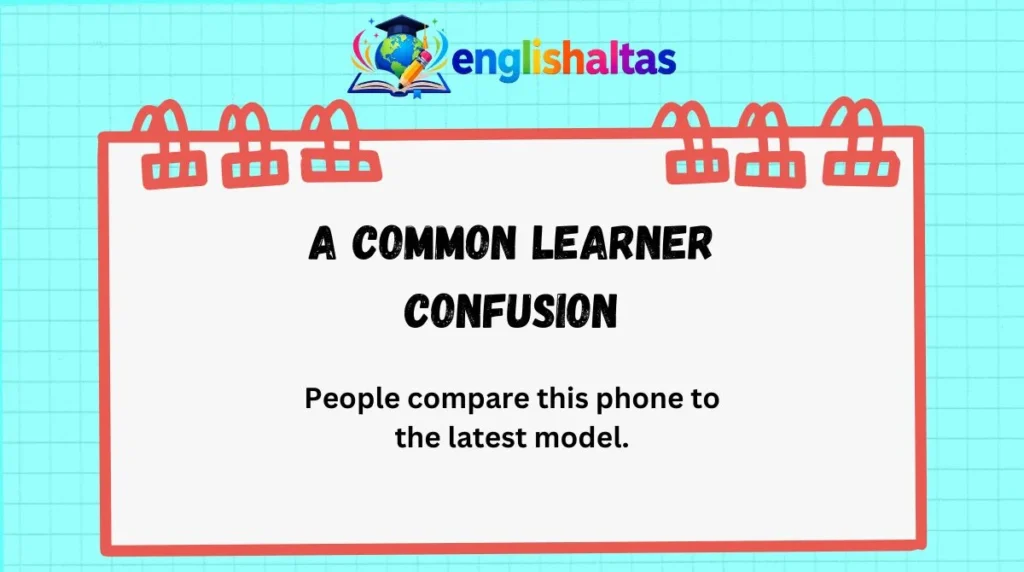
People compare this phone to the latest model.
The speaker is simply pointing out a connection or similarity.
Another common mistake is using compare to when the speaker really wants to examine two things in detail.
For example:
The scientist compared the two medicines with each other.
Here, the scientist is probably checking their differences and similarities carefully. Compare with is a better choice.
Important note
In modern English, the two phrases can sometimes overlap. Native speakers do not always follow a strict rule in every sentence. However, the usual meaning is still helpful:
Compare to = show similarity or make a simple comparison.
What Does “Compare With” Mean?
Compare with means to look at two or more people or things side by side to notice their similarities and differences.
It often suggests a careful or detailed comparison.
Simple grammar rule
compare + something/someone + with + something/someone
You can also use:
compare A with B
When do we use “compare with”?
We use compare with when we want to study or examine two things.
This is common in school work, science, business, reports, and careful discussions.
For example:
Compare this year’s results with last year’s results.
The person wants you to look at both sets of results and see what changed.
Here are more examples:
- Compare this dress with the blue one.
- We compared the two plans with each other.
- The doctor compared the new test results with the old results.
- She compared her answer with mine.
- The teacher asked us to compare the two stories with each other.
- You should compare prices with other shops before buying.
- The company compared this year’s sales with last year’s sales.
- I compared the two phones with each other before choosing one.
A common learner confusion
Some students believe that compare with is always formal. It is not.
You can use it in simple daily English:
Compare this one with that one.
That sentence is completely natural.
Another confusion is the idea that compare with must always be used for things that are exactly alike. This is also wrong.
You can compare different things:
Compare a bicycle with a car.
The two things are different, but you can still look at their similarities and differences.
The main idea
Compare with = examine two things carefully.
If you are asking someone to look at two things and decide which is better, cheaper, faster, or different, compare with is often a good choice.
Difference Between Compare To and Compare With
The difference between compare to vs compare with is mainly about the purpose of the comparison.
Comparison table
| Phrase | Main idea | Common use | Example |
|---|---|---|---|
| Compare to | Show similarity or make a general comparison | Ideas, images, simple similarities | She compared the moon to a lamp. |
| Compare with | Examine two things carefully | Differences and similarities | Compare this phone with that phone. |
1. Usage difference
Compare to is often used when the speaker wants to say:
“This is like that.”
Example:
He compared the child to a little lion.
The focus is on the child’s brave or strong nature.
Compare with is often used when the speaker wants to say:
“Look at these two things and see how they are alike or different.”
Example:
Compare this laptop with the older model.
The speaker may want to check the price, speed, size, and features.
2. Grammar logic
The preposition to often creates a connection between two ideas.
A is compared to B.
The speaker connects A and B because they have something in common.
The preposition with often gives the idea of putting things side by side.
A is compared with B.
The speaker looks at A and B together.
This is a useful grammar idea, but remember that English is flexible. In real English, the phrases sometimes overlap.
3. Sentence structure difference
The basic structure is almost the same:
Subject + compare + A + to + B
Compare To vs Compare With
Examples:
- The poet compared the stars to diamonds.
- The scientist compared the two results with each other.
The only visible grammar difference is the preposition. But that small word can change the focus of the sentence.
4. Meaning comparison
Look at these two sentences:
Compare To vs Compare With
This may mean Ali is similar to his father in appearance, behavior, or personality.
Compare To vs Compare With
This sounds more like people are examining Ali and his father to see how they are alike or different.
The meaning can be very close. The context tells us the exact idea.
A simple way to understand it
Think of a picture.
If you say:
Compare To vs Compare With
You are creating an image. You are saying she is like a rose in some way.
If you say:
Compare To vs Compare With
You are looking at two pictures carefully.
Grammar Rules You Must Remember
Rule #1: Use “compare to” for a clear similarity
When you want to say that one thing is like another, use compare to.
Compare To vs Compare With
The focus is on a shared quality, such as strength or energy.
Rule #2: Use “compare with” for a detailed examination
When you want to look at two things carefully, use compare with.
Compare To vs Compare With
You may be checking both answers for similarities and mistakes.
Rule #3: “Compare with” is common when asking someone to judge two things
This is especially common with prices, products, results, and choices.
Compare the prices with other stores before you buy.
You are asking for a careful comparison.
Rule #4: “Compare to” often creates an image or idea
Writers and speakers often use compare to to make language more interesting.
Compare To vs Compare With
The clouds are not really pillows. The comparison helps us imagine them.
One more useful grammar point
You may also see the passive form:
Compare To vs Compare With
Compare To vs Compare With
Examples:
- The new player is often compared to a famous athlete.
- Compare To vs Compare With
The same basic difference remains.
Common Mistakes Students Make
Many mistakes happen because learners believe to and with are interchangeable in every situation. They are not always the best choice.
Mistake 1: Using “compare to” for a detailed product check
❌ Compare this phone to that phone before buying.
This sentence is not always wrong, but it can sound less precise if you mean a careful feature-by-feature check.
✅ Compare this phone with that phone before buying.
Easy tip: If you are checking price, size, speed, or features, think about compare with.
Mistake 2: Using “compare with” for a creative image
❌ The writer compared the moon with a silver ball.
Again, this may be understood, but compare to is the more natural choice when creating a picture or image.
✅ The writer compared the moon to a silver ball.
Easy tip: If you mean “looks like” or “is like,” use compare to.
Mistake 3: Thinking “compare with” means “compare only two things”
This is a common misunderstanding.
You can compare more than two things:
The teacher compared the three essays with each other.
The important point is the careful examination, not the number of things.
Mistake 4: Thinking “compare to” is only for people
You can compare many things:
- people
- animals
- places
- products
- ideas
- sounds
- colors
Examples:
She compared the noise to thunder.
The city was compared to a giant garden.
Mistake 5: Forgetting the preposition
❌ I compared my answer my friend’s answer.
✅ I compared my answer with my friend’s answer.
The verb compare usually needs a connecting word when you mention the second thing.
A quick correction tip
Ask yourself:
Am I showing a similarity?
➡️ Compare to
Am I checking two things carefully?
➡️ Compare with
This small question can help you choose quickly.
Easy Trick to Remember the Difference
Here is a very simple memory trick:
TO = “This is like that.”
Think of compare to as creating a link.
The baby was compared to an angel.
You are saying:
“The baby is like an angel.”
WITH = “Put them together and check.”
Think of compare with as putting two things with each other.
Compare this answer with my answer.
You are saying:
“Look at both answers and check them.”
Real-life logic
Imagine you are shopping.
You see a new pair of shoes and say:
These shoes are compared to a famous brand.
The focus is on the similarity.
But if you are deciding which shoes to buy, you might say:
I compared these shoes with three other pairs.
Now you are checking the choices.
TO gives you a picture. WITH gives you a side-by-side check.
It is not a perfect rule for every sentence, but it is an excellent trick for beginners.
Daily Life Examples of Compare To and Compare With
Here are some simple examples you may hear or use in everyday English.
1. Talking about a child
A: Your son looks very confident.
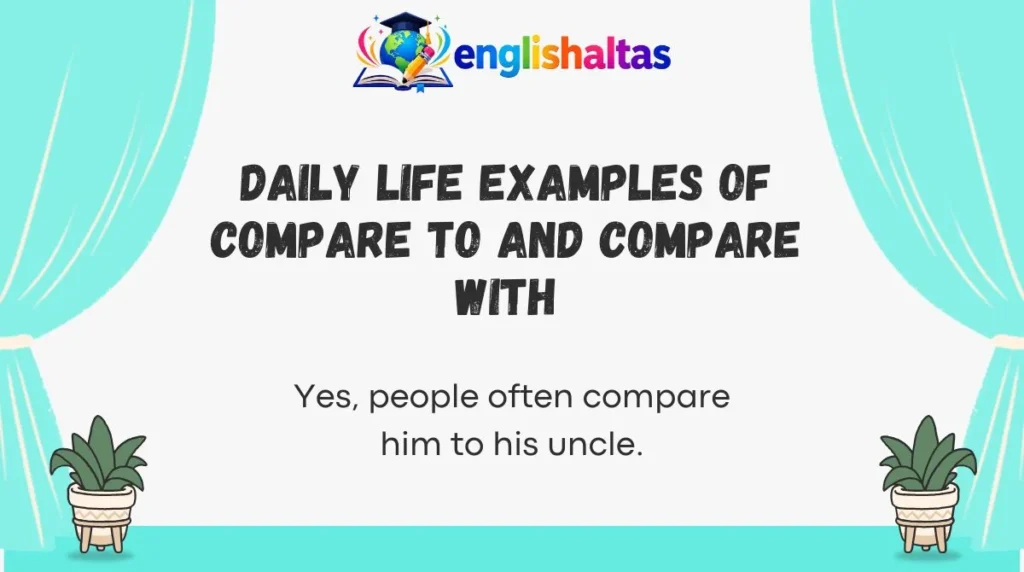
B: Yes, people often compare him to his uncle.
The focus is on a similarity.
2. Choosing a phone
A: Which phone will you buy?
B: I am comparing this phone with the other model first.
The speaker wants to check both phones carefully.
3. Talking about food
This cake is often compared to a famous bakery’s cake.
The focus is on a similar taste or quality.
4. Comparing school results
The principal compared this year’s results with last year’s results.
The principal is checking the two sets of results.
5. Describing a person
The coach compared the young player to a rising star.
The coach is creating a picture of the player’s ability.
6. Shopping for clothes
I compared the black jacket with the brown jacket before choosing one.
The speaker looked at both jackets carefully.
7. Talking about a city
Many visitors compare this city to Paris.
The visitors see a similarity between the two cities.
8. Checking two answers
Compare your answer with your partner’s answer.
The students should look at both answers.
9. Talking about a sound
The singer’s voice was compared to the sound of a bell.
The focus is on the sound being similar.
10. Choosing a service
We compared the prices with three different companies.
The speakers checked several prices before making a choice.
Practice Section: Choose the Correct Option
Choose compare to or compare with.
- The poet compared the moon ___ a bright lamp.
- Please compare this answer ___ the answer in the book.
- Many people compare the city ___ London.
- I compared the two laptops ___ each other.
- The teacher compared the little boy ___ a young hero.
Answers
- to — The poet is creating an image.
- with — You are checking two answers.
- to — The focus is on a general similarity.
- with — The two laptops are being examined carefully.
- to — The boy is being connected to the idea of a hero.
Try making two sentences of your own. Use compare to in one and compare with in the other. Writing your own examples is one of the fastest ways to remember grammar.
FAQs
1. What is the difference between compare to and compare with?
Compare to usually focuses on a similarity or connection between two things. Compare with often means examining two things to find their similarities and differences. In modern English, their meanings can sometimes overlap.
2. Can we use “compare to” in questions?
Yes, you can use compare to in questions.
Who would you compare this singer to?
This question asks which person is similar to the singer in some way.
3. Is “compare with” formal or informal?
Compare with can be both formal and informal. You can use it in school writing, business, and everyday conversation.
Compare these two prices with each other.
4. Is it correct to say “compare to” or “compare with” people?
Both can be correct. Use compare to when you are pointing out a similarity. Use compare with when you are looking at people side by side to examine their similarities and differences.
5. Which is correct: “compare to each other” or “compare with each other”?
Compare with each other is usually the better choice when two or more things are being examined carefully.
The students compared their answers with each other.
6. Are compare to and compare with interchangeable?
Not always. They can have very similar meanings in some sentences, but the focus may change. Compare to often highlights likeness, while compare with often suggests a detailed comparison. Context is important.
Conclusion
The difference between compare to vs compare with is small, but it is useful to understand. Compare to usually shows a similarity or creates a clear picture.
It often means that one person or thing is like another. Compare with usually means looking at two or more things carefully to see their similarities and differences.
Remember the easy trick: TO gives a picture, while WITH gives a side-by-side check.
Do not worry if the two phrases sometimes feel confusing. Even advanced English learners see them used in similar ways.
The best way to improve is to notice the purpose of the comparison. Are you showing a likeness? Think compare to.
Are you checking two things carefully? Think compare with.
Now try making your own sentences. A little practice will make this grammar choice feel much more natural.

Oliver Bennett is an English language educator and content writer passionate about simplifying grammar. He creates clear, practical lessons, writing tips, and learning resources that help readers improve their English with confidence.