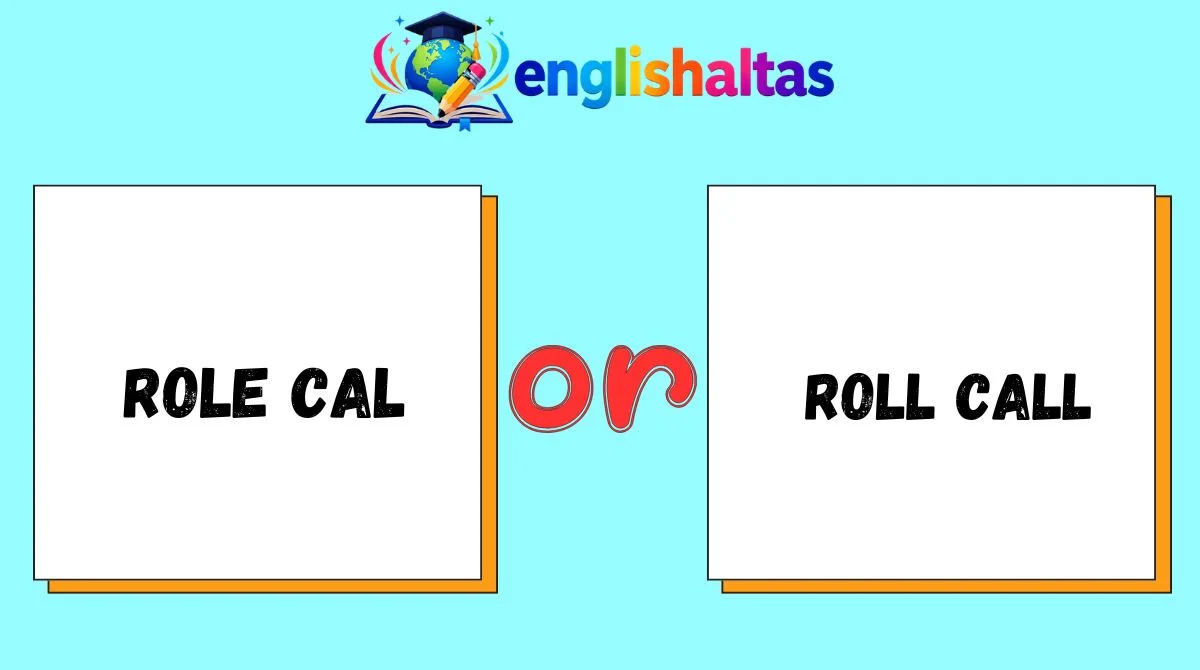
Have you ever written “role call” when you meant “roll call”? If so, you are not alone.
These two expressions sound almost exactly the same when spoken, but they have very different meanings.
That small difference in spelling can be confusing, especially for English learners.
The confusion happens because role and roll are both common English words.
Role usually means a job, function, duty, or part played by someone. Roll, on the other hand, can mean many things, including a list of names.
When we talk about checking who is present, the correct expression is roll call.
A teacher might say, “We are going to take roll call.” A school may have a roll call every morning.
A military officer may also conduct a roll call. The basic idea is simple: someone calls the names on a list to find out who is present.
This distinction is useful far beyond the classroom. You may see roll call in schools, meetings, organizations, official events, and even voting procedures.
By the end of this guide, you will know why “roll call” is correct, why “role call” is usually wrong, how to use both words properly, and how to remember the difference easily.
What Does “Role” Mean?
Role is a noun. It means the job, function, duty, or part that a person or thing has in a particular situation.
It can also mean the character that an actor plays in a movie, television show, or play. Cambridge Dictionary defines role as the position or purpose someone or something has in a situation, organization, society, or relationship. It also uses the word for an actor’s part in a film or play.
Think of role as answering this question:
“What part does this person or thing have?”
For example:
- A teacher has an important role in a student’s education.
- A manager’s role is to guide the team.
- An actor can have a leading role in a movie.
- Parents often have an important role in a child’s life.
When Do We Use “Role”?
We use role when talking about someone’s responsibility, function, position, or part in something.
A common pattern is:
play + a/an + role + in + something
Examples:
- She plays an important role in the school project.
- He played a major role in the team’s success.
- Parents play a key role in children’s learning.
- Technology has an important role in modern education.
- My role in the meeting is to take notes.
- What is your role in this project?
- She accepted the role of team leader.
- He got a leading role in the school play.
Notice something important: role is connected with function or responsibility.
You can be a teacher, captain, leader, actor, helper, or manager. Each position can be described as a role.
Common Learner Confusion About “Role”
Many learners hear role and roll as the same word because they are pronounced alike in many varieties of English.
For example:
- role = a function or part
- roll = a list, movement, or other meaning depending on context
So if you want to say that someone has an important function in a project, use role:
Maria played an important role in the project.
You would not write:
Maria played an important roll in the project.
That spelling changes the word and meaning.
What Does “Roll” Mean?
Roll has several meanings in English. It can be a verb or a noun.
As a verb, roll can mean to move by turning over and over.
For example:
The ball began to roll down the road.
But roll also has an important noun meaning: a list of names of people who belong to a group.
This is the meaning connected to roll call.
Cambridge Dictionary defines roll call as the act of reading names from a list to check whether people are present.
Think of roll in roll call as a list of names.
When Do We Use “Roll”?
We use roll in several different situations.
For example:
- The ball began to roll across the floor.
- The teacher checked the class roll.
- Please add my name to the roll.
- The officer called the roll.
- The students answered during roll call.
- We had roll call before the trip.
- The teacher took roll before starting the lesson.
- Everyone was present when the roll call ended.
The key point is that roll call is connected with a list of names.
When a teacher calls:
“Ali?”
Ali answers:
“Present!”
Then the teacher marks the list. This process is roll call.
Common Learner Confusion About “Roll”
Learners sometimes choose role because they already know that role is a common English word.
For example, they may write:
“The teacher started the role call.”
The intended meaning is usually roll call.
The correct sentence is:
“The teacher started the roll call.”
The word role does not mean a list of students.
Difference Between Role and Roll
The easiest way to understand the difference is to focus on the meaning, not only the pronunciation.
| Word | Main meaning | Common use | Example |
|---|---|---|---|
| role | A function, duty, position, or acting part | job, responsibility, movie, project | She has an important role in the team. |
| roll | A list of names; also movement or other meanings | attendance, list, movement, food | The teacher called the roll. |
| roll call | Calling names from a list to check attendance | school, meetings, military, official groups | The teacher took roll call. |
| role call | Usually an incorrect spelling when attendance is meant | Generally avoid it | Use roll call instead. |
Usage Difference
Role is about a person’s part or function.
His role is to help new students.
Roll can refer to a list of names.
The teacher checked the roll.
Roll call combines this idea of a roll, or list, with the act of calling the names.
The teacher conducted roll call.
Grammar Logic
Both role and roll can be nouns.
But they do not belong in the same situations.
Consider these:
She has a major role in the company.
Here, role means function or position.
Now:
The teacher called the roll.
Here, roll refers to the list of people.
And:
The teacher took roll call.
Here, roll call means the process of calling the names to check attendance.
Sentence Structure Difference
Common structures with role include:
- play a role in something
- have a role in something
- take on a role
- fulfill a role
- accept a role
- a leading role
- an important role
Examples:
He plays a major role in the project.
Common structures with roll include:
- call the roll
- take the roll
- check the roll
- be on the roll
- roll call
Examples:
The teacher called the roll.
Everyone was present for roll call.
Meaning Comparison
A simple question can help:
Are you talking about someone’s job or function?
Use role.
Are you talking about a list of names or checking attendance?
Use roll.
That one question solves most of the confusion.
Grammar Rules You Must Remember
Rule #1: Use “role” for a function or responsibility
When someone has a particular job, purpose, or function, use role.
She plays an important role in the organization.
The coach has a leadership role.
Technology has a useful role in education.
A role tells us what part someone or something has.
Rule #2: Use “roll call” for checking attendance
When names are called to find out who is present, use roll call.
The teacher took roll call at the beginning of class.
We had roll call before leaving school.
The officer conducted roll call in the morning.
This is the most important rule for this topic.
Attendance = roll call.
Rule #3: Do not spell attendance “role call”
If you mean checking who is present, the standard spelling is:
roll call
Not:
role call
For example:
❌ The teacher started role call.
✅ The teacher started roll call.
The reason is simple: the expression comes from the idea of a roll, meaning a list of names.
Rule #4: “Role” and “roll” can both be correct in different sentences
Neither word is generally “the correct word” all the time.
The meaning decides the spelling.
She got a leading role in the play.
The teacher checked the roll.
Both sentences are correct.
The first talks about an acting part.
The second talks about a list.
Common Mistakes Students Make
English learners often make this mistake because role and roll sound alike.
Mistake 1: Writing “role call”
❌ We had role call at 9 a.m.
✅ We had roll call at 9 a.m.
Why? The sentence is about checking attendance, so roll call is needed.
Mistake 2: Using “roll” when talking about someone’s responsibility
❌ My roll in the project is to organize the files.
✅ My role in the project is to organize the files.
Correction tip: Ask yourself, “Am I talking about a person’s job or function?”
If yes, use role.
Mistake 3: Confusing “roll” with “role” in movies
❌ She got a leading roll in the movie.
✅ She got a leading role in the movie.
An actor has a role, not a roll.
Mistake 4: Thinking “role call” means calling people’s roles
This is a logical guess, but it is not the normal expression.
A student might think:
Role Call or Roll Call
But the expression is based on a roll, meaning a list of names.
So remember:
Names on a list → roll → roll call.
Mistake 5: Thinking pronunciation will help
In many accents, role and roll sound the same or nearly the same.
That means listening alone may not solve the problem.
When writing, focus on the meaning.
Function = role
Role Call or Roll Call
Easy Trick to Remember the Difference

Here is a simple classroom trick:
Role = Responsibility
Both ideas start with R, but you can connect role with responsibility.
Think:
Role Call or Roll Call
For example:
My role is to help the students.
Roll = Roster
A roster is a list of people.
Both roll and roster are connected with a list of names.
Think:
Role Call or Roll Call
Then:
Role Call or Roll Call
This makes roll call much easier to remember.
The One-Line Memory Trick
Role is what you do. Roll is the list. Roll call checks who is there.
That is enough to remember the difference in everyday English.
Daily Life Examples
Here are some natural examples you might hear at school, work, meetings, or other group activities.
Example 1: Classroom
Teacher: “Good morning, everyone. I’m going to take roll call.”
This means the teacher will call the students’ names.
Example 2: Student
“Sorry I’m late. Has the teacher taken roll call yet?”
The student wants to know whether attendance has already been recorded.
Example 3: School Trip
Role Call or Roll Call
The teacher checked that everyone was present before the trip began.
Example 4: Team Meeting
Role Call or Roll Call
This means the organizer will check who is present.
Example 5: Talking About a Job
Role Call or Roll Call
Here, role means responsibility.
Example 6: Talking About a Movie
Role Call or Roll Call
Here, role means the character or part played by the actor.
Example 7: Talking About a Project
“Everyone has a different role in the project.”
Each person has a different responsibility.
Example 8: Attendance
Role Call or Roll Call
This is a direct reference to attendance.
Example 9: Leadership
Role Call or Roll Call
Again, role means function or responsibility.
Example 10: School Morning
Role Call or Roll Call
The teachers need to record which students are present.
Practice Section
Answers
1. roll — The correct expression is roll call.
2. role — Here, the word means responsibility or function.
3. role — An actor plays a role in a movie.
4. roll — A class roll can be a list of students.
5. role — The question asks about someone’s responsibility or function.
Quick Test
If you can replace the word with “responsibility”, choose role.
Role Call or Roll Call
If you can connect the word with a list of names, choose roll.
Role Call or Roll Call
FAQs
What is the difference between role and roll?
Role means a function, responsibility, position, or acting part. Roll has several meanings, including a list of names. In roll call, it means calling names from a list to check who is present.
Is it role call or roll call?
The standard expression for checking attendance is roll call. Role call is usually a spelling mistake when the writer means attendance. The expression refers to calling the names on a roll or list.
Can “role” be used in a question?
Yes. You can use role in questions about someone’s responsibility or function.
For example:
Role Call or Roll Call
Here, role asks about the person’s job or part in the project.
Is “roll call” formal or informal?
Roll call can be used in both everyday and formal English. It is common in schools and organizations, and it can also be used in official settings. It is a normal noun phrase rather than slang.
Can I say “take roll” instead of “roll call”?
Yes, particularly in American English, take roll or take the roll can refer to checking attendance. Take attendance is another very common expression.
For learners, roll call is especially useful to recognize because it appears frequently in writing and speech.
Why do role and roll sound the same?
In many varieties of English, role and roll are pronounced alike or very similarly. This makes them homophones for many speakers. Their meanings and spellings are different, so context is important when writing them.
Conclusion
The difference between role call and roll call is small in spelling but important in meaning.
When you are talking about checking attendance or calling the names of people on a list, the correct expression is roll call.
When you are talking about someone’s job, responsibility, function, position, or acting part, use role.
A simple memory trick can make this easy:
Role = responsibility.
Roll = list.
Therefore:
Roll + call = calling the names on a list.
You may hear these words and not notice any difference in pronunciation. That is perfectly normal. The important thing is to choose the spelling based on the meaning.
Try using the words in your own sentences. For example, write one sentence about your role in a school or group activity and another sentence using roll call.
A little practice will make the difference feel natural.
English has many pairs of words that sound alike but have different meanings. Once you learn to connect each spelling with its meaning, these confusing pairs become much easier.

Oliver Bennett is an English language educator and content writer passionate about simplifying grammar. He creates clear, practical lessons, writing tips, and learning resources that help readers improve their English with confidence.