Change block type or style
Move Heading block from position 40 up to position 39
Move Heading block from position 40 down to position 41
Change alignment
Change text alignment
Displays more block tools
e
Therefor or therefore? These two words look almost the same, so it is easy to think they have the same meaning.
Many English learners see therefor and assume it is simply a shorter spelling of therefore. That is not correct.
The difference is small in spelling, but important in meaning. Therefore is a common English word. It means “for that reason,” “as a result,” or “because of that.”
We use it when we want to show a result or conclusion.
Therefor, on the other hand, is a much less common word. It means “for that” or “for that thing.”
It is mostly found in older, legal, or very formal writing. In everyday English, you will rarely need it.
This can be confusing because both words begin with there and contain the letters for.
However, the extra e in therefore is not just a spelling detail. It helps identify a different word with a different grammatical use.
Knowing the difference can help you avoid spelling mistakes in school assignments, emails, essays, reports, and everyday writing.
It can also help you understand unusual words when you meet them in legal or historical documents.
By the end of this guide, you will know what therefor means, what therefore means, when to use each word, why they are different, and how to remember the correct spelling easily.
What Does “Therefor” Mean?
Therefor is a real English word, but it is uncommon in modern everyday English.
It means “for that,” “for that thing,” or “in return for that.” The word is generally used when that refers to something already mentioned.
For example:
The company provided the service and received payment therefor.
Here, therefor means “for that service.”
In simple modern English, we would usually rewrite the sentence:
The company provided the service and received payment for it.
This makes the meaning much clearer for most readers.
When should you use “therefor”?
You may see therefor in:
- Legal documents
- Contracts
- Old-fashioned writing
- Very formal documents
- Historical texts
- Specialized legal language
It is not normally used in casual conversation.
For example:
The buyer shall pay the full amount therefor.
This means:
The buyer shall pay the full amount for it.
The word therefor refers back to something that has already been discussed.
Grammar rule for “therefor”
Therefor is normally an adverb meaning “for that.” It should not be confused with therefore, which expresses a result.
Consider this example:
The seller delivered the goods and received payment therefor.
The meaning is:
The seller delivered the goods and received payment for the goods.
Here, therefor does not mean as a result. It refers to something.
Examples of “therefor”
- The customer accepted the product and paid the price therefor.
- The tenant signed the agreement and received a copy thereof and paid the required fee therefor.
- The company supplied the materials and received compensation therefor.
- The employee performed the required work and received payment therefor.
- The buyer agreed to purchase the property and paid the amount required therefor.
- The service was provided, and the customer received an invoice therefor.
- The contractor completed the work and requested payment therefor.
- The parties agreed to the terms and accepted the responsibilities arising therefrom.
Some of these examples sound unusual to modern English speakers. That is actually an important point: therefor is correct in certain contexts, but it is not a normal replacement for therefore.
A common learner confusion
A learner might write:
I was tired, therefor I went home.
This is incorrect.
The intended meaning is “for that reason”, so the correct word is:
I was tired; therefore, I went home.
Do not use therefor when you mean “as a result.”
A useful test is to replace the word with “for that reason.” If the sentence still makes sense, you probably need therefore, not therefor.
What Does “Therefore” Mean?
Therefore is a common English adverb that means “for that reason,” “as a result,” “consequently,” or “because of that.”
We use it to connect an action, fact, or situation with its result.
For example:
It was raining heavily; therefore, we stayed inside.
The first part gives the reason:
It was raining heavily.
The second part gives the result:
We stayed inside.
So therefore means:
For that reason, we stayed inside.
When should you use “therefore”?
Use therefore when you want to show that one statement leads logically to another.
It is common in:
- Academic writing
- School essays
- Reports
- Business writing
- Formal speech
- Explanations
- Everyday writing
It can sound a little more formal than so, but it is still a normal and widely understood word.
For example:
The shop was closed, so we went home.
You could also write:
The shop was closed; therefore, we went home.
The second version sounds more formal.
Grammar rule for “therefore”
Therefore is an adverb. It does not normally join two complete sentences with only a comma.
For example:
The weather was bad, therefore we canceled the trip.
This is commonly seen, but in careful formal writing, the comma alone is not the best punctuation.
Better choices include:
The weather was bad; therefore, we canceled the trip.
Or:
The weather was bad. Therefore, we canceled the trip.
Or:
The weather was bad, and therefore we canceled the trip.
Examples of “therefore”
- The road was flooded; therefore, we took another route.
- She studied hard; therefore, she passed the exam.
- The store was closed. Therefore, we came back later.
- He forgot his umbrella; therefore, he got wet.
- The computer was not working, and therefore we could not finish the task.
- The evidence was weak; therefore, the decision was delayed.
- The child was tired; therefore, his parents took him home.
- The price had increased; therefore, we decided to wait.
In each sentence, therefore introduces or connects a result.
A common learner confusion
Many learners think therefore means simply “because.”
That is not quite right.
Compare:
I stayed home because I was sick.
Here, because introduces the reason.
Now compare:
I was sick; therefore, I stayed home.
Here, therefore introduces the result.
So remember:
because → reason
therefore → result
Difference Between Therefor and Therefore
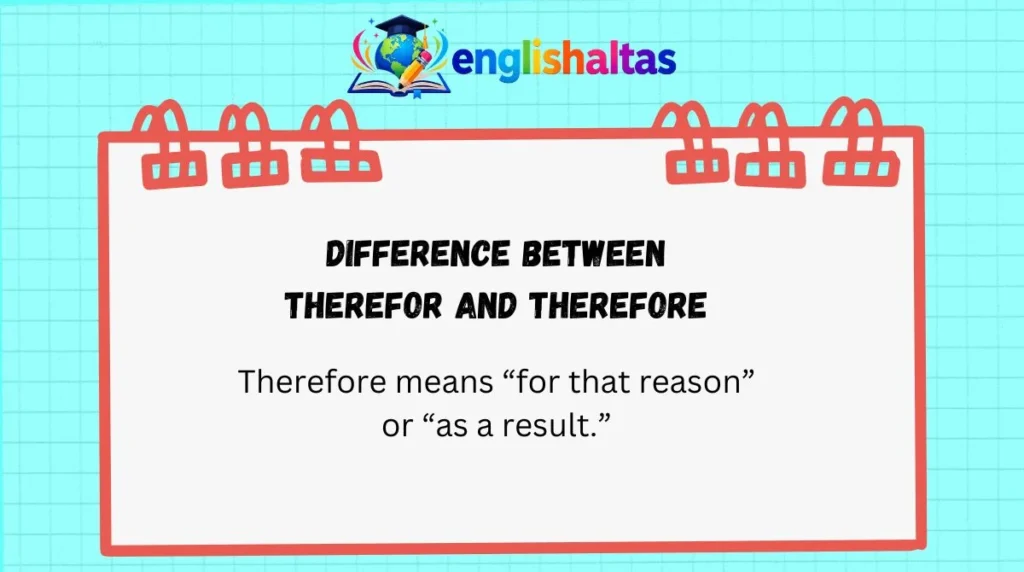
The easiest way to understand these words is to focus on their meanings rather than their spelling.
Therefor means “for that.”
Therefore means “for that reason” or “as a result.”
The difference is only one letter, but the grammatical meaning changes completely.
Comparison Table
| Word | Meaning | Main use | Common today? | Example |
|---|---|---|---|---|
| therefor | for that; for that thing | Refers to something previously mentioned | Rare | Payment was made therefor. |
| therefore | for that reason; as a result | Shows a result or conclusion | Very common | It was late; therefore, we left. |
Usage difference
Look at these two sentences:
The company provided the equipment and received payment therefor.
Here, therefor means for the equipment.
Now:
The company provided the equipment; therefore, it received payment.
Here, therefore means as a result.
The words do completely different jobs.
Grammar logic
Think about the relationship between the words around them.
With therefor, you can often replace the word with:
for that
For example:
Payment was made therefor.
becomes:
Payment was made for that.
With therefore, you can often replace it with:
for that reason
For example:
The road was unsafe; therefore, we turned back.
becomes:
The road was unsafe; for that reason, we turned back.
This replacement test is one of the best ways to choose the correct word.
Sentence structure
Therefor usually connects to something that has already been mentioned.
Pattern:
action or thing + payment/reward/compensation + therefor
Example:
The work was completed, and payment was made therefor.
Meaning:
Payment was made for the work.
Therefore usually connects a reason with its result.
Pattern:
reason + therefore + result
Example:
The work was completed; therefore, the project was approved.
Meaning:
The project was approved because of that / as a result.
Meaning comparison
Consider this pair:
He completed the work and received payment therefor.
Meaning:
He received payment for the work.
Now:
He completed the work; therefore, he received payment.
Meaning:
Receiving payment happened as a result of completing the work.
The first word points back to a thing.
The second word points from a reason to a result.
Grammar Rules You Must Remember
Rule #1: Use “therefore” for a result
When you mean “as a result” or “for that reason,” use therefore.
Correct:
She was sick; therefore, she stayed home.
Incorrect:
She was sick; therefor, she stayed home.
A simple check is to ask:
“Does this word mean ‘as a result’?”
If yes, use therefore.
Rule #2: Use “therefor” to mean “for that”
Therefor refers to something that has already been mentioned.
Example:
The company completed the service and received payment therefor.
This means:
The company received payment for that service.
The word is uncommon, so in normal modern English, for it is often a clearer choice.
Rule #3: Do not use “therefor” as a spelling shortcut for “therefore”
This is one of the most common mistakes.
Some learners remember the pronunciation or general appearance of therefore but accidentally leave out the final e.
Wrong:
It was raining; therefor, we stayed home.
Correct:
It was raining; therefore, we stayed home.
The missing e changes the word.
Rule #4: Be careful with punctuation after “therefore”
When therefore connects two complete thoughts, a semicolon or full stop is often appropriate.
Correct:
The bus was late; therefore, I missed the meeting.
Also correct:
The bus was late. Therefore, I missed the meeting.
You can also use it inside a sentence:
The bus was late, and therefore I missed the meeting.
Avoid joining two complete sentences with only a comma:
The bus was late, therefore I missed the meeting.
For informal writing, people often write this way, but careful formal writing benefits from stronger punctuation.
Common Mistakes Students Make
Mistake 1: Writing “therefor” when they mean “therefore”
Wrong:
I forgot my keys, therefor I could not enter.
Correct:
I forgot my keys; therefore, I could not enter.
Why does the mistake happen?
The two words look nearly identical. Learners often remember the beginning of the word but forget the final e.
Correction tip:
When the meaning is “as a result,” always spell it therefore.
Mistake 2: Thinking “therefor” is always incorrect
This is the opposite mistake.
Therefor is a real word. It is just uncommon in modern everyday English.
For example:
The buyer paid the amount therefor.
This can be grammatically correct in a formal or legal context.
However, most people would naturally say:
The buyer paid the amount for it.
So do not think therefor is always a spelling mistake. It has a genuine meaning.
Mistake 3: Confusing “therefore” with “because”
Look at these examples:
I stayed home because I was tired.
The word because introduces the reason.
I was tired; therefore, I stayed home.
The word therefore introduces the result.
A quick way to remember this is:
Because asks “Why?”
Therefore shows “What happened as a result?”
Mistake 4: Using “therefore” when you mean “for that”
Consider:
The customer received a bill therefor.
If you mean “for that service,” therefor may be the intended word.
If you write:
The customer received a bill therefore.
you are changing the grammatical meaning.
When the meaning is “for that thing,” think therefor.
When the meaning is “for that reason,” think therefore.
Easy Trick to Remember the Difference

Here is a very simple memory trick:
THEREFOR = FOR THAT
Break the word into:
there + for
Think:
therefor = for that
Example:
Payment was made therefor.
Ask:
Payment was made for what?
Answer:
For that.
THEREFORE = FOR THAT REASON
Think of the final E as helping you remember the longer idea:
therefore = for that reason
Example:
It was raining; therefore, we stayed inside.
Ask:
Why did we stay inside?
Answer:
For that reason.
So the easiest memory rule is:
Therefor = for that.
Therefore = for that reason.
If you remember only this, you will avoid most mistakes.
Daily Life Examples
Although therefor is rare in everyday speech, therefore is useful in many normal situations.
1. Talking about the weather
It is very cold today; therefore, I am wearing a jacket.
Meaning:
Therefor or Therefore?
2. Talking about school
Therefor or Therefore?
The studying is the reason, and confidence is the result.
3. Talking about work
Therefor or Therefore?
The manager’s busy schedule caused the speaker to choose another action.
4. Talking about travel
Therefor or Therefore?
The blocked road was the reason for changing the route.
5. Talking about shopping
Therefor or Therefore?
The high price caused the decision.
6. Talking about health habits
Therefor or Therefore?
The tiredness led to the action.
7. Talking about technology
Therefor or Therefore?
The dead battery caused the problem.
8. Talking about plans
Therefor or Therefore?
The forecast is the reason for changing the plan.
9. A formal example with “therefor”
Therefor or Therefore?
Here, therefor means for the completed work.
In everyday English, a more natural version would be:
Therefor or Therefore?
10. Another formal example
Therefor or Therefore?
Again, therefor means for the goods.
A modern, simple version would be:
Therefor or Therefore?
These examples show why therefor can sound strange to modern readers even when it is grammatically correct.
Practice Section
Choose therefor or therefore in each sentence.
1.
The weather was terrible; ________, the game was canceled.
2.
The company provided the service and received payment ________.
3.
I forgot my wallet; ________, I could not buy lunch.
4.
The buyer accepted the goods and paid the amount required ________.
5.
She worked hard; ________, she achieved her goal.
Answers
1. therefore
Therefor or Therefore?
The word means “as a result.”
2. therefor
Therefor or Therefore?
The word means “for that service.”
3. therefore
Therefor or Therefore?
The second action is the result of the first situation.
4. therefor
Therefor or Therefore?
The payment was for the goods.
5. therefore
Therefor or Therefore?
The word introduces a result.
FAQs
What is the difference between “therefor” and “therefore”?
Therefor means “for that” and is mostly used in legal, formal, or old-fashioned writing. Therefore means “for that reason” or “as a result.”
Therefore is much more common in modern English.
Can “therefor” mean “therefore”?
No. They are different words with different meanings.
Use therefore when you mean “as a result”. Use therefor when you mean “for that” and the context calls for this uncommon formal expression.
Is “therefor” grammatically correct?
Yes. Therefor is a legitimate English word. However, it is rare in modern everyday English.
You are more likely to see it in legal documents, contracts, or older forms of writing. In normal conversation, for it is usually clearer.
Is “therefore” formal or informal?
Therefore is somewhat formal, but it is completely normal and widely used.
In casual conversation, people often use so instead:
Therefor or Therefore?
In formal writing, you might write:
Therefor or Therefore?
Both express a result.
Can we use “therefore” at the beginning of a sentence?
Yes.
For example:
Therefor or Therefore?
This is a common and grammatically acceptable use.
It can also appear in the middle of a sentence:
Therefor or Therefore?
Can we use “therefor” in everyday conversation?
You technically can, but it will sound unusual to most speakers.
For example:
Therefor or Therefore?
This is grammatically possible, but most people would naturally say:
Therefor or Therefore?
Therefor is mainly useful when reading or writing formal, legal, or older texts.
Conclusion
The difference between therefor and therefore is small in spelling but large in meaning.
Therefore is the word you will use most often. It means “for that reason,” “as a result,” or “consequently.” It connects a reason with a result.
Therefor or Therefore?
Therefor is a real word, but it is much less common. It means “for that” and usually refers to something already mentioned.
Therefor or Therefore?
For most modern writing, you probably will not need therefor. If you see it in a contract or legal document, remember that it does not mean therefore. It usually means “for that thing.”
The easiest rule is:
Therefor = for that.
Therefore = for that reason.
Once you learn this simple difference, choosing the correct word becomes much easier. When you want to show a result, write therefore. When a rare formal expression means “for that,” therefor may be correct.
A little practice with real sentences will make the difference natural, especially when writing essays, emails, reports, and other English texts.

Oliver Bennett is an English language educator and content writer passionate about simplifying grammar. He creates clear, practical lessons, writing tips, and learning resources that help readers improve their English with confidence.