Many English learners get confused when they see phrases like “inherent in” and “inherent to.”
Both seem correct because native speakers use both in books, articles, and everyday conversations.
This often makes students wonder if they have the same meaning or if one is more correct than the other.
The confusion becomes even bigger because different dictionaries, teachers, and style guides may give slightly different advice.
Some writers almost always use inherent in, while others sometimes choose inherent to.
If you are learning English as a second language, it is easy to feel unsure about which phrase to use.
The good news is that the difference is not difficult once you understand the idea behind each expression.
Knowing the right preposition can make your English sound more natural and more accurate. It also helps you write better essays, emails, reports, and conversations.
Whether you are preparing for an English exam, improving your writing, or simply trying to speak more confidently, understanding these expressions is a useful grammar skill.
By the end of this guide, you will know what “inherent” means, why people say “inherent in” or “inherent to,” when each one is used, and which choice is more common in modern English.
You will also see plenty of simple examples that make the difference easy to remember.
What Does “Inherent” Mean?
The word inherent is an adjective. It describes a quality, feature, or characteristic that is a natural and permanent part of someone or something. It is not added from the outside. Instead, it already belongs to the person, object, idea, or situation.
Simple Definition
Inherent means existing as a natural part of something.
It describes qualities that cannot easily be separated from the thing they belong to.
Easy Examples
- Kindness is inherent in her personality.
- Risk is inherent in every business.
- Curiosity is inherent in young children.
- Beauty is not inherent in expensive things.
- Change is inherent in life.
- Trust is inherent in a healthy friendship.
- Competition is inherent in sports.
- Creativity is inherent in many artists.
In each sentence, the quality naturally belongs to the subject. It is not something added later.
When Do We Use “Inherent”?
We use inherent when we want to describe something that naturally exists inside another thing.
It often appears in discussions about:
- Human nature
- Science
- Business
- Law
- Education
- Technology
- Relationships
- Philosophy
- Everyday life
Examples
- There are inherent risks in mountain climbing.
- Every language has inherent rules.
- The plan has inherent weaknesses.
- Leadership requires inherent confidence.
- There are inherent challenges in learning a new language.
- The machine has an inherent design flaw.
- Every investment carries inherent uncertainty.
- Teamwork has inherent benefits.
Notice that inherent usually comes before a noun.
Examples:
- inherent risk
- inherent value
- inherent quality
- inherent ability
- inherent problem
- inherent strength
- inherent weakness
- inherent characteristic
Grammar Rule for “Inherent”
Inherent is an adjective, not a verb.
It cannot stand alone as an action word.
It is commonly followed by a prepositional phrase, especially:
- inherent in
- inherent to
Examples:
- Patience is inherent in good teaching.
- Risk is inherent in driving.
- Curiosity is inherent to human nature.
- Change is inherent to growth.
Although both patterns are grammatically acceptable, one is much more common in modern English. You will learn the difference later in this guide.
Sentence Patterns
Pattern 1
Something + is + inherent + in + something
Examples:
- Danger is inherent in fire.
- Trust is inherent in friendship.
- Risk is inherent in business.
- Emotion is inherent in music.
Pattern 2
Something + is + inherent + to + something
Examples:
- Freedom is inherent to democracy.
- Curiosity is inherent to childhood.
- Responsibility is inherent to leadership.
- Creativity is inherent to art.
This pattern is less common than inherent in, but it still appears in formal writing and speech.
Words Commonly Used with “Inherent”
Native speakers often pair inherent with certain nouns.
Here are some common combinations:
- inherent risk
- inherent danger
- inherent quality
- inherent value
- inherent nature
- inherent ability
- inherent strength
- inherent weakness
- inherent limitation
- inherent problem
- inherent characteristic
- inherent uncertainty
- inherent challenge
- inherent feature
- inherent right
Learning these word pairs helps your English sound much more natural.
More Example Sentences
Here are additional examples showing how inherent is used in everyday English.
- Every job has inherent challenges.
- Risk is inherent in investing money.
- Respect should be inherent in every relationship.
- Curiosity is inherent in children.
- There is an inherent beauty in nature.
- Every new business faces inherent uncertainty.
- Patience is an inherent quality of a good teacher.
- Some materials have inherent strength that makes them useful.
Common Learner Confusion About “Inherent”
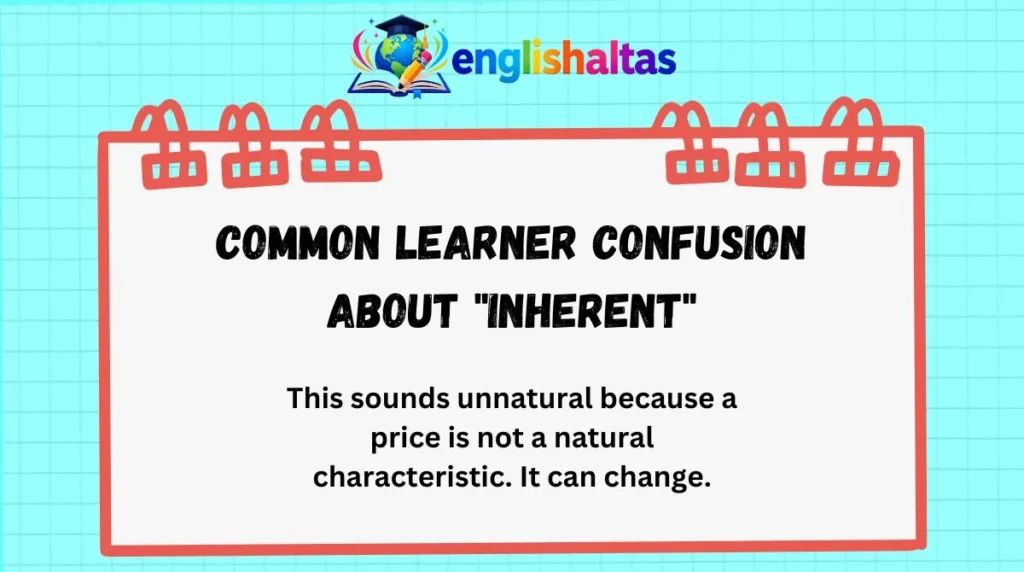
Many learners believe inherent simply means important or necessary.
That is not correct.
Look at these examples.
❌ The phone has an inherent price.
This sounds unnatural because a price is not a natural characteristic. It can change.
✅ The phone has inherent limitations.
The limitations are part of the phone’s design.
Another mistake is using inherent to describe temporary situations.
❌ She has an inherent cold today.
A cold is temporary.
✅ She has an inherent talent for music.
Talent is viewed as a natural quality.
Remember this simple idea:
If something naturally belongs to a person, object, or idea, “inherent” is often the right word.
If it can easily change or be removed, inherent is usually not the best choice.
What Does “Inherent in” Mean?
The phrase inherent in means that a quality, feature, risk, or characteristic exists naturally inside something or as a natural part of it.
Among English speakers, inherent in is the most common and widely accepted expression. You will find it in newspapers, books, academic writing, business reports, legal documents, and everyday English.
Think of the word in as meaning inside or within. When we say something is inherent in something else, we mean that it is already inside it and cannot easily be separated.
Simple Definition
Inherent in = naturally existing within something.
When Do We Use “Inherent in”?
Use inherent in when talking about a quality or feature that naturally belongs to a person, thing, process, idea, or situation.
Examples
- Risk is inherent in every investment.
- Honesty is inherent in true friendship.
- Mistakes are inherent in the learning process.
- Competition is inherent in sports.
- Change is inherent in life.
- Creativity is inherent in human thinking.
- Responsibility is inherent in leadership.
- Uncertainty is inherent in scientific research.
Notice that each quality is a natural part of the thing being discussed rather than something added later.
Grammar Pattern
Subject + be + inherent in + noun
Examples:
- Patience is inherent in good teaching.
- Beauty is inherent in nature.
- Trust is inherent in strong relationships.
- Discipline is inherent in military training.
This structure is the one you will see most often in both British and American English.
Why Is “Inherent in” So Common?
The preposition in naturally suggests that something exists inside, within, or as part of something else. Since inherent already means “existing as a natural part,” the two words fit together naturally.
For this reason, many grammar experts and dictionaries list inherent in as the standard and preferred expression.
Difference Between Inherent in and Inherent to (Detailed)
Now that you know what inherent means and why inherent in is so common, it’s time to compare it with inherent to.
The short answer is simple:
- Both “inherent in” and “inherent to” are grammatically correct.
- Inherent in is far more common in modern English.
- Inherent to is usually found in formal, academic, legal, and technical writing.
Most English learners can safely use inherent in in almost every situation.
Comparison Table
| Feature | Inherent in | Inherent to |
|---|---|---|
| Grammar | Correct | Correct |
| Common in everyday English | ✅ Very common | Less common |
| Formal writing | ✅ Yes | ✅ Yes |
| Academic writing | ✅ Very common | Common |
| Sounds natural in conversation | ✅ Yes | Sometimes |
| Meaning | Naturally exists within something | Naturally belongs to something |
| Best choice for learners | ✅ Yes | Use in formal contexts |
Meaning Difference
Although both expressions share the same basic idea, there is a very small difference in emphasis.
Inherent in
This expression focuses on something existing inside or as part of another thing.
Think of it as saying:
“It is already within it.”
Examples:
- Risk is inherent in driving.
- Change is inherent in life.
- Honesty is inherent in good leadership.
- Competition is inherent in sports.
Here, the quality exists within the activity or idea.
Inherent to
This expression emphasizes that something belongs naturally to another thing.
Think of it as saying:
“It naturally belongs to it.”
Examples:
- Freedom is inherent to democracy.
- Responsibility is inherent to leadership.
- Curiosity is inherent to childhood.
- Creativity is inherent to artistic work.
The meaning is almost the same, but to highlights a natural connection rather than something existing inside.
Which One Do Native Speakers Use More?
If you search modern books, newspapers, websites, and magazines, you’ll notice something interesting.
Inherent in appears much more often than inherent to.
Examples you may hear:
- There are risks inherent in the job.
- Stress is inherent in modern life.
- Error is inherent in human judgment.
- Uncertainty is inherent in research.
While these are also possible:
- Risk is inherent to the profession.
- Discipline is inherent to military life.
The first style is simply more common.
Sentence Structure Difference
Pattern 1
Subject + be + inherent in + noun
Examples
- Danger is inherent in fire.
- Success is inherent in hard work.
- Trust is inherent in friendship.
- Patience is inherent in teaching.
Pattern 2
Subject + be + inherent to + noun
Examples
- Courage is inherent to leadership.
- Freedom is inherent to democracy.
- Responsibility is inherent to parenthood.
- Curiosity is inherent to learning.
Both structures are grammatically correct.
Which Should You Choose?
For everyday English, school writing, emails, and conversations, choose:
✅ Inherent in
It sounds more natural and is accepted almost everywhere.
Use inherent to mainly when reading or writing formal texts.
If you’re unsure, “inherent in” is the safer choice.
Grammar Rules You Must Remember
Learning a few simple grammar rules will help you avoid mistakes.
Rule #1: “Inherent” Is an Adjective
Inherent describes a noun.
It is not a verb.
Correct:
- Risk is inherent in business.
- Patience is inherent in good teachers.
Incorrect:
- The problem inherented yesterday.
- She inherents kindness.
Rule #2: Use “Be” Before “Inherent”
You normally use a form of be before inherent.
Examples:
- is inherent
- are inherent
- was inherent
- were inherent
- has been inherent
Correct:
- Trust is inherent in friendship.
- These risks are inherent in the system.
- The weakness was inherent in the design.
Incorrect:
- Risk inherent in business.
- Trust inherent friendship.
Rule #3: Follow It with “In” or “To”
After inherent, we usually use a preposition.
Most often:
- inherent in
- inherent to
Correct:
- Danger is inherent in mountain climbing.
- Responsibility is inherent to leadership.
Incorrect:
- Danger is inherent for climbing.
- Honesty is inherent with friendship.
Rule #4: Use It for Natural Qualities
Inherent describes something that naturally belongs to a person, object, idea, or situation.
Correct:
- Creativity is inherent in children.
- Risk is inherent in investing.
Incorrect:
- My shirt is inherent today.
- The weather is inherent this week.
These sentences sound unnatural because inherent does not describe temporary conditions.
Common Mistakes Students Make
Many learners understand the word inherent, but they use it incorrectly.
Let’s look at the most common mistakes.
Mistake 1: Using the Wrong Preposition
Wrong:
❌ Risk is inherent with driving.
Correct:
✅ Risk is inherent in driving.
Wrong:
❌ Honesty is inherent for friendship.
Correct:
✅ Honesty is inherent in friendship.
Easy Tip
After inherent, think of in first.
Mistake 2: Using It for Temporary Things
Wrong:
❌ She has an inherent headache.
A headache comes and goes.
Correct:
✅ She has an inherent musical talent.
Talent is a natural quality.
Mistake 3: Thinking It Means “Important”
Some learners confuse inherent with essential or important.
Wrong idea:
Inherent = very important
Correct idea:
Inherent = naturally part of something
Example:
- Risk is inherent in business.
This does not mean risk is important.
It means risk naturally exists in business.
Mistake 4: Using It Without a Clear Connection
Wrong:
❌ The chair is inherent.
This sentence feels incomplete.
Correct:
✅ Comfort is inherent in this chair’s design.
Now the natural relationship is clear.
Mistake 5: Overusing “Inherent to”
Some students use inherent to everywhere because they think it sounds smarter.
Example:
- Risk is inherent to driving.
- Error is inherent to learning.
- Competition is inherent to sports.
These are correct.
However, native speakers usually say:
- Risk is inherent in driving.
- Error is inherent in learning.
- Competition is inherent in sports.
Using inherent in more often will make your English sound more natural.
Quick Correction Chart
| Wrong | Correct |
|---|---|
| inherent with | inherent in |
| inherent for | inherent in |
| inherent by | inherent in |
| inherent of | inherent in |
| inherent as | inherent in |
Tips to Avoid Mistakes
- Remember that inherent describes a natural quality.
- Use is, are, was, or were before it.
- Choose inherent in for most situations.
- Use inherent to mainly in formal writing.
- Ask yourself, “Is this quality naturally part of the thing I’m describing?” If the answer is yes, inherent is probably the right word.
Difference Between Inherent in and Inherent to (Detailed)
Now that you know what inherent means and why inherent in is so common, it’s time to compare it with inherent to.
The short answer is simple:
- Both “inherent in” and “inherent to” are grammatically correct.
- Inherent in is far more common in modern English.
- Inherent to is usually found in formal, academic, legal, and technical writing.
Most English learners can safely use inherent in in almost every situation.
Comparison Table
| Feature | Inherent in | Inherent to |
|---|---|---|
| Grammar | Correct | Correct |
| Common in everyday English | ✅ Very common | Less common |
| Formal writing | ✅ Yes | ✅ Yes |
| Academic writing | ✅ Very common | Common |
| Sounds natural in conversation | ✅ Yes | Sometimes |
| Meaning | Naturally exists within something | Naturally belongs to something |
| Best choice for learners | ✅ Yes | Use in formal contexts |
Meaning Difference
Although both expressions share the same basic idea, there is a very small difference in emphasis.
Inherent in
This expression focuses on something existing inside or as part of another thing.
Think of it as saying:
“It is already within it.”
Examples:
- Risk is inherent in driving.
- Change is inherent in life.
- Honesty is inherent in good leadership.
- Competition is inherent in sports.
Here, the quality exists within the activity or idea.
Inherent to
This expression emphasizes that something belongs naturally to another thing.
Think of it as saying:
“It naturally belongs to it.”
Examples:
- Freedom is inherent to democracy.
- Responsibility is inherent to leadership.
- Curiosity is inherent to childhood.
- Creativity is inherent to artistic work.
The meaning is almost the same, but to highlights a natural connection rather than something existing inside.
Which One Do Native Speakers Use More?
If you search modern books, newspapers, websites, and magazines, you’ll notice something interesting.
Inherent in appears much more often than inherent to.
Examples you may hear:
- There are risks inherent in the job.
- Stress is inherent in modern life.
- Error is inherent in human judgment.
- Uncertainty is inherent in research.
While these are also possible:
- Risk is inherent to the profession.
- Discipline is inherent to military life.
The first style is simply more common.
Sentence Structure Difference
Pattern 1
Subject + be + inherent in + noun
Examples
- Danger is inherent in fire.
- Success is inherent in hard work.
- Trust is inherent in friendship.
- Patience is inherent in teaching.
Pattern 2
Subject + be + inherent to + noun
Examples
- Courage is inherent to leadership.
- Freedom is inherent to democracy.
- Responsibility is inherent to parenthood.
- Curiosity is inherent to learning.
Both structures are grammatically correct.
Which Should You Choose?
For everyday English, school writing, emails, and conversations, choose:
✅ Inherent in
It sounds more natural and is accepted almost everywhere.
Use inherent to mainly when reading or writing formal texts.
If you’re unsure, “inherent in” is the safer choice.
Grammar Rules You Must Remember
Learning a few simple grammar rules will help you avoid mistakes.
Rule #1: “Inherent” Is an Adjective
Inherent describes a noun.
It is not a verb.
Correct:
- Risk is inherent in business.
- Patience is inherent in good teachers.
Incorrect:
- The problem inherented yesterday.
- She inherents kindness.
Rule #2: Use “Be” Before “Inherent”
You normally use a form of be before inherent.
Examples:
- is inherent
- are inherent
- was inherent
- were inherent
- has been inherent
Correct:
- Trust is inherent in friendship.
- These risks are inherent in the system.
- The weakness was inherent in the design.
Incorrect:
- Risk inherent in business.
- Trust inherent friendship.
Rule #3: Follow It with “In” or “To”
After inherent, we usually use a preposition.
Most often:
- inherent in
- inherent to
Correct:
- Danger is inherent in mountain climbing.
- Responsibility is inherent to leadership.
Incorrect:
- Inherent in or Inherent to
- Inherent in or Inherent to
Rule #4: Use It for Natural Qualities
Inherent describes something that naturally belongs to a person, object, idea, or situation.
Correct:
- Inherent in or Inherent to
- Inherent in or Inherent to
Incorrect:
- Inherent in or Inherent to
- Inherent in or Inherent to
These sentences sound unnatural because inherent does not describe temporary conditions.
Common Mistakes Students Make
Many learners understand the word inherent, but they use it incorrectly.
Let’s look at the most common mistakes.
Mistake
Wrong:
Inherent in or Inherent to
Correct:
Inherent in or Inherent to
Wrong:
Inherent in or Inherent to
Correct:
Inherent in or Inherent to
Easy Tip
After inherent, think of in first.
Mistake 2: Using It for Temporary Things
Wrong:
Inherent in or Inherent to
A headache comes and goes.
Correct:
Inherent in or Inherent to
Talent is a natural quality.
Mistake 3: Thinking It Means “Important”
Some learners confuse inherent with essential or important.
Wrong idea:
Inherent in or Inherent to
Correct idea:
Inherent in or Inherent to
Example:
- Inherent in or Inherent to
This does not mean risk is important.
It means risk naturally exists in business.
Mistake 4: Using It Without a Clear Connection
Wrong:
Inherent in or Inherent to
This sentence feels incomplete.
Correct:
Inherent in or Inherent to
Now the natural relationship is clear.
Mistake 5: Overusing “Inherent to”
Some students use inherent to everywhere because they think it sounds smarter.
Example:
- Inherent in or Inherent to
- Error is inherent to learning.
- Inherent in or Inherent to
These are correct.
However, native speakers usually say:
- Inherent in or Inherent to
- Error is inherent in learning.
- Inherent in or Inherent to
Using inherent in more often will make your English sound more natural.
Quick Correction Chart
| Wrong | Correct |
|---|---|
| inherent with | inherent in |
| inherent for | inherent in |
| inherent by | inherent in |
| inherent of | inherent in |
| inherent as | inherent in |
Tips to Avoid Mistakes
- Remember that inherent describes a natural quality.
- Use is, are, was, or were before it.
- Choose inherent in for most situations.
- Use inherent to mainly in formal writing.
- Ask yourself, “Is this quality naturally part of the thing I’m describing?” If the answer is yes, inherent is probably the right word.
End of Part 2.
P 3
Easy Trick to Remember the Difference
Many students remember grammar rules for a day or two, but then forget them. A simple memory trick can help you choose the right phrase every time.
Memory Trick #1: Think About the Meaning of “In”
The word in means inside or within.
If a quality exists naturally inside something, use inherent in.
Examples:
- Risk is inherent in driving.
- Trust is inherent in friendship.
- Change is inherent in life.
Imagine that the quality lives inside the thing. This picture makes the phrase easy to remember.
Memory Trick #2: Think About the Meaning of “To”
The word to often shows a connection or relationship.
When something naturally belongs to another thing, you may see inherent to.
Examples:
- Responsibility is inherent to leadership.
- Freedom is inherent to democracy.
- Curiosity is inherent to childhood.
Even so, remember that inherent in is still the more common choice in everyday English.
The One-Sentence Rule
If you can remember only one rule, remember this:
Use “inherent in” for most situations. Use “inherent to” mainly in formal or technical writing.
That one sentence will help you in school, at work, and in daily conversations.
Daily Life Examples
These examples show how native speakers use these expressions in everyday situations.
Conversation 1
A: Is investing always safe?
B: No. Risk is inherent in investing.
Conversation 2
A: Why do children ask so many questions?
B: Curiosity is inherent in children.
Conversation 3
A: Why is teamwork sometimes difficult?
B: Because different opinions are inherent in working with people.
Conversation 4
A: Does every job have problems?
B: Yes. Challenges are inherent in every profession.
Conversation 5
A: Why do leaders make difficult decisions?
B: Responsibility is inherent to leadership.
Conversation 6
Teacher: Making mistakes is inherent in learning a new language.
Conversation 7
Coach: Competition is inherent in sports, but respect is important too.
Conversation 8
Parent: Patience is inherent in good parenting.
Conversation 9
Manager: Some uncertainty is inherent in every new project.
Conversation 10
Doctor: Small risks are inherent in many medical treatments.
Practice Section
Choose the correct answer.
1.
Risk is inherent ___ driving.
A. in
B. with
C. for
Answer: A. in
2.
Curiosity is inherent ___ childhood.
A. to
B. with
C. from
Answer: A. to
3.
Every business has challenges inherent ___ its work.
A. in
B. on
C. over
Answer: A. in
4.
Responsibility is inherent ___ leadership.
A. to
B. by
C. over
Answer: A. to
5.
Which sentence sounds more natural in everyday English?
A. Risk is inherent to driving.
B. Risk is inherent in driving.
Answer: B. Risk is inherent in driving.
FAQs
1. What is the difference between inherent in and inherent to?
Both expressions are grammatically correct and have very similar meanings. Inherent in is the more common choice in modern English because it emphasizes that something exists naturally within another thing. Inherent to is often used in formal, academic, or technical writing to show a natural connection.
2. Which expression is more common in everyday English?
Inherent in is much more common in everyday speech and writing. It appears frequently in books, newspapers, websites, classrooms, and conversations. If you are unsure which one to use, inherent in is usually the safest and most natural choice.
3. Can I use inherent to instead of inherent in?
Yes. In many sentences, you can use either expression without changing the meaning very much. However, inherent in sounds more natural in most situations, while inherent to may sound slightly more formal.
4. Is inherent an adjective or a verb?
Inherent is an adjective. It describes a natural quality or characteristic. It is never used as a verb.
Example:
- Honesty is inherent in trust.
5. Can inherent in be used in questions?
Yes. It works naturally in questions.
Examples:
- Is risk inherent in this job?
- What challenges are inherent in learning English?
- Is creativity inherent in every child?
These questions are common and grammatically correct.
6. How can I remember which one to use?
Think about the meaning of in. If the quality exists naturally inside something, choose inherent in. Since this is also the most common expression, it is the easiest one to remember for everyday English.
Conclusion
The expressions inherent in and inherent to are both correct, but they are not used equally often.
In modern English, inherent in is the preferred choice because it clearly shows that a quality, feature, or characteristic naturally exists within something.
It sounds natural in conversations, school assignments, business writing, and everyday communication.
Inherent to is also correct and is often found in formal, legal, academic, or technical writing.
It highlights a natural relationship between two ideas, but many native speakers still choose inherent in in ordinary situations.
Whenever you use the word inherent, ask yourself one simple question: Is this quality a natural part of the person, thing, or idea? If the answer is yes, inherent is probably the right word.
The best way to master these expressions is through regular practice.
Read English articles, listen to native speakers, and try writing your own sentences. The more you use them, the more natural they will become.

Oliver Bennett is an English language educator and content writer passionate about simplifying grammar. He creates clear, practical lessons, writing tips, and learning resources that help readers improve their English with confidence.