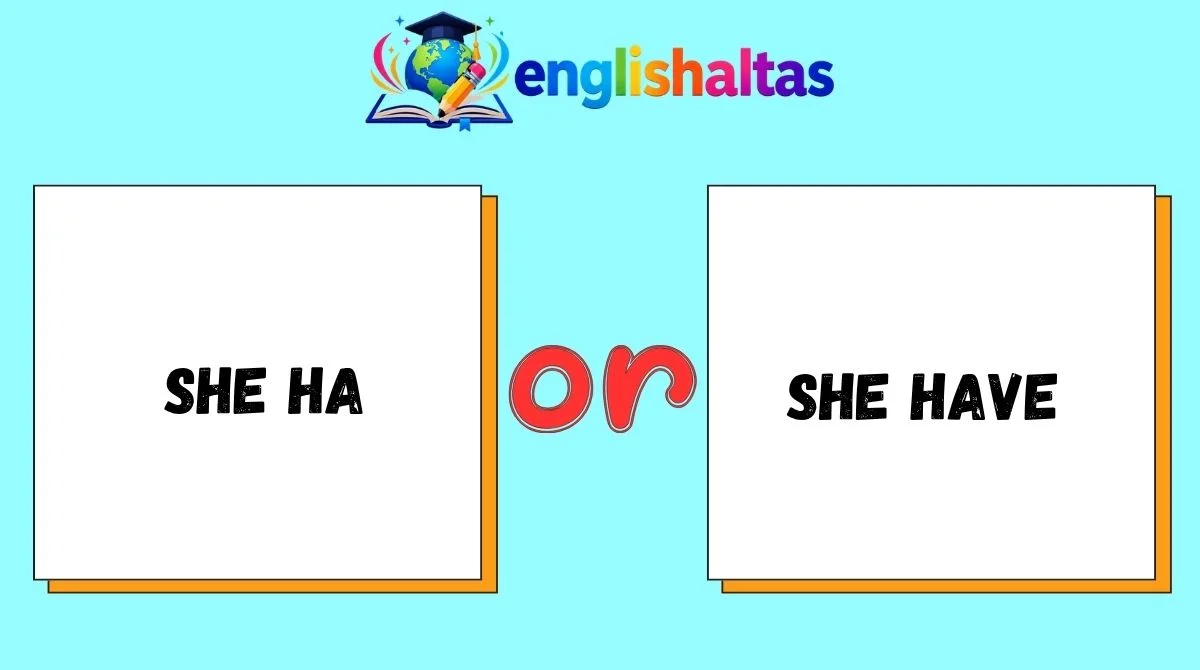
“She has” and “she have” look very similar, so many English learners wonder which one is correct.
If you have ever stopped while writing a sentence and thought, “Should I say she has or she have?”, you are not alone.
This is a very common grammar problem, especially for beginners and non-native English speakers.
The good news is that the basic rule is simple. With the subject she, we normally use has, not have, when have is the main verb in the present simple tense.
For example:
- She has a new phone. ✅
- She have a new phone. ❌
The confusion often happens because have is the basic form of the verb, while has is its special form for he, she, and it. English uses different verb forms depending on the subject.
Understanding this small rule can make your everyday English much more natural. You will see it in conversations, emails, schoolwork, questions, descriptions, and many other situations.
By the end, you will know exactly when to use she has, when have can appear with she, why questions use a different structure, and how to avoid the most common mistakes.
What Does “She Has” Mean?
She has is the correct form when she is the subject and have is being used as the main verb in the present tense.
The word has can show possession, relationships, experiences, conditions, events, or other situations.
For example:
- She has a beautiful house.
- She has two brothers.
- She has a new job.
- She has a headache.
- She has a lot of homework.
- She has breakfast at 8 a.m.
- She has a meeting today.
- She has a good idea.
In these sentences, has tells us that something belongs to her, happens to her, or is connected with her.
The basic grammar rule
The present simple form of have changes when the subject is he, she, or it.
We usually say:
- I have
- You have
- We have
- They have
- He has
- She has
- It has
So the easiest rule is:
Use “has” with he, she, and it in affirmative present-simple sentences.
Consider these examples:
- She has a blue bag.
- She has three children.
- She has a new computer.
- She has enough money.
- She has a cold.
- She has a lot of work today.
- She has lunch at noon.
- She has a difficult exam tomorrow.
All of these sentences are correct because she requires has when have is functioning as the main verb in a normal affirmative present-simple sentence.
Why does “has” change from “have”?
English has several irregular verb forms. Have is one of them.
We do not say:
She haves a car.
That is incorrect.
The correct form is:
She has a car.
The word has is simply the third-person singular present form of have.
This is similar to other common verbs:
- She works.
- She likes music.
- She plays tennis.
- She has a car.
The verb changes because she is third-person singular.
A common learner confusion
Many learners know that the basic verb is have, so they use it after every subject.
They may write:
She have a dog.
But the subject she requires the form has in this type of sentence.
A useful comparison is:
I have a dog.
She has a dog.
The meaning is almost the same, but the verb changes because the subject changes.
What Does “She Have” Mean?
By itself, “she have” is generally not correct in a normal affirmative present-simple sentence.
For example:
She have a car. ❌
The correct sentence is:
She has a car. ✅
However, this does not mean that the words she and have can never appear together.
There are important situations where she + have is correct. The difference is that another word, usually an auxiliary verb, changes the grammar structure.
For example:
Does she have a car? ✅
Here, does is the helping verb. Because does carries the present-tense agreement, the main verb stays in its base form:
Does + she + have
We do not say:
Does she has a car? ❌
The same idea appears with modal verbs:
She may have a problem.
She might have enough money.
She should have more time.
She will have a meeting tomorrow.
After modal verbs such as may, might, should, can, could, will, and would, we use the base form have, not has.
So “she have” is not always wrong. It is wrong when it is used as a simple affirmative present-tense verb without a helping verb or another structure that requires the base form.
Examples where “she have” is incorrect
- She have a car. ❌
- She have two sisters. ❌
- She have a new job. ❌
- She have enough time. ❌
- She have lunch at school. ❌
- She have a headache. ❌
- She have many friends. ❌
- She have a beautiful voice. ❌
Correct them to:
- She has a car.
- She has two sisters.
- She has a new job.
- She has enough time.
- She has lunch at school.
- She has a headache.
- She has many friends.
- She has a beautiful voice.
Examples where “she have” is correct
Now look at these:
- Does she have a car?
- Does she have any brothers?
- Can she have some water?
- Will she have enough time?
- Should she have another chance?
- She may have a problem.
- She might have the answer.
- She could have a better opportunity.
These sentences are correct because the grammar structure requires the base verb have.
Difference Between She Has and She Have
The most important difference is not really between two independent choices. Instead, the correct form depends on the sentence structure.
| Structure | Correct Form | Example |
|---|---|---|
| Simple affirmative | she has | She has a car. |
| Present simple question | does she have | Does she have a car? |
| Present simple negative | she does not have | She does not have a car. |
| With a modal | she + modal + have | She may have a car. |
| Future with will | she will have | She will have a car. |
| Perfect tense | she has had | She has had this car for years. |
1. Affirmative sentences use “she has”
When have is the main verb in a simple present affirmative sentence, use has.
Structure:
She + has + object
Examples:
She has a new laptop.
She has two sisters.
She has a meeting.
2. Questions use “does she have”
When we make a simple present question, we normally use does.
Does + she + have + object?
Examples:
Does she have a car?
Does she have any money?
Does she have a passport?
Notice that we use have, not has, after does.
Why?
Because does already carries the third-person singular form.
Compare:
She has a car.
with:
Does she have a car?
The word does takes the special grammar job, so the main verb returns to its base form.
3. Negative sentences use “does not have”
The same rule applies to negative sentences.
Correct:
She does not have a car.
Incorrect:
She does not has a car. ❌
After does not, use have.
The short form is:
She doesn’t have a car.
This is very common in everyday spoken English.
4. Meaning does not usually change
The basic meaning of have and has is the same. The form changes because of grammar.
Compare:
I have a phone.
She has a phone.
Both sentences describe possession. The subject is different, so the verb form is different.
Grammar Rules You Must Remember
Rule #1: Use “has” with she in a simple present affirmative sentence
When she is the subject and have is the main verb, use has.
Example:
She has a beautiful dress.
Not:
She have a beautiful dress. ❌
This is the first rule to remember.
Rule #2: Use “have” after does
When does appears in a present-simple question or negative structure, use the base verb have.
Examples:
Does she have a car?
She does not have a car.
She doesn’t have a car.
Do not add -s to the main verb after does.
Incorrect:
Does she has a car? ❌
Correct:
Does she have a car? ✅
Rule #3: Use “have” after modal verbs
Modal verbs are followed by the base form of the verb.
Common examples include:
can, could, may, might, should, will, would, must
Examples:
She can have some cake.
She might have a cold.
She should have more rest.
She will have a meeting.
She could have a better chance.
Notice that we do not say:
She can has some cake. ❌
The modal verb is followed by have.
Rule #4: “Has” can also be a helping verb
Has is not always the main verb. It can also be used as an auxiliary verb in the present perfect tense.
For example:
She has finished her homework.
Here, has helps form the present perfect tense.
Another example:
She has already left.
The structure is:
She + has + past participle
Examples:
- She has finished.
- She has eaten.
- She has gone.
- She has arrived.
- She has seen the movie.
This is another important reason why has is common with she.
Common Mistakes Students Make
Mistake 1: “She have a car.”
This happens because learners remember have as the main dictionary form.
❌ She have a car.
✅ She has a car.
Easy tip: If the sentence starts with she and is a simple present affirmative sentence, think has.
Mistake 2: “Does she has a car?”
This mistake is extremely common.
❌ Does she has a car?
✅ Does she have a car?
The reason is simple: does has already taken the third-person singular form.
Think of it this way:
Does + she + have
Not:
Does + she + has
Mistake 3: “She doesn’t has money.”
Again, the helping verb doesn’t controls the grammar.
❌ She doesn’t has money.
✅ She doesn’t have money.
The correct pattern is:
She doesn’t + base verb
So:
- She doesn’t have
- She doesn’t like
- She doesn’t want
- She doesn’t know
- She doesn’t need
Mistake 4: “She can has it.”
After can, use the base form.
❌ She can has it.
✅ She can have it.
The same rule works with other modal verbs:
She should have it.
She might have it.
She will have it.
Mistake 5: Thinking “she have” is never possible
This is the opposite mistake.
It is true that she have is incorrect as a normal simple present affirmative sentence.
But these are correct:
Does she have a pen?
She might have a pen.
She will have a pen.
So do not simply memorize “she have = always wrong.” Learn the sentence structure.
Easy Trick to Remember the Difference
Here is a very simple memory trick:
She → has
Does she → have
Think of two boxes:
Box 1: She is doing the verb herself
She has a car.
Box 2: A helping verb comes first
Does she have a car?
When does, can, may, might, should, will, could, or another helping/modal verb comes before the main verb, the main verb usually stays in its basic form.
So remember:
She has.
But:
Does she have?
And:
She doesn’t have.
This small pattern will help you avoid many mistakes.
Another useful trick is to compare she with I:
I have a book.
She has a book.
Then turn it into a question:
Do I have a book?
Does she have a book?
Notice what happens. Have returns in the question.
Daily Life Examples
Here are some natural examples you might hear or use in everyday English.
1. Talking about a phone
Ali: Does Sara have a new phone?
Ahmed: Yes, she has a new phone.
The question uses have after does, while the answer uses has.
2. Talking about work
She has a lot of work today.
This is a normal present-simple statement.
3. Asking about family
She Has or She Have
The correct question is does she have, not does she has.
4. Talking about illness
She Has or She Have
Here, has is the main verb.
5. Talking about ability or permission
She Has or She Have
After can, use have.
6. Talking about the future
She Has or She Have
After will, use the base form have.
7. Talking about possibility
She Has or She Have
After might, we use have.
8. Talking about a daily routine
She Has or She Have
Here, has is correct because this is a simple present affirmative sentence.
9. Talking about something she does not own
She Has or She Have
Notice that doesn’t is followed by have.
10. Talking about a completed action
She Has or She Have
Here, has is a helping verb used with finished.
These examples show why it is better to learn the complete pattern instead of memorizing only one word.
Practice Section
Choose the correct option in each sentence.
1. She ___ a new bicycle.
a) have
b) has
2. Does she ___ a passport?
a) have
b) has
3. She doesn’t ___ enough time.
a) have
b) has
4. She might ___ a question.
a) have
b) has
5. She ___ two younger sisters.
a) have
b) has
Answers
1. b) has
She has a new bicycle.
2. a) have
Does she have a passport?
3. a) have
She doesn’t have enough time.
4. a) have
She might have a question.
5. b) has
She has two younger sisters.
The key is to look for a helping or modal verb. If there is no such verb and the sentence is a normal present-simple affirmative sentence, she has is usually the correct choice.
FAQs
What is the difference between “she has” and “she have”?
She has is used in normal affirmative present-simple sentences.
For example:
She Has or She Have
She have is not correct in this basic structure. However, have can be used after helping or modal verbs, as in Does she have a car?
Can we use “she have” in a question?
Yes, but usually as part of a structure with does.
Correct:
She Has or She Have
Incorrect:
She Has or She Have
The helping verb does is followed by the base form have.
Is “she has” formal or informal?
She has is neither especially formal nor informal. It is the normal grammatical form used in both spoken and written English.
For example, you can say:
She Has or She Have
in casual conversation or in formal writing.
Why do we say “she has” but “they have”?
Because she is third-person singular, while they is plural.
Compare:
She Has or She Have
She Has or She Have
The verb have changes to has with he, she, and it in simple present affirmative sentences.
Is “she doesn’t have” correct?
Yes. She doesn’t have is completely correct.
For example:
She Has or She Have
The word doesn’t already contains the third-person singular form, so the main verb remains have.
Do not say:
She Has or She Have
Should I say “she has” or “she have”?
In a normal affirmative sentence, use she has.
For example:
She Has or She Have
Use have when the sentence structure requires the base form,
Conclusion
The choice between “she has” and “she have” becomes much easier once you understand the basic grammar pattern.
In a normal present-simple affirmative sentence, use has with she:
She Has or She Have
She Has or She Have
She Has or She Have
But when a helping or modal verb comes before the main verb, use the base form have:
She Has or She Have
She Has or She Have
She Has or She Have
She Has or She Have
The most useful pattern to remember is:
She has.
Does she have?
She doesn’t have.
Once this pattern becomes familiar, you will naturally choose the right form while speaking and writing. Try making a few sentences about people you know.
Say them as statements, then change them into questions and negative sentences. A little daily practice is enough to make this grammar rule feel automatic.

Oliver Bennett is an English language educator and content writer passionate about simplifying grammar. He creates clear, practical lessons, writing tips, and learning resources that help readers improve their English with confidence.