Last updated on November 7th, 2026 at 07:08 am
Defence vs defense is a common spelling question for English learners. You may see defence in a British English book and defense on an American website.
At first, the two words look different enough to make you wonder if they have different meanings.
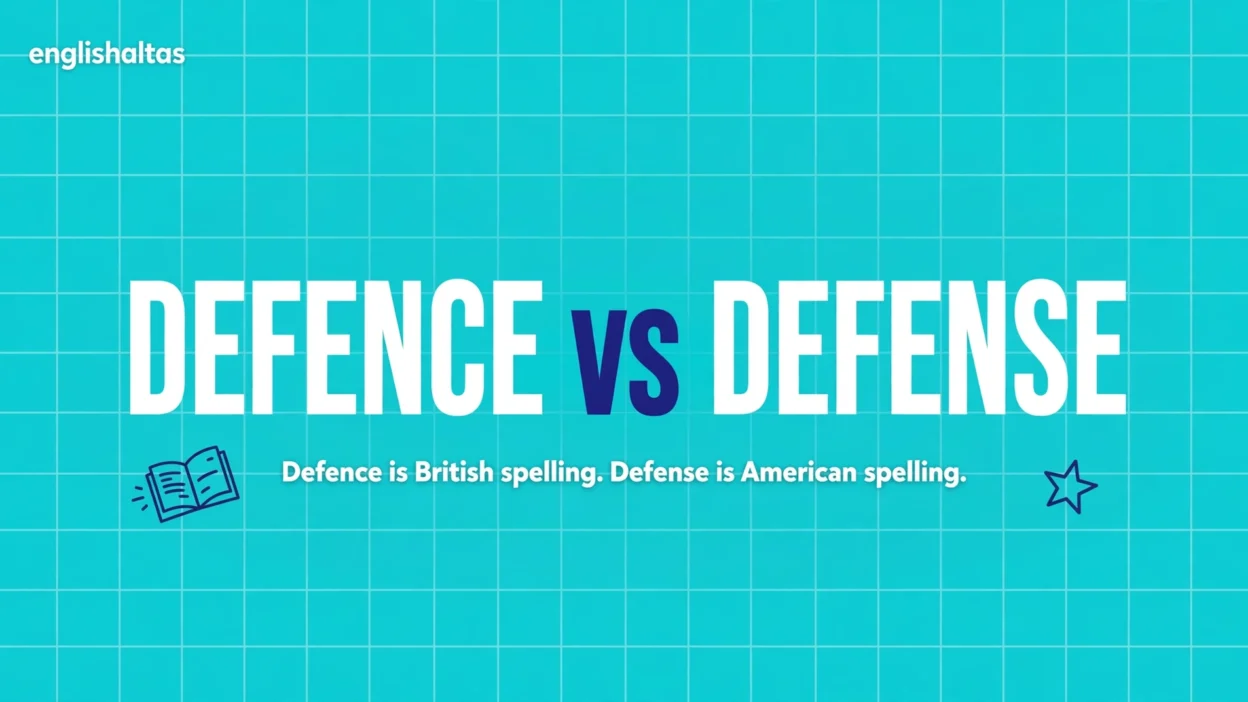
The good news is simple: they mean the same thing. The main difference is the variety of English being used.
Defence is the usual spelling in British English. You will also see it in other forms of English that generally follow British spelling, such as Australian and New Zealand English.
Defense is the usual spelling in American English. If you are writing for an American school, company, website, or audience, defense is normally the better choice.
Both words are nouns. They can describe the act of protecting someone or something, the people who protect a country, or the action of protecting yourself from an accusation or attack.
For example:
- The country increased its defence spending.
- The country increased its defense spending.
Both sentences are correct. The spelling depends on the English variety.
The most important lesson is consistency. If you choose British English, use defence. If you choose American English, use defense. Do not change between the two styles without a reason.
By the end of this guide, you will know exactly when to use each spelling, how to remember the difference, and how to avoid common mistakes in school, work, and everyday writing.
What Does “Defence” Mean?
Defence is the British English spelling of the noun that means protection from attack, danger, criticism, or harm.
It can be used in several situations. A country can have a defence system. A football or soccer team can have a strong defence. A lawyer can prepare a defence for a person accused of a crime. You can also speak about the defence of an idea or opinion.
The important point is that defence is not a different word in meaning from defense. It is simply the spelling normally used in British English.
When should you use “defence”?
Use defence when you are following British spelling rules.
For example, use it when writing for audiences in the United Kingdom. It is also common in countries and organizations that generally follow British English spelling.
The word can appear in both formal and informal writing.
Grammar rule
Defence is a noun. It names an action, system, group, or idea related to protection.
It can be used with articles such as a, an, and the, depending on the sentence.
Examples:
- The army is responsible for national defence.
- The team has a very strong defence.
- She acted in defence of her friend.
- The lawyer prepared a careful defence.
- The country spends a lot of money on defence.
- His argument was a defence of the new policy.
- Good home security can provide extra defence against theft.
- The player moved quickly to help the defence.
Notice that the meaning changes slightly depending on the situation, but the basic idea is always connected to protection.
Common learner confusion
Many learners think the -ce ending in defence and the -se ending in defense create two different meanings. They do not.
Compare:
The government announced a new defence plan.
and:
The government announced a new defense plan.
In defence vs defense, the meaning is the same. The spelling reflects the type of English being used.
Another common mistake is to think that defence is more correct than defense. That is also not true. Both spellings are correct. You simply need to choose the spelling that matches your audience and writing style.
What Does “Defense” Mean?
Defense is the American English spelling of the same noun.
It means protection against an attack, danger, criticism, or other threat. It can be used in military situations, sports, law, arguments, and everyday life.
American English normally uses defense, with -se at the end.
When should you use “defense”?
Use defense when writing in American English.
For example, if you are writing for an American school, American newspaper, American company, or American website, defense is usually the expected spelling.
Examples:
- The country needs a strong defense system.
- Our team played excellent defense.
- The lawyer prepared a strong defense.
- He spoke in defense of his brother.
- The government increased its defense budget.
- The player joined the defense after losing the ball.
- The building has several defense systems.
- Her statement was a defense of the new plan.
In defence vs defense, again, these sentences are about protection or support against something.
Grammar rule
Defense is a noun. It can describe protection, a protective group or system, or an argument made to protect someone or something.
It can also appear in common phrases such as:
- national defense
- defense system
- defense spending
- defense lawyer
- defense strategy
- self-defense
- in defense of
For example:
She spoke in defense of her colleague.
Here, defense means support or protection of another person.
Common learner confusion
The biggest confusion is usually this:
“Which one is the real English spelling?”
The answer is that both are real English spellings.
In defence vs defense, the difference is mainly regional:
- British English → defence
- American English → defense
You may also notice the same pattern in related words. British English often uses -ce, while American English may use -se in certain words.
For example:
- defence → defense
- offence → offense
This makes defence vs defense easier to recognize once you know the pattern.
Difference Between Defence vs Defense
The difference between defence vs defense is mainly spelling and regional English, not meaning.
A British English speaker can write defence, while an American English speaker will normally write defense. Both readers will understand the word.
| Point | Defence | Defense |
|---|---|---|
| English variety | British English | American English |
| Meaning | Protection or support | Protection or support |
| Part of speech | Noun | Noun |
| Pronunciation | Generally the same | Generally the same |
| Ending | -ce | -se |
| Example | national defence | national defense |
| Common in | UK, Australia, New Zealand and other British-style English | United States |
Usage difference
The biggest difference is where the word is used.
Imagine that you are writing two versions of the same sentence:
The government increased defence spending.
This looks natural in British English.
For an American audience, you would normally write:
The government increased defense spending.
In defence vs defense, the meaning does not change.
Grammar logic
There is no special grammar rule that makes defence a different noun from defense. Both words perform the same grammatical job.
You can use either one as the subject or object of a sentence.
Subject:
Defence is important for the country.
Object:
The country needs strong defence.
In American English, simply change the spelling:
Defense is important for the country.
The country needs strong defense.
Sentence structure difference
There is no sentence structure difference in defence vs defense.
You do not need to change the grammar when changing defence to defense.
For example:
British English:
The team improved its defence.
American English:
The team improved its defense.
In defence vs defense, the sentence structure is exactly the same.
The same is true in questions:
Why is the defence so weak?
and:
Why is the defense so weak?
Both spellings in defence vs defense are grammatically correct.
Meaning comparison
In defence vs defense, both words can have several related meanings.
They can refer to:
Protection from attack
The country strengthened its defence.
The country strengthened its defense.
Protection in sport
The team’s defence was excellent.
The team’s defense was excellent.
Protection in law
The lawyer prepared a defence.
The lawyer prepared a defense.
Support for a person or idea
She spoke in defence of her friend.
She spoke in defense of her friend.
So, if you see one spelling in a book and the other spelling somewhere else, do not assume that the meaning has changed.
Grammar Rules You Must Remember
Rule #1: Use “defence” in British English
If your writing follows British English, choose defence.
Example:
The government announced a new national defence policy.
This spelling in defence vs defense is natural in British English.
Rule #2: Use “defense” in American English
If your writing follows American English, choose defense.
Example:
The government announced a new national defense policy.
This is the normal American spelling in defence vs defense.
Rule #3: Do not change the meaning
Changing defence to defense does not change the meaning.
For example:
He spoke in defence of his friend.
and:
He spoke in defense of his friend.
Both sentences in defence vs defense mean that he supported or protected his friend.
Rule #4: Keep your spelling consistent
This is one of the most useful rules for students learning defence vs defense.
If you are writing a British English essay, do not randomly use American spelling in the middle of it.
For example, this combination looks inconsistent:
The team has a strong defence, but its offense needs improvement.
If you are following British English, write:
The team has a strong defence, but its offence needs improvement.
If you are following American English, write:
The team has a strong defense, but its offense needs improvement.
Consistency in defence vs defense makes your writing look more polished.
Common Mistakes Students Make
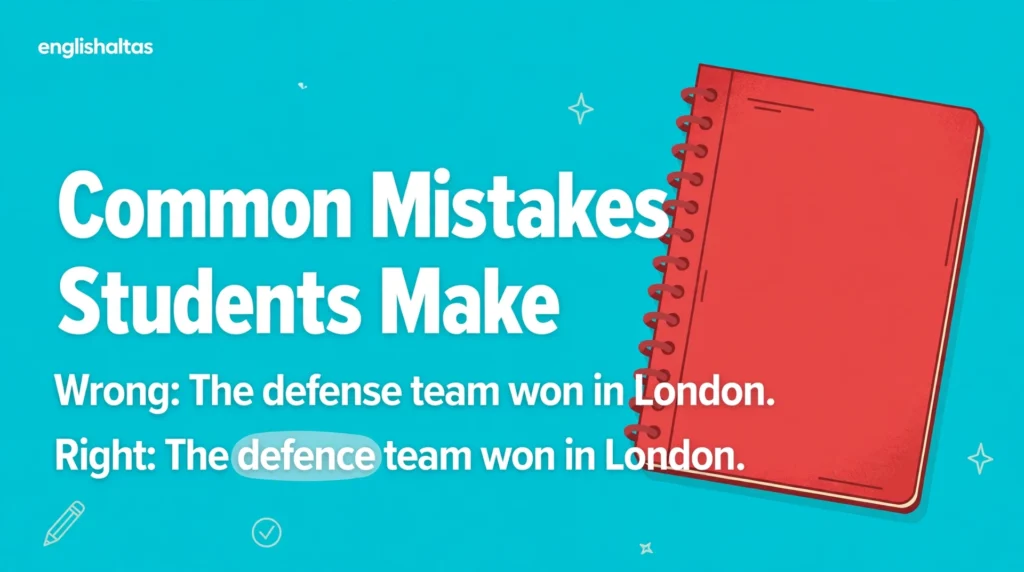
Students often make mistakes with defence vs defense because English spelling changes between countries.
Mistake 1: Thinking one spelling is wrong
A student may see defense and think:
“The correct spelling is defence.”
That is not always true.
If the writer is using American English, defense is correct.
Likewise, an American reader should not assume that defence is a spelling mistake. It is standard British English.
Mistake 2: Mixing the two styles
A learner may use British spelling in one paragraph and American spelling in another.
For example:
The country needs better defence. The new defense plan will cost millions.
This is understandable in defence vs defense, but it mixes spelling styles.
Easy correction for defence vs defense: Choose one English variety before you start a formal piece of writing.
Mistake 3: Changing the pronunciation
Some learners think the two spellings must have different pronunciations.
Usually, they are pronounced the same or very similarly.
In defence vs defense, the spelling changes, but the basic pronunciation does not suddenly become a different word.
Mistake 4: Confusing the noun with the verb
The noun is:
defence / defense
The verb is:
defend
For example:
The army defends the country.
Not:
The army defences the country.
This is an important grammar point in defence vs defense.
You can remember it like this:
defend = verb
defence/defense = noun
Mistake 5: Using “defence” or “defense” when “defend” is needed
Look at this sentence:
She tried to defence her decision.
That is incorrect.
The correct sentence is:
She tried to defend her decision.
Why? Because tried to is followed by a verb, and defend is the verb.
Easy Trick to Remember the Difference
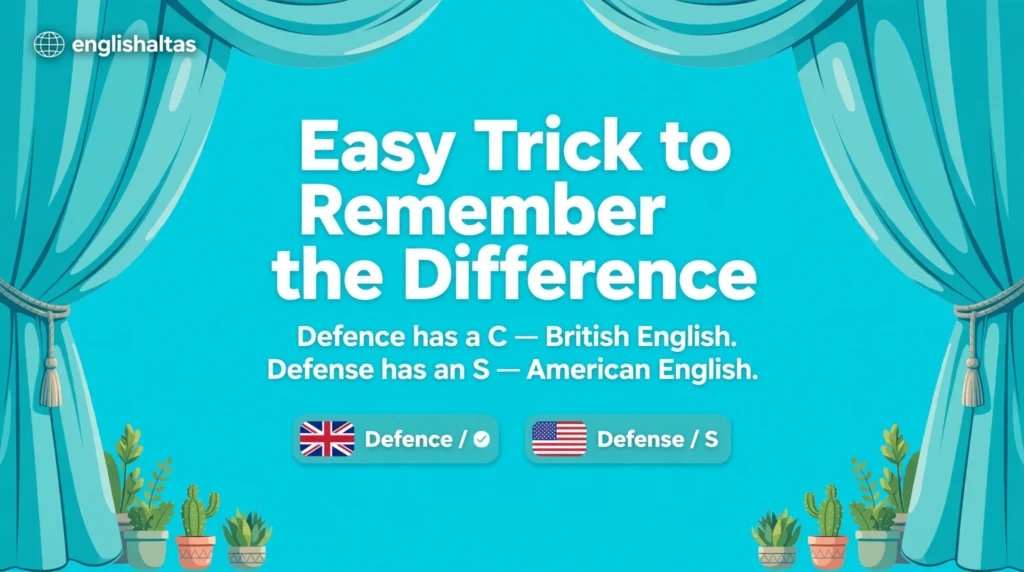
Here is a very simple memory trick:
C = British, S = American.
Think:
defenCE → British English
defenSE → American English
You do not need to memorize a long spelling rule.
Another way to remember it is to think about the word offence/offense.
British English:
- defence
- offence
American English:
- defense
- offense
So if you already know that American English uses offense, you can connect it with defense.
A real-life memory trick
Imagine you are writing to a British teacher:
“My country needs better defence.”
Use C.
Now imagine you are writing to an American teacher:
“My country needs better defense.”
Use S.
The most important thing is not remembering which spelling is “better.” The important thing is remembering which audience you are writing for.
Daily Life Examples
Here are some simple examples that show how the word appears in normal English.
1. Talking about a country
“The country spends a lot of money on national defense.”
An American speaker may use defense. A British speaker would normally use defence.
2. Talking about football or soccer
“Our defence was much better today.”
A British English speaker commonly uses defence.
In American English:
“Our defense was much better today.”
3. Talking about a lawyer
“The lawyer prepared a strong defense for his client.”
This spelling is common in American English.
In British English, you may see:
“The lawyer prepared a strong defence for his client.”
4. Supporting a friend
“She spoke in defense of her friend.”
This means she supported or protected her friend when someone criticized or blamed the friend.
5. Talking about safety
“The house has several security systems for defence.”
In American English, defense would normally be used.
6. Talking about an argument
“His speech was a defence of the new school rules.”
Here, defence means an explanation or argument supporting something.
7. Asking a question
“Why is our defense so weak today?”
This is a normal question in American English.
British English would normally use:
“Why is our defence so weak today?”
8. Talking about a sports player
“She plays in defense for the school team.”
This is common American usage.
A British English speaker would usually write:
“She plays in defence for the school team.”
9. Talking about self-protection
“He took a self-defense class.”
American English normally uses self-defense.
British English commonly uses:
“He took a self-defence class.”
10. Talking about a difficult situation
“The company made a strong defense against the criticism.”
Here, the word means an effort to protect the company from criticism.
Practice Section
Choose defence or defense for each sentence. Think about the English variety shown in the question.
1. British English
The team has a very strong ______.
2. American English
The lawyer prepared a strong ______ for his client.
3. British English
The government announced a new ______ policy.
4. American English
She spoke in ______ of her brother.
5. General spelling question
Are defence vs defense different in meaning?
Answers
1. defence
The team has a very strong defence.
British English uses defence.
2. defense
The lawyer prepared a strong defense for his client.
American English uses defense.
3. defence
The government announced a new defence policy.
Again, British English uses the -ce spelling.
4. defense
She spoke in defense of her brother.
American English uses the -se spelling.
5. No.
The two spellings have the same basic meaning. The main difference is the English variety.
FAQs
What is the difference between defence vs defense?
There is no major difference in meaning. Defence is the standard British English spelling, while defense is the standard American English spelling.
Both words are nouns and can mean protection from attack, danger, criticism, or harm.
Is “defence” British or American?
Defence is British English. It is also common in other varieties that generally follow British spelling, including Australian and New Zealand English.
American English normally uses defense instead.
Is “defense” American English?
Yes. Defense is the standard American English spelling.
For example:
The team has a strong defense.
If you are following British English, the same sentence would normally use defence.
Can I use “defence” in American English?
People in the United States will understand defence, but it is not the usual American spelling.
If you are writing for an American audience, especially in school or professional writing, defense is the safer choice.
Is “defence” more formal than “defense”?
No. The spelling does not show whether the word is formal or informal.
The difference is mainly regional spelling. Defence is associated with British English, while defense is associated with American English.
Are defence vs defense pronounced differently?
Generally, no. They have the same basic pronunciation.
The difference is mainly visible in writing: -ce in defence and -se in defense.
The related verb is defend, which is spelled the same in both British and American English.
Conclusion
The difference between defence vs defense is much easier than it first appears. Both words have the same basic meaning: protection from attack, danger, criticism, or harm.
The main difference is spelling.
Defence is the normal British English spelling, while defense is the normal American English spelling. You may also see defence in other varieties of English that follow British spelling.
There is no need to learn two different meanings or two different grammar rules. Both forms are nouns, and they can be used in the same sentence structures.
The best habit is to choose one English style and stay consistent. If your school or website follows British English, use defence. If it follows American English, use defense.
And remember the simple trick:
British = defence
American = defense
Once you connect the spelling with the English variety, this common spelling problem becomes easy.
Keep reading, writing, and checking real examples, and you will soon choose the right form naturally.

Oliver Bennett is an English language educator and content writer passionate about simplifying grammar. He creates clear, practical lessons, writing tips, and learning resources that help readers improve their English with confidence.