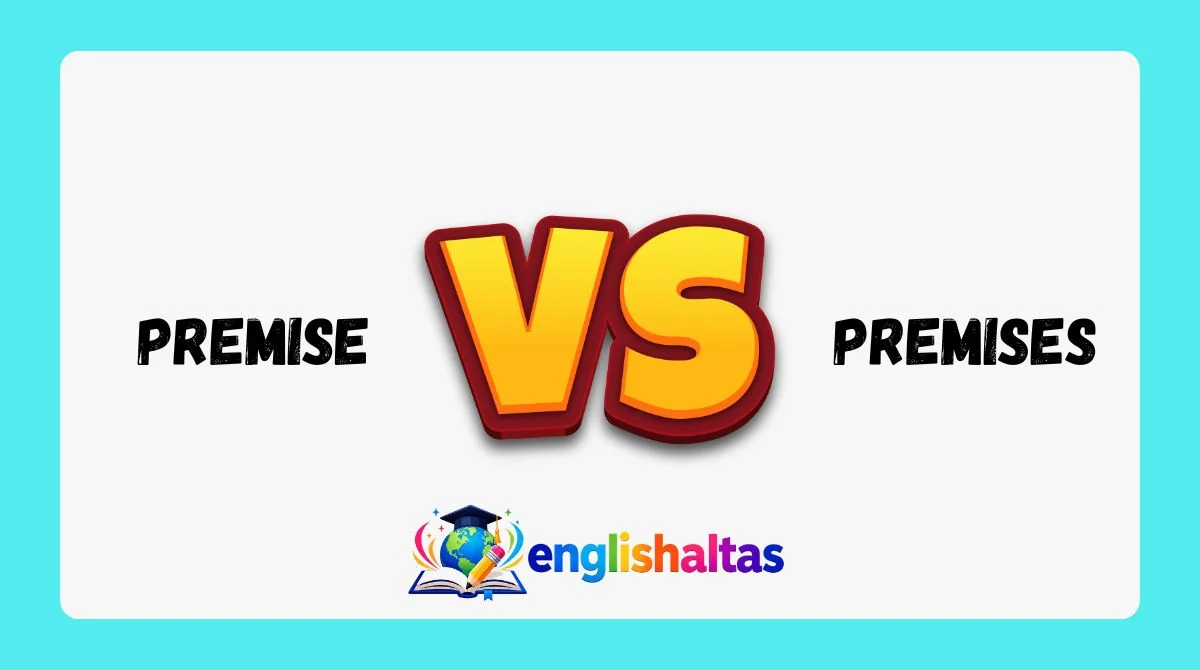
Premise vs premises can confuse English learners because these two words look almost the same.
The only visible difference is the final -s, but that small letter can change the grammar and meaning.
Many students see premise in a book, movie review, or discussion and understand it as an idea or starting point.
Then they see premises and wonder, “Is this just the plural form?” Sometimes it is. But not always.
The word premises also has another common meaning: a building or area used by a business or organization.
That is why this pair causes trouble in daily English, school writing, and spoken conversations.
The good news is that the difference is easy to understand once you see the simple pattern. Premise usually means an idea, reason, or starting point. Premises can mean more than one premise—or a place or property.
After reading this guide, you will know exactly when to use premise and premises, how their grammar works, and how to avoid common mistakes.
You will also see simple examples from real-life English.
So, if you have ever stopped and thought, “Should I write premise or premises?”—this explanation is for you.
What Does “Premise” Mean?
The word premise is a noun. In simple English, it means an idea, fact, or statement used as the starting point for a conclusion or argument.
Think of a premise as the starting idea in someone’s reasoning.
Simple definition
Premise = a starting idea or statement that helps support a conclusion.
Premise vs Premises
All birds have wings.
A parrot is a bird.
Therefore, a parrot has wings.
The first two statements are premises. They help us reach the final conclusion.
In everyday English, premise can also mean the basic idea behind a story, movie, book, or plan.
When do we use “premise”?
Use premise when you are talking about one idea, one reason, or one basic concept.
It is common in:
- Logic
- Debates
- Essays
- Academic writing
- Movie and book discussions
- Business discussions
The word can sound a little formal, but it is still useful in normal English.
Grammar rule for “premise”
Premise is a singular countable noun.
That means you can use a or the before it.
- a premise
- Premise vs Premises
- this premise
- one premise
The plural form of this meaning is premises.
Examples of “premise”
- The premise of the movie is very interesting.
- Her argument is based on a false premise.
- The main premise of the plan is simple.
- I do not agree with the premise of his argument.
- The story has a strange but exciting premise.
- The teacher asked us to explain the premise of our answer.
- The whole idea depends on one important premise.
- The novel’s premise sounds original.
Common learner confusion
A common mistake is thinking that premise only means “idea.” In fact, it is more specific than that.
You usually use premise for an idea or statement that supports something else. It can also mean the basic idea of a story or plan.
For example:
The premise of the movie is that people can travel through time.
Here, premise means the basic idea of the movie.
Do not confuse premise with promise. A promise is something you say you will do. A premise is a starting idea or statement.
What Does “Premises” Mean?
Premises has two main meanings, and this is where many learners get confused.
First, premises can be the plural form of premise. In this meaning, it means two or more ideas or statements used in reasoning.
Second, premises can mean a building, land, or property used for a particular purpose.
Meaning 1: More than one premise
When premises is the plural of premise, it means more than one starting idea or statement.
Simple definition
Premises = two or more ideas or statements that support a conclusion.
For example:
The argument is based on two premises.
This means the argument has two starting ideas or reasons.
Grammar rule
When premises means more than one premise, it is a plural noun.
Use plural verbs with it.
- Premise vs Premises
- Premise vs Premises
Do not use is when premises means several ideas.
Examples of “premises” as plural of premise
- The argument is based on two main premises.
- Both premises are important to the conclusion.
- The students examined the premises of the argument.
- These premises do not support the final answer.
- The writer used several premises in the discussion.
- If the premises are wrong, the conclusion may also be wrong.
Meaning 2: A building or property
Premises also means a building and the land around it, especially when used by a business or organization.
This meaning is very common in British English and formal English.
For example:
Premise vs Premises
Here, premises does not mean ideas. It means this building or property.
Examples of “premises” as a place
- Visitors must leave the premises by 9 p.m.
- The company has moved to new premises.
- Please do not enter the premises without permission.
- Food is prepared on the premises.
- The police arrived at the premises.
- Employees must keep the premises clean.
Common learner confusion
The biggest problem is that premises can have two completely different meanings.
Look at these sentences:
Premise vs Premises
Here, premises means ideas or statements.
The workers left the premises.
Here, premises means a building or property.
The meaning comes from the context.
One more important point: when premises means a building or property, it is normally treated as a plural noun in grammar.
We say:
Premise vs Premises
Not:
The premises is large.
Difference Between Premise and Premises (Detailed)
The main difference between premise and premises is usually singular versus plural.
However, premises also has a special meaning connected to property or a building.
Quick comparison table
| Word | Main meaning | Grammar | Example |
|---|---|---|---|
| Premise | One idea or starting statement | Singular noun | The premise is weak. |
| Premises | Two or more ideas or statements | Plural noun | The premises are weak. |
| Premises | A building or property | Plural-form noun | The premises are secure. |
Usage difference
Use premise when you are talking about one idea or one starting point.
Premise vs Premises
Use premises when you are talking about more than one idea.
Premise vs Premises
Use premises when you mean a building or property.
No visitors are allowed on the premises.
The grammar logic
The grammar is quite simple when premises means ideas.
One premise → several premises
Just like:
- one book → several books
- one reason → several reasons
- one idea → several ideas
So:
Premise vs Premises
becomes:
two premises
But remember, premises as property is a separate vocabulary meaning.
Sentence structure difference
Here is the basic pattern:
The + premise + singular verb
The premise is clear.
The + premises + plural verb
The premises are clear.
For the property meaning:
The premises are closed.
Notice the verb are.
Meaning comparison
Compare these examples carefully:
The premise of the book is interesting.
Meaning: The main idea of the book is interesting.
The premises of the argument are interesting.
Meaning: The starting statements of the argument are interesting.
The premises are closed.
Meaning: The building or property is closed.
The spelling is similar, but the words around it help you understand the meaning.
Grammar Rules You Must Remember
Rule #1: Use “premise” for one idea or starting statement
When you mean one basic idea or reason, use the singular noun premise.
The premise of the story is simple.
Here, there is one main idea.
Easy tip: If you can say one, use premise.
Rule #2: Use “premises” for two or more ideas
When you mean more than one premise, use premises.
The argument is based on three premises.
There are three starting statements, so the plural form is correct.
Remember: premise → premises.
Rule #3: “Premises” can mean a building or property
When you mean a place, building, or property, use premises.
The shop is located on these premises.
In this sentence, premises means the property or area.
Rule #4: Use “are” with “premises”
Because premises is treated as plural, use a plural verb.
The premises are clean.
The premises are protected by security guards.
Avoid:
The premises is clean.
This is a common grammar error.
Common Mistakes Students Make
Many students make mistakes with these words because they focus only on the spelling. They see premise and premises and think, “The second word is just the first word with an s.”
That is only partly true.
Mistake 1: Using “premise” for a place
❌ Please leave the premise.
✅ Please leave the premises.
When you mean a building or property, use premises.
Correction tip: If you can replace the word with building or property, choose premises.
Mistake 2: Using “premises” for one idea
❌ The main premises of the movie is exciting.
✅ The main premise of the movie is exciting.
There is one main idea, so use the singular form.
Correction tip: Look for words like one, main, single, or basic. They often point to premise.
Mistake 3: Using “is” with premises
❌ The premises is very large.
✅ The premises are very large.
This mistake happens because premises can refer to one property in meaning. However, the grammar treats it as plural.
Correction tip: Always remember the fixed pattern: the premises are.
Mistake 4: Confusing premise with promise
❌ The promise of the movie is interesting.
✅ The premise of the movie is interesting.
If you mean the basic idea of a movie or story, use premise.
A promise is a statement about something someone says they will do.
He made a promise to help me.
Mistake 5: Thinking “premises” always means ideas
❌ The workers cleaned the ideas.
Of course, this does not make sense. In a sentence like:
The workers cleaned the premises.
Premises means the building or property.
Correction tip: Check the verb. Words like clean, enter, leave, protect, and occupy often suggest the property meaning.
Easy Trick to Remember the Difference
Here is a simple memory trick:
Premise = one point
Think of the single “s” sound at the end of premise as one starting idea.
One premise = one idea.
Premises = more ideas or a place
If you see premises, ask yourself two questions:
“Are we talking about several ideas?”
If yes, premises is the plural of premise.
The argument has two premises.
Or ask:
“Are we talking about a building or property?”
If yes, use premises.
The workers are on the premises.
A very easy student trick is this:
Premise = think. Premises = think more or think place.
It is not a perfect grammar rule, but it can help you remember the two common meanings quickly.
Daily Life Examples
The best way to understand premise vs premises is to see the words in normal conversations.
1. Talking about a movie
A: Did you watch that new movie?
B: Yes. The premise is really interesting.
Here, premise means the basic idea of the movie.
2. Talking about an argument
A: Why do you disagree with his conclusion?
B: Because his premise is wrong.
The speaker means one starting idea.
3. Talking about several reasons
A: How did you reach that answer?
B: I used two main premises.
Here, premises means two starting ideas or statements.
4. Talking about a business
Manager: Please do not smoke on the premises.
This means inside the business property or building.
5. Talking about a school
Teacher: Students must leave the premises before six o’clock.
The word means the school property.
6. Talking about a story
A: What is the book about?
B: The premise is that a young girl can speak to animals.
Here, premise means the main story idea.
7. Talking about an office
Employee: Can I bring my dog to the office?
Manager: Sorry, pets are not allowed on the premises.
Here, premises means the office property.
8. Talking about logic
Student: Are all the premises correct?
Teacher: Yes, but the conclusion is still wrong.
Premises means multiple starting statements.
9. Talking about a plan
The whole plan is based on one simple premise: everyone will arrive on time.
There is one basic idea, so premise is correct.
10. Talking about property
The security guard checked the premises before closing.
The guard checked the building and surrounding property.
Practice Section
Choose the correct word: premise or premises.
- The main ______ of the movie sounds exciting.
- Visitors are not allowed on the ______ after 10 p.m.
- The argument is based on two important ______.
- The ______ of the story is very unusual.
- The ______ are protected by security guards.
Answers
- premise — one main idea
- premises — a building or property
- premises — more than one starting statement
- premise — the basic idea of the story
- premises — a building or property, with the plural verb are
FAQs
What is the difference between premise and premises?
Premise usually means one starting idea, reason, or statement. Premises can mean two or more such ideas. It can also mean a building or property. The surrounding words and context show the correct meaning.
Can “premises” mean more than one premise?
Yes. Premises is the plural form of premise when you are talking about ideas or statements. For example, The argument has three premises. In this sentence, the word means three starting points for reasoning.
Is “premises” formal or informal?
The word premises is common in both formal and everyday English when it means a building or property. You may hear it in signs, workplace rules, and official notices. The word premise can sound more formal when used in logic or arguments.
Can I use “premise” for a building?
Usually, no. When you mean a building or property, the correct word is premises. For example, Please leave the premises. Do not normally say Please leave the premise with this meaning.
Is “premises” singular or plural?
Premises is grammatically treated as plural. Use a plural verb such as are. For example, The premises are clean. This is true even when premises refers to one property or business location.
What is the premise of a movie or book?
The premise of a movie or book is its basic idea or starting concept. For example, you might say, The premise of the novel is that a boy discovers a secret world. It explains the main idea behind the story.
Final Conclusion
The difference between premise and premises becomes much easier when you remember the basic idea.
Premise is usually one starting idea, reason, or statement. It can also describe the main idea behind a movie, book, or story.
Premises can mean two or more premises. It also has a second common meaning: a building, land, or property used for a particular purpose.
The grammar is simple. Use premise for one idea, premises for several ideas, and premises when you mean a place or property. Also remember the useful grammar pattern: the premises are.
Try to notice these words in movies, books, workplace signs, and everyday conversations. A few real examples can make the difference stick in your mind.
Keep practicing, and do not worry if you mix them up at first. English has many word pairs that look almost the same.
Once you understand the meaning and grammar, choosing the correct word becomes much more natural.

Oliver Bennett is an English language educator and content writer passionate about simplifying grammar. He creates clear, practical lessons, writing tips, and learning resources that help readers improve their English with confidence.