Last updated on November 7th, 2026 at 06:44 am
English learners often see “Would you want,” “Would you like,” and “Do you want” and wonder if they all mean the same thing.
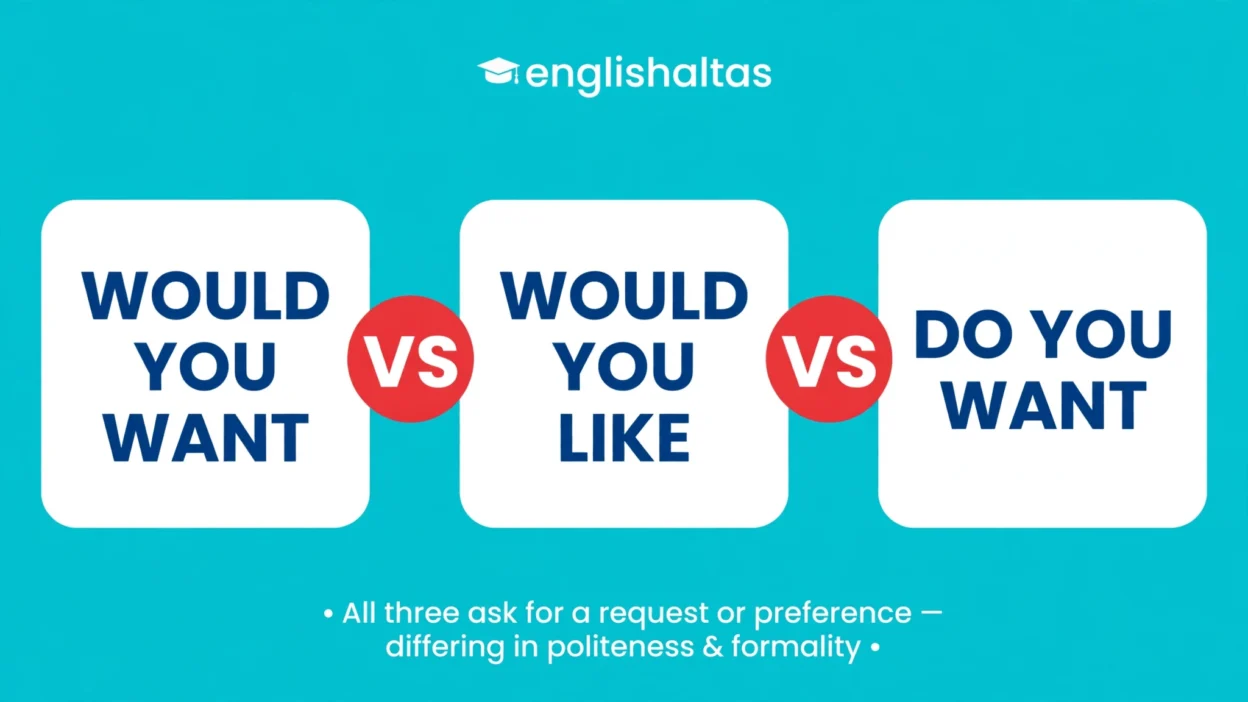
They are very close in meaning, but they do not always sound natural in the same situation. This is the core of would you want vs would you like vs do you want.
The confusion usually comes from the word want. Learners know that want means to desire something, so they may think that changing do to would creates no real difference.
However, English speakers use these forms to show different levels of politeness, directness, possibility, and context.
For example, a waiter may ask, “Would you like some water?” This sounds polite and natural. A friend may simply ask, “Do you want some water?” That is also correct, but it is more direct and casual.
Then what about “Would you want some water?”? It is grammatically possible in some situations, but it often sounds unusual when you are simply offering something.
The good news is that the difference is easy to learn. Once you understand how English speakers use these questions in real situations, choosing the right form becomes much easier.
This guide explains the meaning, grammar, politeness, sentence patterns, common mistakes, and everyday use of would you want vs would you like vs do you want.
By the end, you should be able to choose the natural expression without guessing. That is the goal of this guide to would you want vs would you like vs do you want.
What Does “Would You Want” Mean?
“Would you want” asks about what a person would desire in a particular situation. It usually talks about a possible, imagined, or conditional situation rather than a simple offer. This imagined meaning is one part of would you want vs would you like vs do you want.
The basic structure is:
Would + subject + want + noun/to-infinitive?
Examples:
- Would you want a bigger house if you could afford one?
- Would you want to live in another country?
- Would you want to change your job?
- Would you want to come with us if we invited you?
- Would you want more time to finish the project?
- Would you want to stay here during the summer?
- Would you want to study abroad if you had the chance?
- Would you want a different room if one became available?
The important point is that “would” often creates a condition or imagined situation.
Compare these two questions:
Do you want a new car?
This asks about your actual desire now.
Would you want a new car if you won the lottery?
This asks about your desire in an imagined situation.
That is the main reason “would you want” can sound strange when used as a simple offer. If you are holding a cup of tea and asking someone if they want it, native speakers normally say: In short, would you want vs would you like vs do you want is a question of situation first and grammar second.
“Would you like some tea?”
They usually do not say:
“Would you want some tea?”
The second sentence is not automatically grammatically wrong, but it does not sound like the normal polite offer in everyday English.
When should you use “Would You Want”?
Use it when the question involves a condition, possibility, preference, or imagined situation.
For example:
If you moved to London, would you want to live in the city center?
There is an imagined situation: moving to London.
Another example:
If your company offered you a promotion, would you want to accept it?
Again, the situation is hypothetical.
Common Learner Confusion
Many students learn that would = polite and then use “would you want” for every polite question.
That is not the best rule.
Would can make some expressions polite, but the natural polite form for offering something is usually “Would you like…?”
So remember:
- Would you want…? → often asks about a hypothetical preference.
- Would you like…? → commonly makes a polite offer or asks about a preference.
- Do you want…? → asks directly about a real desire.
What Does “Would You Like” Mean?
“Would you like” is one of the most useful polite expressions in English. It is the polite part of would you want vs would you like vs do you want.
It is commonly used to offer something, invite someone, or politely ask about a person’s preference.
The basic structures are:
Would + subject + like + noun?
or
Would + subject + like + to + verb?
Examples:
- Would you like some coffee?
- Would you like a piece of cake?
- Would you like some help?
- Would you like another glass of water?
- Would you like to sit here?
- Would you like to come with us?
- Would you like to order now?
- Would you like to watch a movie tonight?
Notice the difference between like and want.
In this structure, would like means something close to want, but it sounds more polite and softer.
For example:
I want some tea.
This is direct.
I would like some tea.
This is more polite and is common when speaking to staff, making a request, or speaking in a formal situation.
“Would You Like” for Offers
When you offer something, “Would you like…?” is usually the natural choice. See Merriam-Webster for the definition of would.
For example:
Would you like some coffee?
Would you like a seat?
Would you like some help with your bags?
These questions do not sound too strong. They give the other person a polite choice.
“Would You Like” for Invitations
You can also use it when inviting someone.
Would you like to join us for dinner?
Would you like to come to my party?
Would you like to go for a walk?
Here, would you like to + verb is a very common invitation pattern. It is one of the most useful patterns in would you want vs would you like vs do you want for learners who want to sound polite.
Common Learner Confusion
Some learners think that “would like” always refers to a future wish. That is not quite right.
For example:
I would like a cup of tea.
This can simply mean:
I want a cup of tea.
The difference is that would like is more polite and less direct. Remembering that helps with would you want vs would you like vs do you want, because the polite form is not always the one with would.
Also, do not use “would like” + verb-ing in this pattern.
Incorrect:
Would you like going with us?
Natural:
Would you like to go with us?
The normal structure is:
would like + to + base verb
Difference Between Would You Want vs Would You Like vs Do You Want
These three questions are related, but their natural use is different. That is why would you want vs would you like vs do you want is best learned as one set, not as three separate rules.
| Expression | Main use | Tone | Example |
|---|---|---|---|
| Would you want…? | Hypothetical or conditional preference | Neutral | Would you want to move abroad if you got the chance? |
| Would you like…? | Polite offer, invitation, or preference | Polite/soft | Would you like some tea? |
| Do you want…? | Direct question about a real desire | Casual/direct | Do you want some tea? |
1. Would You Want
This form often has an imagined condition.
Would you want to live by the sea if you had enough money?
The speaker is not necessarily offering the listener a house by the sea. They are asking about an imagined choice.
You can often see words such as:
- if
- suppose
- imagine
- in that situation
- given the chance
For example:
If you could work anywhere, would you want to work from home?
2. Would You Like
This is the usual choice for polite offers and invitations. That is why it leads in would you want vs would you like vs do you want for polite situations.
Would you like some more rice?
Would you like to come inside?
Would you like a different size?
It can also ask about a preference:
Would you like a window seat?
There does not need to be an imaginary condition.
3. Do You Want
This is direct and common in everyday conversation.
Do you want coffee?
Do you want to go home?
Do you want my old phone?
It is especially common between friends, family members, classmates, and people who already have a comfortable relationship.
It is not automatically rude. “Do you want…?” is perfectly normal English. The situation and tone matter.
Grammar Logic
The biggest grammar difference is the auxiliary verb. That one change in the auxiliary is what separates the three forms in would you want vs would you like vs do you want.
With do you want, we use the present simple question form:
Do + subject + base verb?
Do you want pizza?
With would you want, we use:
Would + subject + base verb?
Would you want pizza if you were hungry?
With would you like, we use:
Would + subject + like + noun/to-infinitive?
Would you like pizza?
Would you like to eat pizza?
Notice that after would, the verb stays in its base form.
Correct:
Would You Want vs Would You Like
Correct:
Would You Want vs Would You Like
Incorrect:
Would You Want vs Would You Like
Incorrect:
Would You Want vs Would You Like
Grammar Rules You Must Remember
Rule #1: Use “Do You Want” for Direct, Real Questions
When you simply want to know what someone wants, do you want is natural. In would you want vs would you like vs do you want, this is the simplest of the three to use correctly.
Would You Want vs Would You Like
Would You Want vs Would You Like
Would You Want vs Would You Like
Think of it as a straightforward question about the person’s desire.
Rule #2: Use “Would You Like” for Polite Offers and Invitations
If you are offering something or inviting someone, would you like is usually the best choice. That is the main rule for polite offers in would you want vs would you like vs do you want.
Would You Want vs Would You Like
Would You Want vs Would You Like
Would You Want vs Would You Like
This is especially useful in restaurants, shops, workplaces, hotels, and other polite situations. In would you want vs would you like vs do you want, would you like is the safe choice in these places.
Rule #3: Use “Would You Want” for Hypothetical Situations
When you are talking about an imagined situation, would you want can be correct and natural. That is the hypothetical side of would you want vs would you like vs do you want.
Would You Want vs Would You Like
Would You Want vs Would You Like
The question is about what the person would choose under a particular condition.
Rule #4: “Would Like” Is Not the Same as “Like”
Be careful with these two patterns:
I like coffee.
This means coffee is something I enjoy or generally prefer.
I would like coffee.
This usually means I want coffee now or would prefer coffee in the current situation.
For example:
Would You Want vs Would You Like
This describes a general preference.
Would You Want vs Would You Like
This is a request or desire for chocolate now.
Common Mistakes Students Make
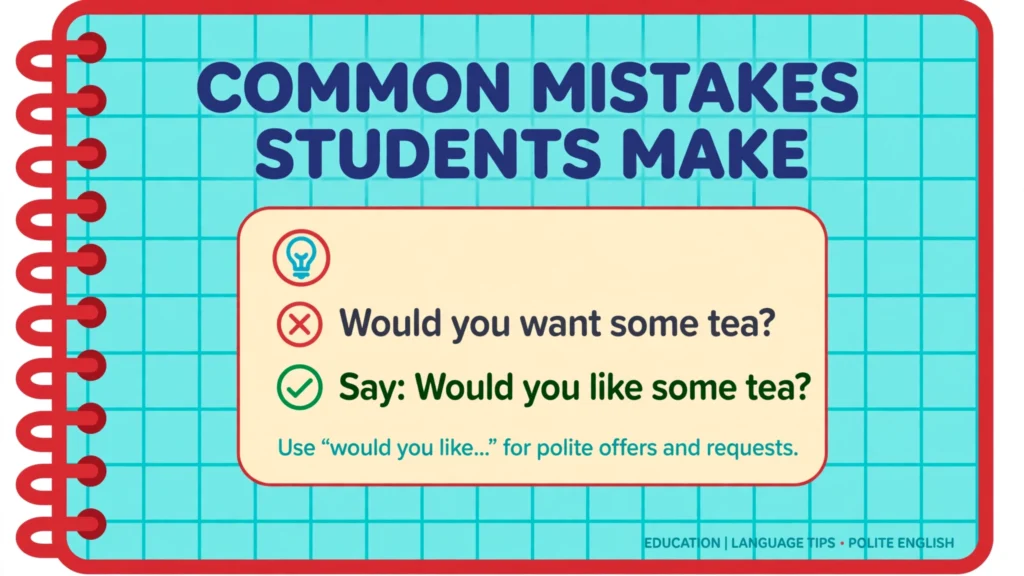
Mistake 1: Using “Would You Want” for Every Polite Offer
A learner may say:
Would You Want vs Would You Like
It may be understandable, but it is not normally the best choice for a simple offer. This is one of the most common errors in would you want vs would you like vs do you want, and it comes from using would for every polite question.
Better:
Would You Want vs Would You Like
Or, in casual conversation:
Would You Want vs Would You Like
Mistake 2: Thinking “Do You Want” Is Always Rude
It is not.
Friends commonly say:
Would You Want vs Would You Like
Would You Want vs Would You Like
Would You Want vs Would You Like
These are normal conversational questions.
However, in a customer-service situation, “Would you like…?” often sounds more polished.
Mistake 3: Saying “Would You Like” Without “To”
When a verb follows like, learners sometimes forget to.
Incorrect:
Would You Want vs Would You Like
Correct:
Would You Want vs Would You Like
The pattern is:
Would you like + noun
or
Would you like + to + verb
Mistake 4: Changing “Would” to “Did”
Do not say:
Would You Want vs Would You Like
when you mean to make a normal present offer.
“Did you want…” can have other uses, especially when asking about a past desire or using a softer conversational question, but beginners should first learn the clearer patterns.
For a current offer:
Would You Want vs Would You Like
Mistake 5: Using “Want” After “Would” Incorrectly
After would, use the base form.
Correct:
Would You Want vs Would You Like
Not:
Would You Want vs Would You Like
The same rule applies to like:
Would You Want vs Would You Like
Not:
Would You Want vs Would You Like
Easy Trick to Remember the Difference
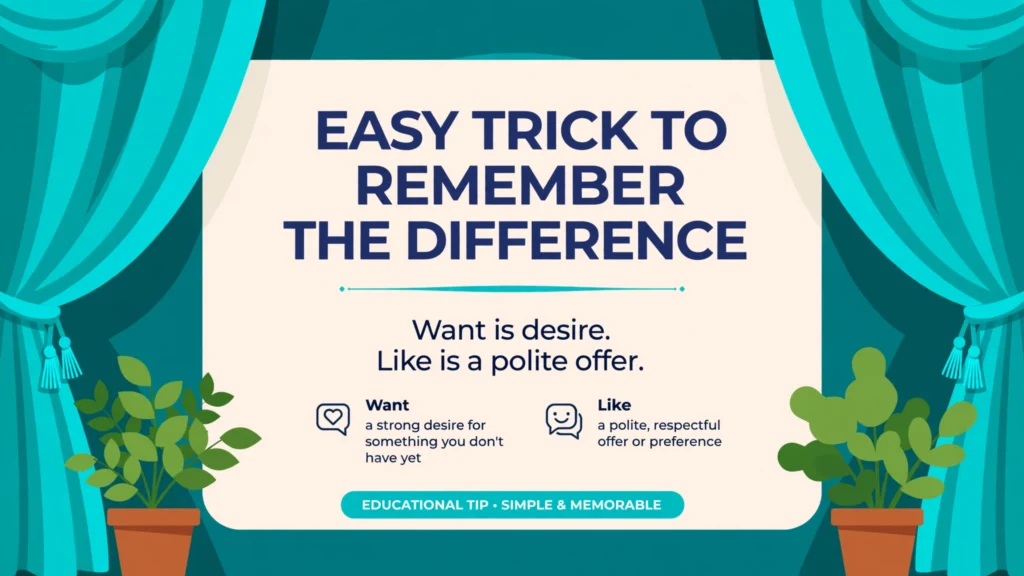
Here is a simple memory trick:
DO = direct
WOULD LIKE = polite
WOULD WANT = imagined
Think about three situations.
Situation 1: You are talking to your friend
You have pizza in front of you.
Would You Want vs Would You Like
This is relaxed and direct.
Situation 2: You are a waiter
You are serving a customer.
Would You Want vs Would You Like
This sounds polite and professional.
Situation 3: You are talking about a dream
Your friend says they may move to another country.
Would You Want vs Would You Like
This is about a possible situation.
So remember:
Do you want? → What do you want now?
Would you like? → What would you politely choose or accept?
Would you want? → What would you want in an imagined situation?
This small trick can help you choose the right form quickly. Keep it in mind whenever you compare would you want vs would you like vs do you want in a real conversation.
Daily Life Examples
Real conversations make these differences easier to understand. Each example below shows would you want vs would you like vs do you want in a place where learners actually use English.
Example 1: At Home
Mom: I’m making tea. Do you want some?
Son: Yes, please.
This is casual and natural.
Example 2: At a Restaurant
Waiter: Would you like some water?
Customer: Yes, please. Thank you.
The waiter uses a polite offer.
Example 3: Talking About a Dream
Ali: If you could live anywhere, would you want to live in Canada?
Sam: Yes, I think so.
The situation is imaginary.
Example 4: With a Friend
Sarah: I’m going to the store. Do you want anything?
Emma: Yes. Can you get me some milk?
The question is direct but friendly.
Example 5: At a Hotel
Receptionist: Would you like a room with a view?
Guest: Yes, that would be great.
The polite form fits the professional setting.
Example 6: Talking About a Job
Manager: If we offered you a different position, would you want to take it?
Employee: I would need to think about it.
This is a hypothetical question.
Example 7: Inviting a Friend
John: Would you like to come to dinner with us?
Mike: Sure. What time?
This is a polite invitation.
Example 8: Offering Food to Family
Dad: There’s some cake in the kitchen. Do you want a piece?
Daughter: Yes!
The casual form works well with family.
Example 9: Talking About Travel
A: If you had one free month, would you want to travel around Europe?
B: Absolutely!
The question describes an imagined situation.
Example 10: Helping Someone
Teacher: Would you like some help with that exercise?
Student: Yes, please.
The teacher is making a polite offer.
Practice Section
Choose the best option in would you want vs would you like vs do you want.
1. You are at a café and want to offer your friend some coffee.
_____ some coffee?
2. You are asking your brother if he wants pizza tonight.
_____ some pizza?
3. You are asking a friend about an imaginary future.
If you could work anywhere, _____ to work from home?
4. A hotel employee is offering a guest another towel.
_____ another towel?
5. You are asking what your friend would choose if they won a large amount of money.
If you won the lottery, _____ to buy a new house?
Answers
1. Would you like some coffee?
Would You Want vs Would You Like
2. Do you want some pizza?
Would You Want vs Would You Like
3. Would you want to work from home?
Would You Want vs Would You Like
4. Would you like another towel?
Would You Want vs Would You Like
5. Would you want to buy a new house?
The lottery situation is hypothetical.
FAQs
What is the difference between would you want vs would you like vs do you want?
“Would you like” is commonly used for polite offers, requests, and invitations. “Would you want” is more often used to ask about a hypothetical or conditional preference. For example, “Would you like some tea?” is a natural offer, while “Would you want to live abroad if you had the chance?” asks about an imagined situation. That is the main difference to remember in would you want vs would you like vs do you want.
Can we use “would you want” in questions?
Yes. “Would you want” is grammatically correct when the meaning fits the situation. It is especially useful when discussing possible or imaginary situations. For example: “Would you want to change your job if you found a better one?”
Is “would you like” more formal than “do you want”?
Usually, yes. “Would you like” sounds softer and more polite, especially with strangers, customers, guests, or people in professional situations. “Do you want” is also correct and is very common in casual conversations.
Is “do you want” rude?
No. “Do you want” is not automatically rude. Friends and family use it all the time. Your tone and the situation matter. “Do you want some water?” can sound perfectly friendly when spoken naturally to someone you know.
Can “would you like” mean “do you want”?
Yes. In many situations, “would like” has a meaning close to “want,” but it is more polite or softer. “I want a coffee” and “I would like a coffee” both express a desire for coffee, but the second is usually more suitable when making a polite request.
What is the correct form: “Would you like to go?” or “Would you like going?”
The normal form is “Would you like to go?” When would like is followed by an action, use to + base verb. For example: “Would you like to join us?” and “Would you like to watch a movie?”
Conclusion
The difference between would you want vs would you like vs do you want becomes much easier when you focus on the situation rather than trying to translate every sentence word for word.
Use “Do you want…?” for a direct question about a real desire, especially in casual conversation.
Use “Would you like…?” when you want to make a polite offer, invitation, or request. This is one of the most useful expressions for everyday English.
Use “Would you want…?” mainly when talking about a possible, imagined, or conditional situation.
The key idea is simple:
Do you want? = direct and real
Would you like? = polite and soft
Would you want? = hypothetical or conditional
You do not need to memorize dozens of complicated grammar rules. Pay attention to the situation, listen to how native speakers use these expressions, and practice making your own sentences. That is the best way to master would you want vs would you like vs do you want.
With a little practice, choosing between these three forms will start to feel natural. Practising would you want vs would you like vs do you want in short, everyday sentences is the fastest way to make the choice automatic.

Oliver Bennett is an English language educator and content writer passionate about simplifying grammar. He creates clear, practical lessons, writing tips, and learning resources that help readers improve their English with confidence.