Last updated on November 7th, 2026 at 06:56 am
English has many words that look almost the same but do not always mean the same thing. Sometimes, two words have nearly identical meanings but differ in spelling or usage.
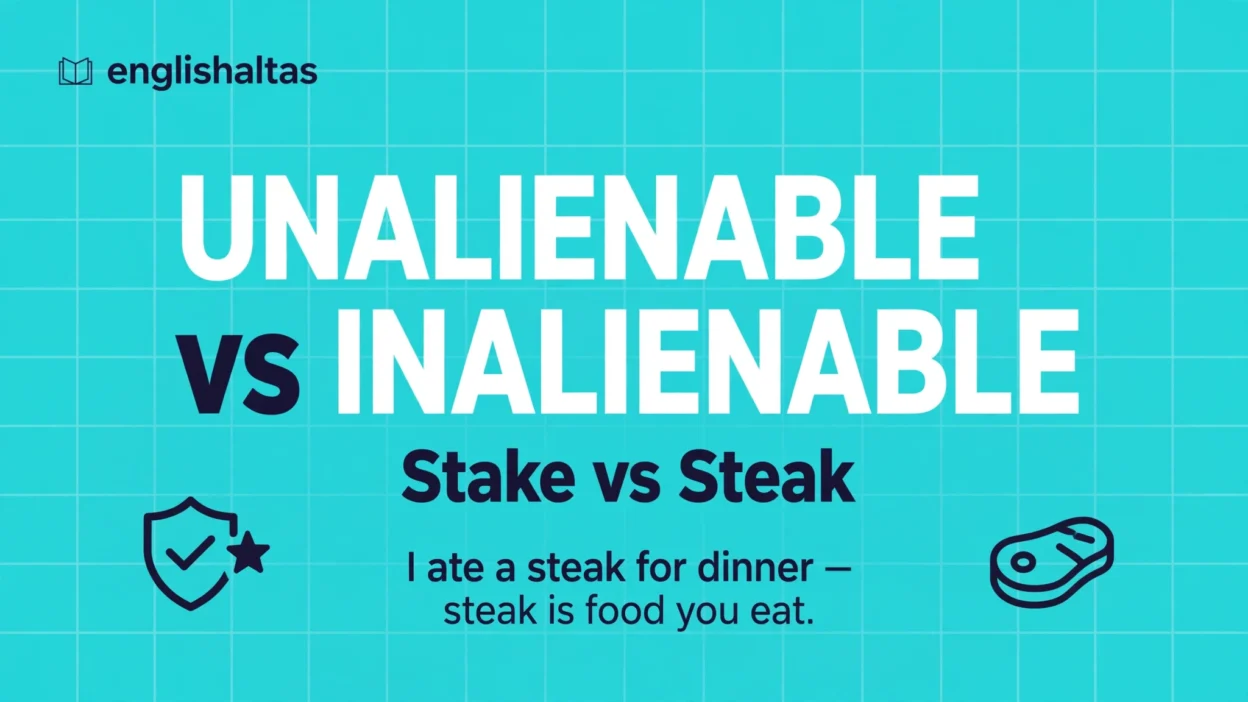
At other times, two words sound exactly alike but have completely different meanings. Unalienable vs inalienable and stake vs steak are good examples of both problems.
The words unalienable and inalienable are very close in meaning. Both can describe a right or quality that cannot be taken away, given up, or transferred.
However, inalienable is much more common in modern English, while unalienable is often seen in historical, legal, or political writing.
The pair stake and steak is different. These two words sound the same when spoken, but their meanings are completely different.
A stake can be a share in something, a strong piece of wood, or an amount of money or value involved in something. A steak, on the other hand, is a piece of meat or fish prepared as food.
These differences matter because choosing the wrong word can change the meaning of a sentence.
After reading this guide, you will know when to use each word, how to remember the difference, and how to avoid common mistakes.
That is the goal of this guide to unalienable vs inalienable and stake vs steak.
What Does “Unalienable” Mean?
Unalienable means something that cannot be taken away, sold, transferred, or given up.
The word is most often used with rights, freedoms, or qualities that are considered naturally belonging to a person. For example, someone may say that people have unalienable rights to life or freedom.
The word is made from the idea of something that cannot be “alienated.” Here, alienate does not mean “make someone dislike you.” In legal and formal English, alienate can mean to transfer something to another person.
So, an unalienable right is a right that cannot properly be transferred or removed. That idea is central to unalienable vs inalienable and stake vs steak.
When should you use “unalienable”?
Use unalienable mainly when talking about rights, freedoms, or things that are considered impossible to give away or take away.
It is a formal word, so it is not very common in casual conversation.
For example:
- Every person should have unalienable rights.
- Freedom was described as an unalienable right.
- The document speaks about the unalienable dignity of every person.
- They believed that human freedom was unalienable.
- The constitution protects certain unalienable rights.
- He argued that education should be treated as an unalienable opportunity.
- The people claimed an unalienable right to live freely.
- The writer described human dignity as unalienable.
A common learner confusion
Many learners see unalienable and think it means the same as unrelated or alien, because of the word alien. That is not correct.
Here, alienable has a special legal meaning: something that can be transferred or given to someone else.
Therefore:
- Alienable = can be transferred or given away
- Unalienable = cannot be transferred or given away
There is also another spelling that is much more common today: inalienable.
What Does “Inalienable” Mean?
Inalienable means something that cannot be taken away, transferred, surrendered, or separated from the person or thing that naturally has it.
It is commonly used with words such as rights, freedom, dignity, liberty, and human rights. Those uses are a good place to start with unalienable vs inalienable and stake vs steak.
For example, if you say, “Everyone has inalienable rights,” you mean that those rights are naturally part of being human and cannot properly be removed or handed over.
When should you use “inalienable”?
Inalienable is the more common choice in modern English when you are writing about basic human rights, freedom, dignity, or other rights that cannot be given away.
Examples:
- Everyone has inalienable human rights.
- Freedom is an inalienable part of human dignity.
- The law recognizes certain inalienable rights.
- Every child deserves inalienable rights and protection.
- They believed that liberty was an inalienable right.
- Human dignity should be treated as inalienable.
- The group defended the inalienable freedom of the people.
- The declaration refers to the inalienable rights of citizens.
Is “inalienable” more common than “unalienable”?
Yes. Inalienable is generally the safer and more natural choice in modern English. That choice is one of the main lessons of unalienable vs inalienable and stake vs steak.
Both forms are legitimate English words, but inalienable appears much more often in contemporary writing.
This does not mean that unalienable is wrong. It is simply less common and may have a more historical or formal feel.
A useful rule for learners is:
When talking about basic human rights in modern English, “inalienable” is usually the best choice.
Difference Between Unalienable and Inalienable
The meanings of unalienable and inalienable are almost the same. Both describe something that cannot be transferred, surrendered, or taken away.
The main difference is usage and frequency, not meaning. That is the first difference to learn in unalienable vs inalienable and stake vs steak.
| Feature | Unalienable | Inalienable |
|---|---|---|
| Basic meaning | Cannot be transferred or taken away | Cannot be transferred or taken away |
| Common use | Formal, historical, legal writing | Modern formal and general writing |
| Often used with | Rights, freedom, dignity | Rights, freedom, dignity |
| Common today | Less common | More common |
| Casual conversation | Uncommon | Uncommon |
| Best choice for learners | Acceptable | Usually preferred |
Usage difference
Consider these two sentences:
People have unalienable rights.
People have inalienable rights.
Both sentences can express essentially the same idea. However, the second sentence sounds more natural in most modern contexts. This small difference matters in unalienable vs inalienable and stake vs steak.
Grammar logic
Both words are adjectives.
They describe a noun.
For example:
- an inalienable right
- an inalienable freedom
- an unalienable right
- an unalienable quality
They can also appear after a linking verb:
- These rights are inalienable.
- Their freedom is unalienable.
You should not normally use either word as a verb or noun in ordinary beginner English.
Meaning comparison
Think of the two words as two different forms pointing to nearly the same idea:
unalienable = not able to be alienated
inalienable = not able to be alienated
For most modern writing, choose inalienable unless you have a specific reason to use unalienable. That rule will help you in unalienable vs inalienable and stake vs steak.
What Does “Stake” Mean?
Stake has several meanings, and this is one reason learners sometimes find it confusing.
A stake can mean a share, interest, or personal investment in something.
For example:
She has a stake in the company.
This means she has an ownership interest or something important to gain or lose from the company. It is a clear example from unalienable vs inalienable and stake vs steak.
A stake can also mean an amount of money or something valuable that is risked or involved.
For example:
He put $50 at stake in the competition.
The word can also mean a strong pointed piece of wood or metal that is pushed into the ground.
For example:
The farmer used a stake to support the young tree.
When should you use “stake”?
Use stake when you mean an interest, share, risk, or physical post.
Examples:
- She owns a large stake in the business.
- He has a financial stake in the project.
- The company bought a 20% stake in the new firm.
- A lot of money is at stake.
- They used wooden stakes to mark the garden.
- He tied the plant to a stake.
- The players knew that their reputation was at stake.
- She has a personal stake in the decision.
Common expressions with “stake”
English speakers use stake in several common expressions.
At stake means something important is at risk.
Our future is at stake.
A stake in something means an interest or share in it.
He has a stake in the company.
Stake your claim means to say or show that something belongs to you or that you want a particular opportunity.
She staked her claim to the property.
These expressions are useful in both everyday and professional English. They are worth learning in unalienable vs inalienable and stake vs steak.
What Does “Steak” Mean?
Steak is a noun that usually means a thick piece of meat prepared as food.
The word is especially common when talking about beef.
For example:
We had steak for dinner.
Steak can be cooked in different ways, such as rare, medium, or well-done. That food meaning is the easy half of unalienable vs inalienable and stake vs steak.
The word can also be used for certain cuts of fish or other foods, such as tuna steak.
When should you use “steak”?
Use steak when talking about food.
Examples:
- I ordered a steak for dinner.
- The steak was very tender.
- She cooked the steak on the grill.
- He likes his steak well-done.
- We had steak and vegetables for dinner.
- The restaurant serves a large steak.
- She bought a fresh steak from the butcher.
- The tuna steak was delicious.
Common learner confusion
The biggest problem is pronunciation.
Stake and steak usually sound exactly the same:
stake = /steɪk/
steak = /steɪk/
This means you cannot always know which word someone means just by hearing it.
You need to understand the context. Context is the key to unalienable vs inalienable and stake vs steak.
If someone says:
“I bought a steak.”
They are talking about food.
If someone says:
“I bought a stake in the company.”
They are talking about ownership or investment.
The spelling tells you which meaning is intended when you are reading. That spelling clue helps in unalienable vs inalienable and stake vs steak.
Difference Between Stake and Steak
Stake and steak are homophones. Homophones are words that sound alike but have different meanings and spellings. That is why they are paired in unalienable vs inalienable and stake vs steak.
| Feature | Stake | Steak |
|---|---|---|
| Pronunciation | /steɪk/ | /steɪk/ |
| Main meaning | Share, interest, risk, or post | A piece of meat or fish |
| Part of speech | Usually noun; also verb | Usually noun |
| Example | She has a stake in the business. | She ordered a steak. |
| Connected idea | Business, risk, ownership, wood | Food, cooking, meat |
Sentence structure difference
Stake can be used in many structures.
- a stake in + noun
- at stake
- put something at stake
- stake something
- stake a claim
Examples:
He has a stake in the company.
Our reputation is at stake.
They staked their future on the plan.
Steak is normally used as a food noun.
Examples:
I want a steak.
The steak is ready.
She cooked the steak.
You would not normally say:
She cooked the stake.
That would suggest she cooked a piece of wood or another object called a stake, which is probably not what you mean. The joke shows why unalienable vs inalienable and stake vs steak needs care.
Grammar Rules You Must Remember
Rule #1: Use “inalienable” for rights that cannot be taken away
When you are talking about basic rights or freedoms, inalienable is usually the best modern choice.
Example:
Freedom is an inalienable human right.
Remember that inalienable is an adjective, so it describes a noun. That grammar point is part of unalienable vs inalienable and stake vs steak.
Rule #2: “Unalienable” is also correct, but less common
Do not automatically mark unalienable as wrong.
It has essentially the same meaning as inalienable.
Example:
The writer described freedom as an unalienable right.
For normal modern writing, however, inalienable will usually sound more familiar. Keep that in mind in unalienable vs inalienable and stake vs steak.
Rule #3: Use “stake” for interest, risk, or a physical post
If you are talking about business ownership, something important that may be won or lost, or a piece of wood or metal, use stake.
Example:
She has a stake in the company.
Or:
The farmer placed a stake in the ground.
Rule #4: Use “steak” for food
If you are talking about meat or a similar food item, use steak.
Example:
We had steak for dinner.
A simple food clue can help you remember the spelling. Use it whenever you meet unalienable vs inalienable and stake vs steak.
Common Mistakes Students Make
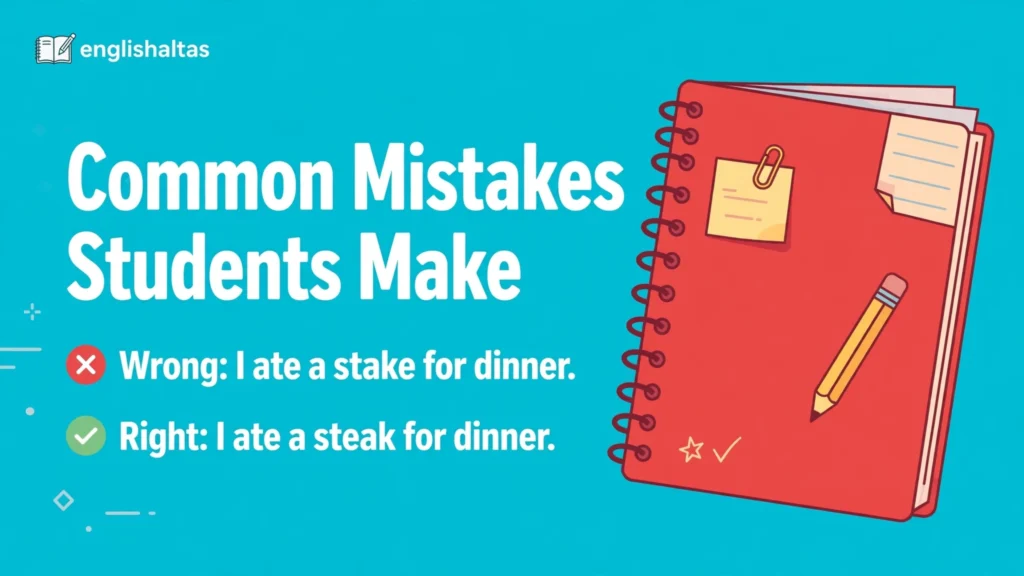
Many mistakes happen because English learners depend too much on sound. Sound is the main trap in unalienable vs inalienable and stake vs steak.
When stake and steak are spoken, they sound alike. A learner may know the correct meaning but still choose the wrong spelling while writing.
Mistake 1: Using “steak” for business ownership
❌ He has a steak in the company.
✅ He has a stake in the company.
The person has an interest or share in the company, not a piece of meat. That is the point of unalienable vs inalienable and stake vs steak.
Mistake 2: Using “stake” for food
❌ I ordered a stake at the restaurant.
✅ I ordered a steak at the restaurant.
The food is spelled steak.
Mistake 3: Thinking “unalienable” is always wrong
❌ Unalienable is not an English word.
This is not correct.
Unalienable is a real English word. It has nearly the same meaning as inalienable, although it is less common in modern usage. That fact is worth remembering in unalienable vs inalienable and stake vs steak.
Mistake 4: Using “alienable” when you mean “inalienable”
The prefix matters.
Alienable means something can be transferred.
Inalienable means it cannot be transferred.
For example:
The right is inalienable.
This means the right cannot properly be given away or taken away. That meaning is central to unalienable vs inalienable and stake vs steak.
Easy correction tip
Before writing, ask yourself one simple question:
Am I talking about food?
If yes, choose steak.
If you are talking about business, risk, ownership, or a post in the ground, choose stake.
For the other pair, ask:
Am I talking about a right or quality that cannot be taken away?
If yes, inalienable is usually your best modern choice. That quick check works for unalienable vs inalienable and stake vs steak.
Easy Trick to Remember the Difference
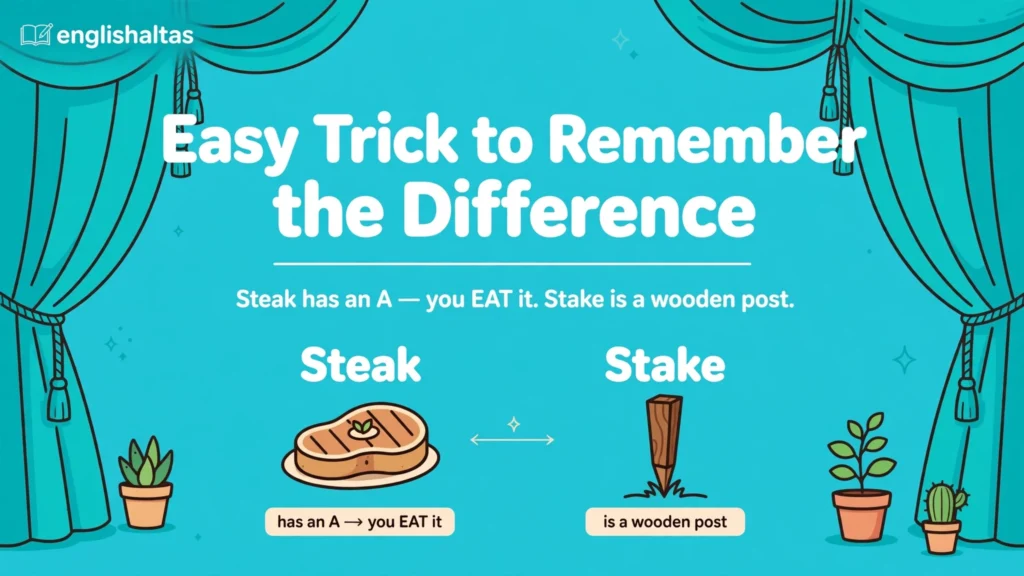
Here is a simple memory trick for stake vs steak.
Think:
Steak = food.
The word steak has “eat” sounds hidden in the way many learners remember it: st-EAK. It is not a perfect spelling rule, but it can remind you that steak belongs in the kitchen.
Now think:
Stake = share or risk.
You can have a stake in a business.
I have a stake in the company.
You can also have something at stake.
My job is at stake.
So remember:
Steak → plate
Stake → business, risk, or post
For unalienable vs inalienable, remember that both mean something that cannot be transferred or taken away.
But for modern everyday formal writing:
Inalienable → preferred
Unalienable → acceptable, but less common
This small distinction will help you make a more natural choice. It is a useful ending to unalienable vs inalienable and stake vs steak.
Daily Life Examples
Here are some simple examples showing how these words work in real situations. They show unalienable vs inalienable and stake vs steak in everyday use.
Example 1: Restaurant
A: What are you ordering?
B: I think I’ll have a steak.
Here, steak means food.
Example 2: Business
A: Does Maria own part of the company?
B: Yes. She has a large stake in it.
Here, stake means an ownership interest.
Example 3: Risk
A: Why are they so worried?
B: Their jobs are at stake.
Something important may be lost, so we use stake.
Example 4: Dinner
A: How was your meal?
B: The steak was excellent.
The subject is food, so steak is correct.
Example 5: Human rights
A: What does the law protect?
B: It protects certain inalienable rights.
Here, inalienable describes rights that cannot properly be taken away.
Example 6: Historical writing
A: What word did the writer use for these rights?
B: The writer called them unalienable rights.
This is also possible. Unalienable has the same basic meaning.
Example 7: Company investment
A: Why is he interested in the new company?
B: He has a financial stake in it.
He has money or an ownership interest connected to the company.
Example 8: Gardening
A: Why did you put that piece of wood in the ground?
B: It’s a stake. I’m using it to support the plant.
Here, stake means a pointed piece of wood or another material.
Example 9: Freedom
A: Do you think freedom can simply be given away?
B: Many people consider freedom an inalienable right.
The adjective describes the nature of the right.
Example 10: A dinner and a business deal
A: What are you doing tonight?
B: I’m having steak with my family. Tomorrow, I need to discuss my stake in the company.
The two words sound alike, but their meanings are completely different. That contrast sums up unalienable vs inalienable and stake vs steak.
Practice Section
Choose the correct word in each sentence.
1. We ordered a delicious ___ at the restaurant.
stake / steak
2. She has a large ___ in the company.
stake / steak
3. Human freedom is often described as ___.
inalienable / steak
4. Their jobs are at ___.
stake / steak
5. The farmer used a wooden ___ to support the tree.
stake / steak
Answers
- steak
- stake
- inalienable
- stake
- stake
The key is to look at the meaning, not just the sound. That key unlocks unalienable vs inalienable and stake vs steak.
FAQs About Unalienable, Inalienable, Stake, and Steak
What is the difference between unalienable and inalienable?
Unalienable and inalienable have almost the same meaning. Both describe something that cannot be transferred, surrendered, or taken away. Inalienable is much more common in modern English, especially when discussing human rights and freedom. That answer is a good summary of unalienable vs inalienable and stake vs steak.
Is unalienable a correct English word?
Yes. Unalienable is a correct English word. It is not a spelling mistake for inalienable. However, it is less common today. In most modern writing, inalienable is the more natural choice.
What is the difference between stake and steak?
Stake has meanings connected with ownership, interest, risk, or a pointed post. Steak means a piece of meat or fish prepared as food. They sound the same but have different spellings and meanings. That is the short answer in unalienable vs inalienable and stake vs steak.
Can “stake” be used in questions?
Yes. Stake can easily be used in questions.
For example:
How much of the company do you have a stake in?
Or:
What’s at stake if we lose?
The exact sentence structure depends on the meaning of stake.
Is “inalienable” formal or informal?
Inalienable is mainly a formal word. It is common in legal, political, academic, and serious discussions about rights and freedom. You are less likely to hear it in casual conversation.
How can I remember steak and stake?
Use the meaning as your clue. Steak is food, so think about a plate or dinner. Stake is used for business interests, risks, or a post in the ground. If you can replace the word with food, use steak.
Final Conclusion
The four words unalienable, inalienable, stake, and steak become much easier once you focus on meaning. That is the main message of unalienable vs inalienable and stake vs steak.
Unalienable and inalienable are very close. Both describe something that cannot be transferred, surrendered, or taken away.
In modern English, inalienable is generally the more common and natural choice, especially with words such as rights, freedom, and dignity. Unalienable is also correct, but it appears less often.
Stake and steak are different in another way. They sound the same, but their meanings are completely different.
A stake can be an interest in a company, something at risk, or a post in the ground. A steak is food.
When you are unsure, stop and think about the meaning of the sentence. Food means steak. Business, risk, or a post means stake.
A right that cannot be taken away is usually inalienable. Use that test in unalienable vs inalienable and stake vs steak.
A little practice with real sentences will make these words feel natural. Once you learn the meaning behind each spelling, choosing the correct word becomes much easier.
Practice is the best way to master unalienable vs inalienable and stake vs steak.

Oliver Bennett is an English language educator and content writer passionate about simplifying grammar. He creates clear, practical lessons, writing tips, and learning resources that help readers improve their English with confidence.