Last updated on November 7th, 2026 at 06:54 am
Effective vs efficient are two common English words that look and sound similar, so many learners use them in the wrong way.
Both words can describe something that works well, but they focus on different ideas.
Think about a student who studies for an exam. If the student studies in a way that helps them get a high score, the study method is effective.
If the student gets the same good result while using less time, effort, or money, the method is also efficient. This is the heart of the effective vs efficient difference.
That small difference is important in everyday English. You may hear people talk about an effective teacher, an efficient worker, an effective solution, or an efficient system.
The words are also common in school, business, technology, health, and daily conversation. The effective vs efficient choice appears in all of these places.
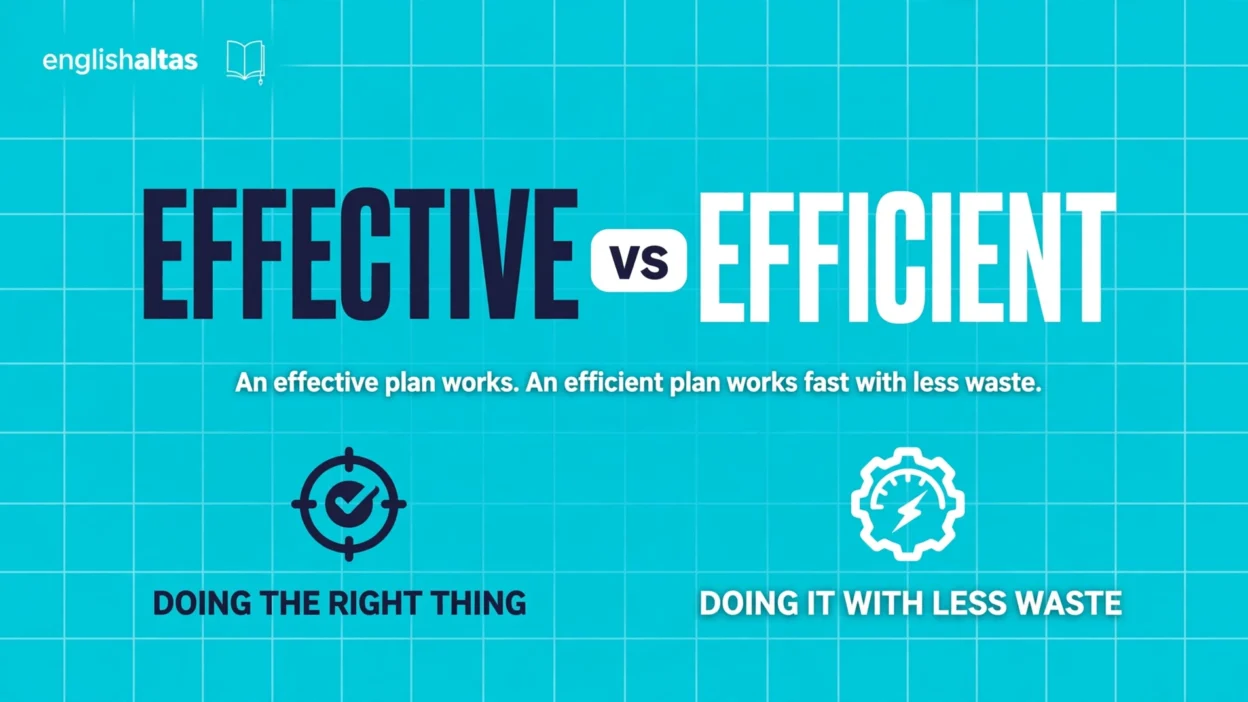
The easiest way to remember the difference is this: effective means successful at producing a result, while efficient means producing a result with little waste.
After learning this difference, you should be able to choose the right word in sentences, understand why some examples use effective and others use efficient, and avoid common mistakes.
This guide to effective vs efficient will help you use both words with confidence.
You will also see that something can be effective but not efficient, or efficient but not effective. Understanding this idea makes the difference much clearer.
That contrast is what makes effective vs efficient such a useful pair to learn.
What Does “Effective” Mean?
Effective means successful in producing the result that you want or need. Keeping the result in mind is the first step in the effective vs efficient comparison.
When something is effective, it works. It achieves its purpose or helps bring about a desired result.
For example, if a medicine helps a person feel better, it can be called effective. If a study method helps a student learn a difficult lesson, that method is effective. This is a simple effective vs efficient example: the result is what matters.
When should you use “effective”?
Use effective when your main idea is about success or results.
You are asking:
“Does it work?”
If the answer is yes, you can often use effective.
Grammar rule
Effective is an adjective.
It usually comes before a noun:
- an effective method
- an effective teacher
- an effective solution
- an effective treatment
It can also come after a linking verb such as be, seem, become, or remain:
- The method is effective.
- Her advice was effective.
- The new plan seems effective.
Examples of “effective”
- This is an effective way to learn new words.
- The teacher used an effective method to explain the lesson.
- We need an effective solution to this problem.
- Regular practice is effective for improving English.
- The new rule was effective in reducing mistakes.
- She gave me some effective advice.
- The medicine was effective against the infection.
- His speech was short but very effective.
Notice that these sentences mainly focus on whether something achieved its goal. They are good effective vs efficient examples because the result is the focus.
For example, “an effective way to learn” means the way actually helps you learn.
Common learner confusion
Learners sometimes think effective means “fast.” It does not.
Something can be effective even if it takes a long time.
For example:
Reading one book every month is an effective way to improve vocabulary.
It may not produce quick results, but it can still work well.
Another important point is that effective does not always mean “perfect.” It simply means that something produces the intended or useful result.
What Does “Efficient” Mean?
Efficient means able to produce a good result while using as little time, energy, money, effort, or other resources as possible. This focus on saving resources is the other side of effective vs efficient.
When something is efficient, there is little waste.
For example, imagine two workers who complete the same job correctly. One worker takes eight hours, while the other takes four hours and uses the same resources. The second worker is more efficient. This worker comparison is a clear effective vs efficient example.
When should you use “efficient”?
Use efficient when you want to talk about how well resources are used.
You are asking:
“Does it work without wasting time, effort, money, or energy?”
If the answer is yes, efficient may be the right word.
Grammar rule
Efficient is also an adjective.
It usually comes before a noun:
- an efficient worker
- an efficient system
- an efficient machine
- an efficient process
It can also come after a linking verb:
- The new system is efficient.
- She is very efficient.
- This machine seems efficient.
Examples of “efficient”
- She is an efficient employee.
- The new system is more efficient than the old one.
- We need an efficient way to organize these files.
- This car is fuel-efficient.
- He found an efficient way to finish the work.
- The machine uses energy efficiently.
- Our team became more efficient after using the new software.
- Public transportation can be an efficient way to travel.
These examples focus on saving resources while getting the job done. Each one is an effective vs efficient example in which saving resources matters.
Common learner confusion
A common mistake is to think efficient simply means “good.”
That is not quite correct.
An efficient system should normally produce useful results with little waste. A system that is fast but does not achieve its goal is not truly efficient in the full sense.
For example:
The worker finished the report in ten minutes, but it was full of errors.
We would not normally praise this as efficient because the desired result was not properly achieved.
Difference Between Effective vs Efficient
The main difference is simple:
Effective = gets the desired result.
Efficient = gets the desired result with little waste.
An effective method focuses on what result is achieved. An efficient method focuses on the result and the resources used to achieve it. Together, they sum up effective vs efficient in a few words.
| Effective | Efficient |
|---|---|
| Focuses on results | Focuses on results and resources |
| Means successful | Means working with little waste |
| Asks “Does it work?” | Asks “Does it work with good use of time, effort, money, or energy?” |
| Can take a lot of time | Usually saves time or resources |
| Can require more effort | Tries to reduce unnecessary effort |
| Common with solutions and methods | Common with systems, workers, machines, and processes |
Usage difference
Consider these two sentences:
The treatment is effective.
This tells us that the treatment works.
Now:
The treatment is efficient.
This sounds unusual in many everyday contexts unless we are talking about the resources, time, or process involved.
Another example:
She is an effective teacher.
This means she successfully helps students learn.
She is an efficient teacher.
This may mean she organizes her work well, manages time carefully, and avoids wasting effort.
A teacher can be both effective and efficient. She is a good effective vs efficient example because she does both well.
Grammar logic
Both words are adjectives, so they can describe nouns or appear after linking verbs.
Adjective + noun:
- an effective plan
- an efficient plan
- an effective worker
- an efficient worker
After a linking verb:
- The plan is effective.
- The process is efficient.
The grammar is similar, but the meaning is different. The effective vs efficient meaning is what changes, not the grammar.
Sentence structure difference
There is no special sentence structure that separates the two words. The important difference is the idea you want to express.
Compare:
The new system is effective.
The system achieves its purpose.
The new system is efficient.
The system achieves its purpose while using resources well.
The new system is both effective and efficient.
The system works and avoids unnecessary waste.
A simple example with studying
Imagine two students.
Student A studies for six hours and gets a high score.
Student B studies for three hours and gets the same high score.
Both study methods may be effective because both produce a good result.
But Student B’s method is more efficient because it achieves the result using less time.
This is one of the best ways to understand the difference. It is a clear effective vs efficient example for learners.
Grammar Rules You Must Remember
Rule #1: “Effective” focuses on the result
Use effective when you want to say that something works or achieves its purpose. This rule is the starting point for effective vs efficient in real sentences.
Example:
This exercise is effective for improving your pronunciation.
The important idea is that the exercise helps improve pronunciation.
Rule #2: “Efficient” focuses on good use of resources
Use efficient when something works without unnecessary waste of time, energy, money, effort, or materials. This rule completes the effective vs efficient picture for saving resources.
Example:
The new computer system is more efficient.
This suggests that the system can do its job while using resources better.
Rule #3: Something can be effective without being efficient
A method may produce the correct result but require too much time or effort. That is a classic effective vs efficient case: it works, but it wastes time.
Example:
The cleaning method is effective, but it takes three hours.
It works, so it is effective. However, it may not be efficient because it takes a long time.
Rule #4: Something can be efficient but fail to achieve the real goal
Being fast or economical does not automatically make something effective. That is the other classic effective vs efficient mistake to avoid.
Example:
The machine uses very little energy, but it does not clean the room properly.
It may use resources efficiently, but it is not effective because it fails to achieve its purpose.
The best solution is often both effective and efficient. A solution like that is the ideal effective vs efficient result.
Common Mistakes Students Make
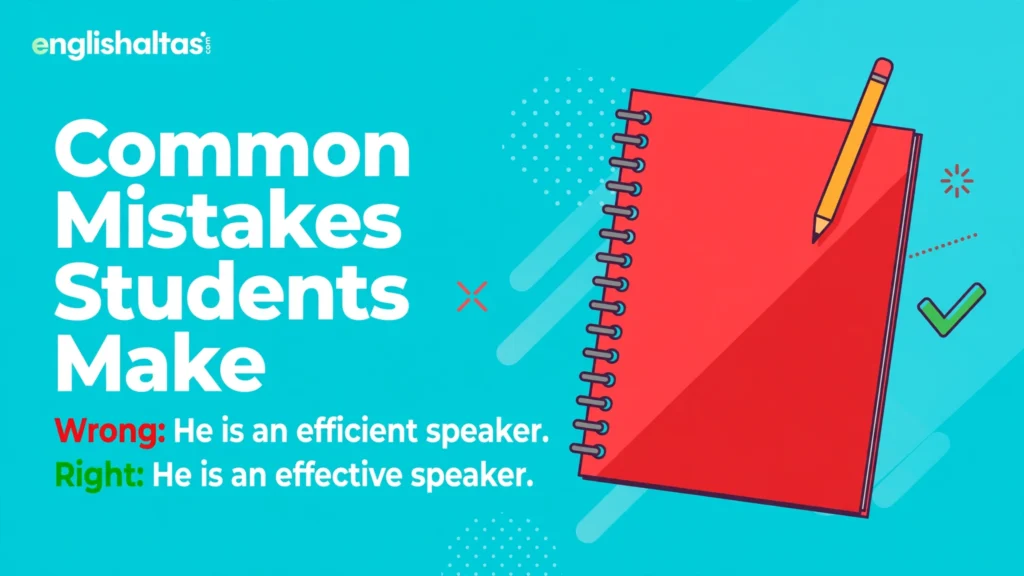
Mistake 1: Using “efficient” when you mean “successful”
Wrong:
This medicine is very efficient for headaches.
Better:
This medicine is very effective for headaches.
The main point is that the medicine works.
Mistake 2: Thinking “effective” means “fast”
Wrong idea:
If something takes a long time, it cannot be effective.
Correct idea:
Something can take a long time and still be effective.
For example:
Learning a language through regular practice is effective, even though it takes time.
The method works. That makes it effective. That is a useful effective vs efficient reminder for learners.
Mistake 3: Using “effective” when talking about saving time
Suppose a worker completes a task in half the normal time without reducing quality.
You could say:
She found an efficient way to complete the task.
The focus is on saving time and avoiding unnecessary work.
Mistake 4: Thinking every “good” worker is efficient
A worker can be very good at producing results but still waste time.
For example:
John is effective, but he spends too much time on simple tasks.
This tells us that John gets the job done, but his work process may not be efficient. John shows the effective vs efficient difference in a real worker.
Mistake 5: Forgetting that both words can describe the same thing
Sometimes you do not have to choose only one.
For example:
The new system is effective and efficient.
It works well and uses resources wisely.
This is often the ideal situation. It is the best effective vs efficient outcome you can aim for.
Easy correction tip
Before choosing the word, ask yourself one question:
Am I talking about the result, or am I talking about the use of resources?
- Result → effective
- Time, money, effort, energy, or waste → efficient
Easy Trick to Remember the Difference
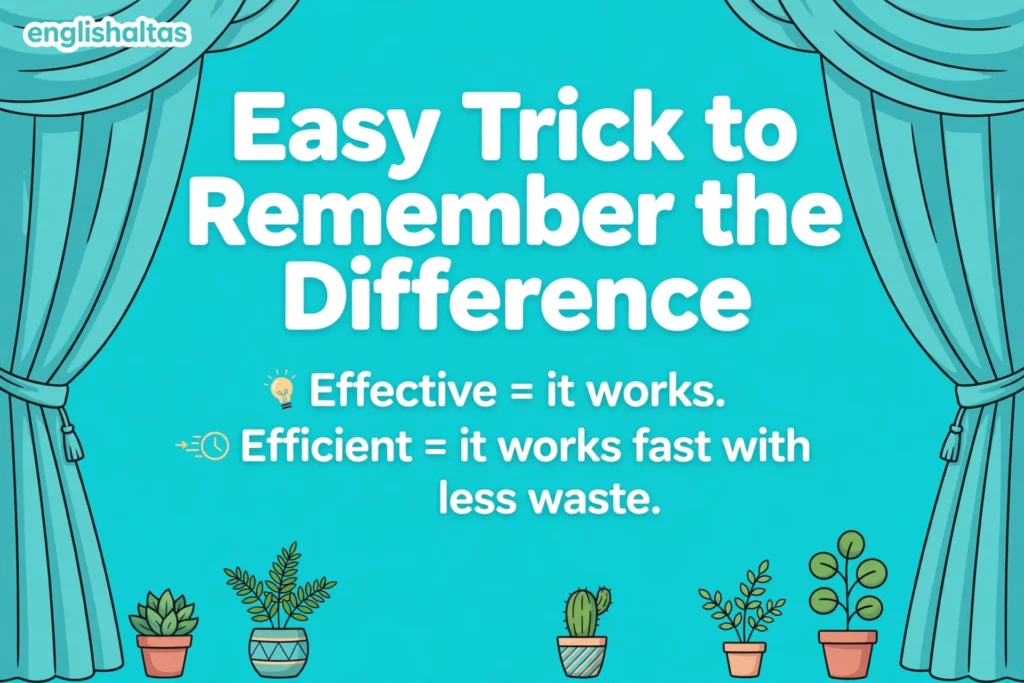
Here is a simple memory trick:
Effective = Effect
The word effective is connected to an effect or result.
Ask:
“What effect does it have?”
If something produces the result you want, it is effective.
Efficient = Economy
Think about economy.
An efficient person, machine, or system tries to avoid wasting:
- time
- money
- energy
- effort
- materials
So remember:
Effective = gets the job done.
Efficient = gets the job done without waste.
Imagine you need to travel 10 kilometers.
A car that takes you to your destination is effective.
If another car takes you to the same destination while using less fuel, that car is more efficient.
The second car can be both effective and efficient.
This simple real-life picture can help you remember the difference for a long time. Keep that picture in mind whenever you meet effective vs efficient again.
Daily Life Examples
The difference becomes easier when you see it in normal conversations. Each conversation below is a small effective vs efficient example.
1. At school
Student: Which study method should I use?
Teacher: Flashcards can be very effective for learning new vocabulary.
The focus is on whether flashcards help you learn.
2. Saving time
Manager: How did you finish the report so quickly?
Employee: I used a more efficient system for organizing the information.
The focus is on saving time and reducing unnecessary work.
3. At work
She is an effective manager because her team reaches its goals.
The manager gets results.
She is an efficient manager because she uses meetings and work time carefully.
The focus is on resource use.
4. Cooking
This recipe is effective for making soft bread.
It produces the desired result.
This recipe is efficient because it uses fewer ingredients and takes less time.
It reduces waste and saves resources.
5. Technology
The new software is effective at protecting important files.
It successfully protects the files.
The new software is efficient because it uses less computer memory.
It uses fewer resources.
6. Cleaning
This cleaner is effective at removing stains.
It removes the stains.
This cleaning machine is efficient because it cleans a large area quickly.
It saves time and effort.
7. Traveling
Taking the train is an effective way to reach the city.
The train gets you where you need to go.
Taking the train is an efficient way to travel because you can avoid traffic and save fuel.
The focus is on efficient use of resources.
8. Communication
Her explanation was effective because everyone understood the instructions.
The explanation achieved its purpose.
Her explanation was efficient because she gave all the important information in two minutes.
It achieved the purpose without wasting time.
9. Household work
This method is effective for removing dust.
It works.
This vacuum cleaner is efficient because it cleans the room quickly and uses less energy.
It works while using resources well.
10. Exercise
Walking every day can be an effective way to stay active.
It can help achieve the desired result.
A well-planned workout can be efficient because it gives you useful exercise in a short amount of time.
The focus is on using time and effort wisely.
Practice Section
Choose effective or efficient in each sentence. Use what you have learned about effective vs efficient to choose the right word.
1.
This new study method is very ________ because it helps students remember difficult words.
2.
The company introduced an ________ system that saves employees several hours each week.
3.
The treatment was ________ and helped the patient recover.
4.
We need a more ________ way to organize these files because the current process wastes too much time.
5.
Her explanation was short but ________; everyone understood the instructions.
Answers
1. effective
The focus is on the result: students remember the words.
2. efficient
The system saves time, so the focus is on resource use.
3. effective
The treatment produced the desired result.
4. efficient
The sentence talks about reducing wasted time.
5. effective
The explanation achieved its purpose because people understood it.
FAQs About Effective vs Efficient
What is the difference between effective vs efficient?
Effective means successful at producing the desired result. Efficient means achieving a result while using time, effort, money, energy, or other resources wisely.
For example, an effective study method helps you learn. An efficient study method helps you learn while using your study time well.
Can something be effective and efficient at the same time?
Yes. In fact, this is often the ideal situation.
For example, a washing machine can be effective if it cleans clothes properly and efficient if it cleans them while using less water and electricity.
So the two words are not opposites.
Can we use “effective” for people?
Yes. You can describe a person as effective when they achieve the results they are supposed to achieve.
For example:
She is an effective teacher.
This means she successfully helps her students learn.
Can we use “efficient” for people?
Yes. An efficient person organizes work well and avoids unnecessary waste of time, effort, or resources.
For example:
He is an efficient worker.
This suggests that he completes his work in a well-organized way without wasting time or effort.
Is “effective” formal or informal?
Effective is common in both formal and informal English.
You can use it in everyday conversation:
That exercise is effective.
You can also use it in professional or academic writing:
The program was effective in improving student performance.
Is “efficient” formal or informal?
Efficient is also used in both everyday and formal English.
You might say:
This is an efficient way to do it.
It is also common in business, technology, science, and professional writing.
Is an effective method always efficient?
No. A method can work well but still waste time, money, energy, or effort.
For example, a study method may help a student get a high score, but if the student needs ten hours every day to use it, the method may not be very efficient.
Final Conclusion
The difference between effective vs efficient is small, but it is very useful in everyday English.
Remember the main idea: effective means successful, while efficient means successful with little waste.
If you are talking about whether something works or produces the result you want, choose effective.
If you are talking about saving time, money, energy, effort, or other resources while getting a result, choose efficient.
A teacher can be effective because students learn well. The same teacher can be efficient because lessons are organized and classroom time is used wisely.
The best situation is often to be both effective and efficient.
Do not worry if the difference feels confusing at first. Try making your own sentences about studying, working, cooking, traveling, or using technology. Each time, ask yourself:
“Am I focusing on the result, or on avoiding waste?”
That one question will help you choose the right word with much more confidence.

Oliver Bennett is an English language educator and content writer passionate about simplifying grammar. He creates clear, practical lessons, writing tips, and learning resources that help readers improve their English with confidence.