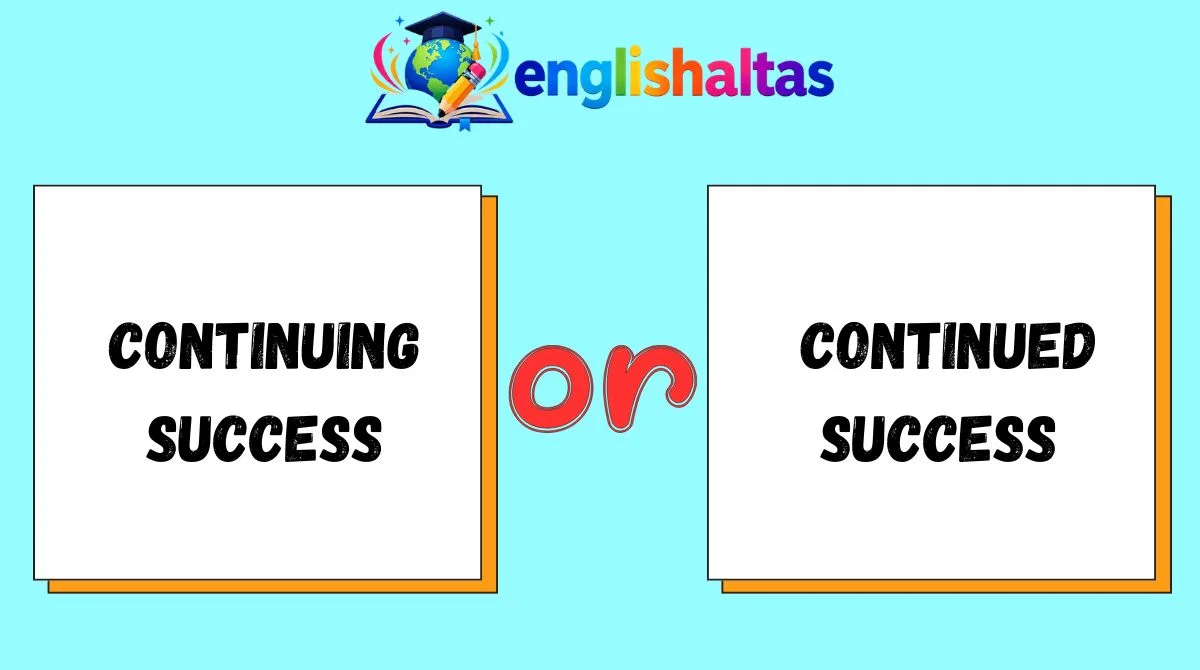
Continuing success or continued success? Which phrase should you use?
This small grammar choice confuses many English learners because both continuing and continued come from the verb continue. They also seem to have almost the same meaning.
ou may see a sentence like, “We wish you continuing success,” and then find another sentence saying, “We wish you continued success.”
So, which one sounds correct? The answer is that both phrases can be correct, but they focus on slightly different ideas.
This difference matters in emails, school writing, business messages, congratulations, and everyday English.
Native speakers often choose one phrase based on the meaning they want to express. For a learner, however, the choice can feel confusing.
The good news is that the grammar is not difficult. Continuing usually highlights something that is still happening or moving forward.
Continued often means that something has already been happening and is expected to keep going.
By the end of this guide, you will clearly understand continuing success vs.
continued success, how each phrase works, which one is more common in certain situations, and how to choose the right phrase without guessing.
You will also see simple examples from real life and a short practice section to test your understanding.
What Does “Continuing” Mean?
Continuing means still happening, still going, or moving forward without stopping.
It comes from the verb continue. The ending -ing shows an action or situation that is in progress.
Simple meaning of continuing
Think of continuing as “still going on.”
For example:
The team’s continuing success has impressed everyone.
This means the team is still succeeding, and its success is continuing now.
When should you use “continuing”?
Use continuing when you want to focus on the ongoing nature of something. It shows that a situation is still developing or happening.
It often describes:
- continuing success
- continuing growth
- continuing support
- continuing progress
- continuing interest
- continuing efforts
- continuing problems
Grammar rule for “continuing”
Continuing + noun is a common structure.
continuing + success
Here, continuing works as an adjective. It describes the noun success.
You can also use continuing in other grammar structures:
The company is continuing to grow.
Here, continuing is part of the verb phrase is continuing.
8 example sentences with “continuing”
- We are proud of your continuing success.
- The school has shown continuing growth this year.
- Her continuing efforts helped the team.
- The company is continuing to expand.
- Thank you for your continuing support.
- His continuing progress made his teacher happy.
- The project needs continuing attention.
- Their continuing success is a result of hard work.
Common learner confusion
Many students think continuing success means “success that has not happened yet.” That is not correct.
Continuing success means success that is still happening or moving forward.
For example, if a business has been doing well for several months and is still doing well, you can talk about its continuing success.
A simple way to understand it is:
Continuing = still happening now
What Does “Continued” Mean?
Continued means something that has gone on and is expected to go on or has been maintained.
It is the past participle form of continue, and it often works as an adjective.
Simple meaning of continued
Think of continued as “kept going” or “ongoing from before.”
For example:
We wish you continued success.
This means:
You have already been successful, and we hope your success keeps going.
This is a very common phrase in congratulations, business writing, and polite messages.
When should you use “continued”?
Use continued when you are talking about something that started earlier and has been maintained or is expected to continue.
It often describes:
- continued success
- continued support
- continued growth
- continued cooperation
- continued improvement
- continued interest
- continued efforts
Grammar rule for “continued”
Like continuing, continued can work as an adjective before a noun.
continued + success
So:
continued success
means that success continues from an earlier point.
You can also use continued in other sentence structures:
The project continued for three years.
Here, continued is the past form of the verb continue.
8 example sentences with “continued”
- We wish you continued success in your career.
- Thank you for your continued support.
- The company experienced continued growth.
- Her continued efforts brought good results.
- He made continued progress in English.
- The team received praise for its continued improvement.
- We appreciate your continued cooperation.
- They hope for continued success in the future.
Common learner confusion
Some students believe continued only talks about the past because it looks like a past-tense word.
That is not always true.
In continued success, the word continued describes a situation that began earlier and is still going on or is expected to go on.
For example:
We wish you continued success.
This is a present wish for the future. It does not mean the person’s success has ended.
A simple way to understand it is:
Continued = kept going from before
Difference Between Continuing Success and Continued Success
Both continuing success and continued success are grammatically correct. The main difference is the focus and feeling of the phrase.
Quick comparison table
| Phrase | Basic meaning | Main focus | Common use |
|---|---|---|---|
| Continuing success | Success still happening | Ongoing action or situation | Descriptions and reports |
| Continued success | Success kept going from before | Past success continuing | Wishes and formal messages |
1. “Continuing success” focuses on what is happening
When you say continuing success, you are looking at success as an ongoing process.
The team’s continuing success surprised its competitors.
The focus is on the fact that the team continues to succeed.
It sounds like you are describing a current situation.
2. “Continued success” looks back at earlier success
When you say continued success, you often recognize that success has already existed.
We wish you continued success.
The hidden idea is:
“You have been successful. We hope that success continues.”
That is why this phrase is very common in good wishes and congratulations.
3. The grammar logic is different
The -ing form often gives us the feeling of an action or situation in progress.
continuing success
It feels active and ongoing.
The -ed form can describe something maintained from an earlier point.
continued success
It feels like success has already been present and is continuing.
4. Sentence structure is almost the same
Both phrases follow this structure:
adjective + noun
- continuing + success
- continued + success
The difference is not mainly about sentence structure. The real difference is the meaning and focus.
5. Which phrase is more common?
Continued success is usually more common in phrases like:
We wish you continued success.
This is a familiar and polite expression.
Continuing success is also correct, but it is often used when someone is describing an ongoing trend or current performance.
Compare these sentences:
The company is enjoying continuing success.
This describes the company’s current situation.
We wish the company continued success.
This expresses a good wish for the future.
The easiest comparison
Continuing success = success is still happening.
Continued success = success has been happening, and we hope it keeps going.
The difference is small, but this simple idea will help you choose the right phrase.
Grammar Rules You Must Remember
Rule #1: Use “continuing” to focus on an ongoing situation
Continuing highlights something that is still happening or developing.
The student’s continuing progress is impressive.
The student is still making progress.
Easy tip: If you want to stress “still happening,” continuing may fit well.
Rule #2: Use “continued” for something that started earlier and carries on
Continued often connects the present with an earlier situation.
Thank you for your continued support.
The person has supported you before, and that support is still important.
Easy tip: If you mean “you have done this before, and it keeps going,” use continued.
Rule #3: “Continued success” is especially common in good wishes
This is one of the most important patterns.
We wish you continued success.
Best wishes for continued success.
I hope you enjoy continued success in your new role.
These phrases sound natural and polite.
Remember: In congratulations and formal wishes, continued success is usually the safer choice.
Rule #4: Both words can describe “success”
Do not think one phrase is correct and the other is always wrong.
The business is enjoying continuing success.
Correct.
We wish you continued success.
Correct.
The right choice depends on what you want to say.
Grammar is not only about the word form. Meaning also matters.
Common Mistakes Students Make
Mistake 1: Thinking “continued” means the success is over
Some learners see -ed and think:
“Continued is past, so the success must be finished.”
This is a common mistake.
Wrong idea
Continued success means past success only.
Correct idea
Continued success means success that carries on from an earlier time.
We wish you continued success.
This is a future-looking wish.
Correction tip: Do not automatically think -ed = finished. Look at the whole phrase.
Mistake 2: Using “continuing” in every situation
A learner may write:
I wish you continuing success.
This sentence is understandable, but continued success sounds much more natural for a good wish.
Better
I wish you continued success.
Why? Because the speaker is recognizing earlier success and wishing for more.
Correction tip: For phrases such as “I wish you…” and “Best wishes for…”, remember continued success.
Mistake 3: Believing “continuing success” is incorrect
This is the opposite problem.
Some students learn the phrase continued success and then think continuing success is always wrong.
That is not true.
The company has enjoyed continuing success in the market.
This is perfectly understandable and grammatically correct.
Correction tip: Ask yourself, “Am I describing an ongoing situation?” If yes, continuing may be suitable.
Mistake 4: Confusing the phrases with “success continues”
The phrases are related, but they are not exactly the same as a full sentence.
Success continues.
This is a complete sentence.
Continuing success
This is a noun phrase.
Continued success
This is also a noun phrase.
Correction tip: Check the role of the phrase in the sentence. Is it acting as a subject, object, or part of a wish?
Mistake 5: Choosing a phrase only because it sounds formal
Some students think continued sounds more intelligent, so they use it everywhere.
That is not a good grammar habit.
For example:
The company has continuing problems.
Here, the speaker is describing problems that are still happening.
The meaning matters more than trying to sound formal.
Simple tip: First understand the idea. Then choose the word.
Easy Trick to Remember the Difference
Here is a simple classroom trick:
Continuing = still going
Continued = kept going
Imagine a football match.
If the match is continuing, the match is still happening right now.
Now imagine a team that has won many matches. You say:
We wish the team continued success.
You are thinking:
“The team has already done well. May that success keep going.”
Use this two-question trick
Ask yourself:
Question 1: Am I describing something that is happening now?
If yes, think about continuing.
The company is enjoying continuing success.
Question 2: Am I wishing for success to carry on from before?
If yes, choose continued.
We wish you continued success.
A very short memory line
Continuing shows the action. Continued remembers the journey.
This is not a strict grammar rule for every sentence, but it is a very useful memory trick for this phrase.
Daily Life Examples
Here are some natural examples you may hear or use in real life.
1. At a graduation ceremony
We wish you continued success in your future career.
The student has already achieved something, and you hope for more success.
2. In a business email
Continuing Success or Continued Success
The person has supported the business before and is still supporting it.
3. Talking about a company
The company is enjoying continuing success in the local market.
This describes a success that is still happening.
4. Talking to a student
Continuing Success or Continued Success
The student’s progress is ongoing.
5. A congratulation message
Continuing Success or Continued Success
This is one of the most natural uses of continued success.
6. Talking about a sports team
Continuing Success or Continued Success
The team keeps performing well.
7. A polite business message
Continuing Success or Continued Success
The cooperation began earlier and has continued.
8. Talking about personal improvement
Her continuing efforts are finally producing results.
She is still working hard.
9. A teacher speaking to a student
Continuing Success or Continued Success
The student has already made progress.
10. A conversation about a growing business
Continuing Success or Continued Success
The speaker is explaining an ongoing business situation.
Notice the pattern: continued success often appears in wishes, while continuing success often appears in descriptions of an ongoing situation.
Practice Section: Choose the Correct Option
Choose continuing success or continued success in each sentence.
1. We wish you __________ in your new job.
2. The team’s __________ has surprised many people.
3. Thank you for your __________ support.
4. The company’s __________ growth is a good sign.
5. Best wishes for __________ in the future.
Answers
1. continued success
Continuing Success or Continued Success
This is a good wish for future success.
2. continuing success
Continuing Success or Continued Success
This describes success that is still happening.
3. continued support
Continuing Success or Continued Success
This is a common phrase for support that has continued from before.
4. continuing growth
Continuing Success or Continued Success
The growth is still happening.
5. continued success
Continuing Success or Continued Success
This is a standard good-wish expression.
FAQs
What is the difference between “continuing success” and “continued success”?
Continuing success focuses on success that is still happening or developing. Continued success suggests success that has already been happening and is expected to carry on. Both phrases can be grammatically correct.
Is “continued success” or “continuing success” more common?
Continued success is usually more common in good wishes and formal messages. For example, “We wish you continued success.” Continuing success is often used to describe an ongoing situation or trend.
Can we use “continuing success” in a sentence?
Yes, you can. For example: “The company is enjoying continuing success.” It means the company’s success is still happening. The phrase is grammatically acceptable.
Is “continued success” formal or informal?
Continued success sounds polite and slightly formal. You may see it in business emails, congratulations, official messages, and professional writing. However, it is also common in everyday good wishes.
Can I say “I wish you continuing success”?
The sentence may be understood, but “I wish you continued success” sounds more natural to most English speakers. The phrase continued success is a common expression for wishes.
Does “continued success” mean that success has ended?
No. Continued success does not mean the success is over. It means success has continued from an earlier time or is expected to keep going. “We wish you continued success” is a positive future wish.
Conclusion
The difference between continuing success and continued success is small, but the meaning becomes clear when you focus on the idea behind each word.
Continuing usually highlights something that is still happening or moving forward. For example, a company may enjoy continuing success in the market.
Continued often means something has already been happening and carries on from before. That is why continued success is very common in congratulations and good wishes.
The easiest memory trick is simple: continuing means “still going,” while continued means “kept going from before.”
Do not worry if this difference felt confusing at first. Many English learners have the same question.
Try to notice these phrases in emails, messages, and real conversations. After you see them a few times, choosing the right phrase will feel much easier.

Oliver Bennett is an English language educator and content writer passionate about simplifying grammar. He creates clear, practical lessons, writing tips, and learning resources that help readers improve their English with confidence.