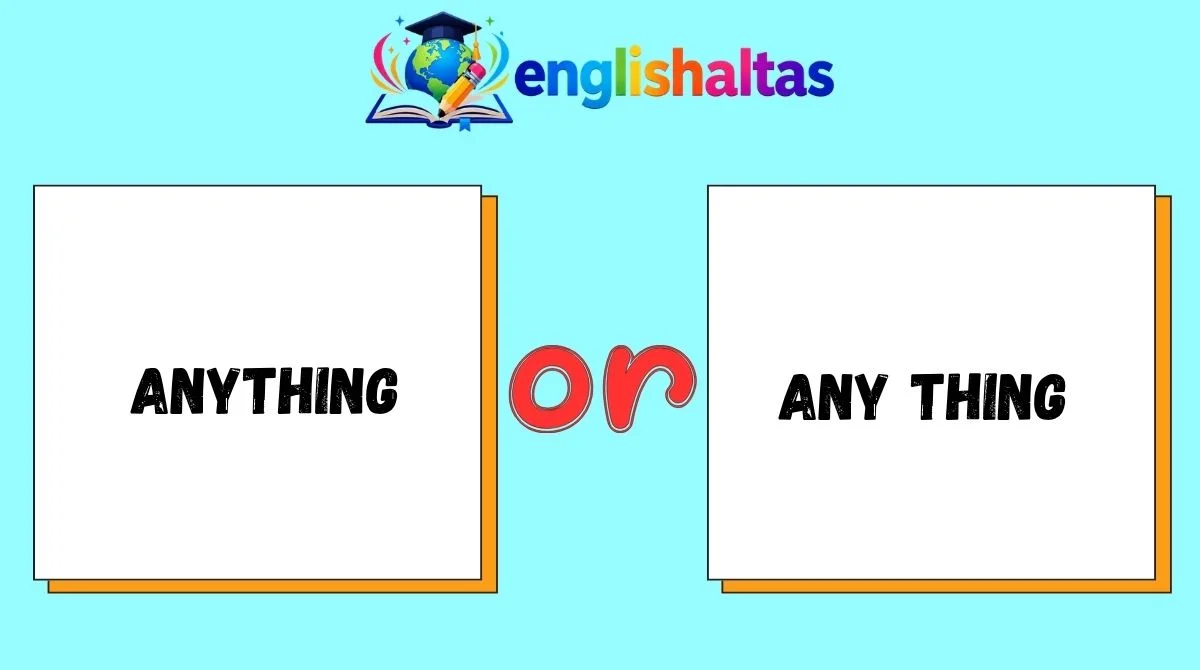
Anything and any thing look almost the same, so it is easy to wonder which form is correct. Many English learners see both forms and ask, “Should I write this as one word or two words?”
The short answer is that anything is the normal and much more common form in modern English. However, any thing can sometimes be correct when the writer wants to treat any and thing as separate words.
This small spelling difference matters because English has many words that change meaning when they are written together or separately.
Words such as something, someone, nobody, everyone, and anything are called indefinite pronouns. They are used every day in questions, answers, conversations, emails, school writing, and casual speech.
For example, you might say, “Do you need anything?” or “I can eat anything.” Here, anything means any object, item, or thing at all.
But there are rare situations where a speaker may want to emphasize the noun thing itself. In that case, any thing may be written as two words.
The good news is that the difference is easier than it first appears. Once you understand how anything works as an indefinite pronoun and how any thing works as two separate words, you can choose the correct form with confidence.
What Does “Anything” Mean?
Anything is normally written as one word. It is an indefinite pronoun that means any object, item, matter, or thing, without naming a specific one.
It is often used when the exact thing is unknown, unimportant, or not limited to one particular choice.
For example:
- “Do you need anything from the store?”
- “You can ask me anything.”
- “I don’t have anything to eat.”
- “Did you hear anything strange?”
- “She can buy anything she wants.”
- “I haven’t seen anything like this before.”
- “Is there anything I can do?”
- “He didn’t say anything about the meeting.”
In these sentences, anything replaces a noun. You do not need to say any thing because the word already has a complete meaning.
When Should You Use “Anything”?
Use anything when you mean any thing at all and the word is acting as an indefinite pronoun.
It is especially common in:
Questions
“Would you like anything to drink?”
“Is there anything I can help you with?”
Negative sentences
“I don’t know anything about it.”
“She didn’t buy anything.”
Conditional sentences
“If you need anything, call me.”
“If you see anything unusual, tell me.”
Sentences showing no limit
“You can choose anything from the menu.”
“He will eat anything.”
The Grammar Rule
The basic rule is simple:
Anything is normally one word when it means “any thing at all” and works as an indefinite pronoun.
It can be the subject or object of a sentence.
For example:
- Anything is possible.
- I didn’t find anything.
- She can do anything.
- Did you buy anything?
- We need anything? — This is usually unnatural without a special context; “Do we need anything?” is the normal question.
One useful point is that anything does not usually refer to one known object. It has an open meaning.
Compare:
- “I want anything.” = I am not particular about what I get.
- “I want the book.” = I have a particular book in mind.
Common Learner Confusion
A common mistake is thinking that because the word contains the noun thing, it should always be written as two words.
That is not how compound words work in English.
Anything is an established one-word indefinite pronoun, just like:
- something
- everything
- nothing
So if you mean “any thing at all,” the normal spelling is anything.
What Does “Any Thing” Mean?
Any thing consists of two separate words: any + thing.
This form is much less common than anything in modern everyday English. In most normal sentences, you should use anything instead.
However, any thing can be grammatically possible when any is being used as a determiner before the noun thing, especially when the writer wants to emphasize or contrast the word thing.
For example:
- “It was not just any thing; it was a family treasure.”
- “I would not exchange it for any thing in the world.”
- “She was looking for any thing that could help her.”
- “Not any thing will solve this problem.”
Even in some of these examples, modern writers would normally prefer anything. The two-word form is often used only when there is a clear reason to keep any and thing separate.
When Can “Any Thing” Be Used?
There are a few situations where a writer may deliberately use any thing as two words.
One situation is strong emphasis.
For example:
“This is not just any thing. It has special meaning to me.”
Here, the speaker is drawing attention to the noun thing. The meaning is close to “not just an ordinary thing.”
Another situation is when thing is being contrasted with another noun or idea.
For example:
“I don’t want any thing or person to stop us.”
This construction is unusual in everyday English, but the separation can make the structure clear.
A third situation occurs in older writing or special literary styles. Older English sometimes used word combinations differently from modern English. Therefore, you may occasionally see any thing in older books or historical texts.
Important Point About Modern English
For everyday English, do not make the two-word form your default.
If you want to say:
“I don’t need anything.”
write anything, not any thing.
If you want to ask:
“Did you buy anything?”
write anything.
If you want to say:
“You can choose anything.”
write anything.
The two-word form should have a clear purpose.
Difference Between Anything and Any Thing
The biggest difference is grammatical.
Anything is normally a single indefinite pronoun. It means any object, matter, or thing at all.
Any thing is made of two separate words. Here, any modifies the noun thing.
| Point | Anything | Any thing |
|---|---|---|
| Spelling | One word | Two words |
| Grammar | Indefinite pronoun | Determiner + noun |
| Frequency | Very common | Rare |
| Everyday English | Normal choice | Usually unnecessary |
| Meaning | Any thing at all | Any particular thing, with emphasis on “thing” |
| Common in questions | Yes | Rare |
| Common in negative sentences | Yes | Rare |
| Common in casual speech | Yes | Very rare |
| Best choice for learners | Yes | Only in special contexts |
Usage Difference
Consider this sentence:
Anything or Any Thing
Here, anything is an indefinite pronoun. It is the object of want.
Anything or Any Thing
Anything or Any Thing
Here, the writer is emphasizing the word thing. The phrase an ordinary or random thing with something special.
The difference is subtle, and that is why learners often become confused.
Grammar Logic
Think about anything as one complete word.
You do not normally analyze it in everyday writing as:
Anything or Any Thing
in the same way you would analyze:
Anything or Any Thing
For example:
- any book
- any student
- any car
- any answer
These are clearly two-word combinations because book, student, car, and answer remain ordinary nouns.
But anything has developed into a fixed indefinite pronoun. It functions as one grammatical unit.
That is why we normally write:
Anything or Any Thing
rather than:
Anything or Any Thing
Sentence Structure Difference
With anything, the word can stand alone:
Anything or Any Thing
There is no noun after it because anything itself is the pronoun.
With any thing, thing is still functioning as a noun:
Anything or Any Thing
In modern English, however, the natural version would usually be:
Anything or Any Thing
So although the two-word structure can exist, the one-word form is normally preferred.
Grammar Rules You Must Remember
Rule #1: Use “anything” for the normal indefinite pronoun
When you mean any thing at all, use anything.
Correct:
“I don’t need anything.”
Incorrect for normal modern usage:
“I don’t need any thing.”
The one-word form is the standard choice.
Rule #2: “Anything” is common in questions and negative sentences
You will often see anything after words such as not, never, and nothing, as well as in questions.
Examples:
- “Did you find anything?”
- “I don’t know anything.”
- “She never says anything.”
- “Is there anything wrong?”
- “We didn’t hear anything.”
This is one of the easiest patterns to remember.
Rule #3: Use “anything” in conditional sentences
Anything is also very common after if.
Examples:
- “If you need anything, call me.”
- “If you see anything unusual, let me know.”
- “If anything happens, stay calm.”
- “If you want anything from the shop, tell me.”
Here, anything has the open meaning of “any possible thing.”
Rule #4: Use “any thing” only when there is a real reason to separate the words
Do not write any thing simply because you can see the two parts any and thing.
Use the two-word form only when thing is deliberately being treated as a separate noun, often for emphasis, contrast, or a special stylistic purpose.
For ordinary English, choose anything.
Common Mistakes Students Make
Mistake 1: Writing “any thing” in every sentence
A learner may think:
Anything or Any Thing
But English contains many compound words that work as single units.
For example:
- something
- anything
- everything
- nothing
So:
Wrong in normal usage: “I didn’t buy any thing.”
Better: “I didn’t buy anything.”
Mistake 2: Thinking “anything” is only used in questions
Some learners first meet anything in questions such as:
Anything or Any Thing
They then think it cannot be used elsewhere.
It is also extremely common in negative and conditional sentences.
Negative:
“I don’t want anything.”
Conditional:
“If you need anything, call me.”
Positive:
“You can choose anything you like.”
Mistake 3: Replacing “anything” with “any thing” before another word
Learners sometimes write:
Anything or Any Thing
The normal modern form anything unusual.”
Here, unusual describes anything, but it does not make any thing necessary.
The same applies to:
Anything or Any Thing
Not:
Anything or Any Thing
Mistake 4: Assuming the two forms always have exactly the same style
Although the meanings can overlap, the forms do not have the same frequency.
Anything is natural and ordinary.
Any thing can sound unusual, old-fashioned, overly deliberate, or literary depending on the sentence.
For normal conversation and general writing, anything is almost always the better choice.
Easy Correction Tip
When you are unsure, ask yourself:
Anything or Any Thing
If the answer is yes, use anything.
Easy Trick to Remember the Difference
Here is a simple memSpecial emphasis on “thing” = possibly two words: any thing.
Imagine someone asks:
Anything or Any Thing
You answer:
Anything or Any Thing
You are not thinking about the noun thing. You simply mean that you have no special choice.
Now imagine someone says:
Anything or Any Thing
The speaker is focusing on thing itself. The phrase creates contrast:
not just any thing → but something special
That is the main idea.
For students, another easy rule is even simpler:
Anything or Any Thing
You will be correct in the vast majority of situations.
Daily Life Examples
The best way to understand a grammar point is to see it in natural conversations.
Example 1: At Home
Mom: “Do you need anything from the kitchen?”
Son: “No, I’m fine. Thanks.”
Here, anything means any item at all.
Example 2: At a Store
Friend: “Did you buy anything?”
You: “Yes, I bought some snacks.”
The question does not ask about one specific item. It asks whether you bought something at all.
Example 3: At School
Student: “I don’t understand anything in this lesson.”
Teacher: “That’s okay. Let’s start with the first example.”
Here, anything appears in a negative sentence.
Example 4: At Work
Manager: “Is there anything I can do to help?”
Employee: “Could you check this report?”
This is a very common spoken-English pattern.
Example 5: On the Phone
Friend: “If you need anything, just call me.”
You: “Thanks. I will.”
The word appears naturally in a conditional sentence.
Example 6: Choosing Food
Waiter: “Would you like anything else?”
Customer: “No, thank you.”
This is a common restaurant expression.
Example 7: Talking About a Special Object
Friend: “Why are you keeping that old box?”
You: “It’s not just any thing. It was my father’s.”
The two-word form is being used deliberately for emphasis. In ordinary writing, however, many writers would still choose anything and express the contrast in another way.
Example 8: Looking for Help
You: “Did you find anything useful online?”
Friend: “Yes. I found a helpful guide.”
Again, anything is the natural choice.
Example 9: Shopping for a Gift
Sister: “What should I buy him?”
Brother: “Anything simple is fine.”
Here, anything means any choice that meets the basic condition.
Example 10: Emergency Situation
Person A: “Did you see anything unusual?”
Person B: “No, everything looked normal.”
This is another very natural everyday use.
Practice Section
Choose the correct option: anything or any thing.
1. Did you buy ______ at the supermarket?
2. I don’t need ______ right now.
3. You can ask me ______ you want.
4. This isn’t just ______; it has great personal value.
5. If you notice ______ unusual, tell the teacher.
Answers
1. anything
“Did you buy anything at the supermarket?”
2. anything
“I don’t need anything right now.”
3. anything
“You can ask me anything you want.”
4. any thing
“This isn’t just any thing; it has great personal value.”
The two-word form is used here to emphasize thing and create a contrast.
5. anything
“If you notice anything unusual, tell the teacher.”
A useful pattern to remember is anything + adjective:
- anything useful
- anything unusual
- anything interesting
- anything important
- anything strange
These are normally written with anything as one word.
FAQs
What is the difference between “anything” and “any thing”?
Anything is normally one word and works as an indefinite pronoun meaning “any thing at all.” It is very common in modern English.
Any thing contains two separate words and is much less common. It may be used when the writer wants to emphasize the noun thing or create a contrast.
Is “anything” one word or two words?
Anything is one word. It is a standard indefinite pronoun.
For example:
Anything or Any Thing
Writing any thing in this sentence would normally be unnecessary and unnatural.
Can we use “anything” in questions?
Yes. Anything is very common in questions.
Examples include:
Anything or Any Thing
Anything or Any Thing
Anything or Any Thing
Questions often use anything because the speaker does not know whether there is a thing to talk about.
Is “any thing” grammatically correct?
It can be grammatically possible, but it is rare in normal modern English.
It may appear when any modifies the noun thing separately, especially for emphasis or contrast. In most everyday sentences, however, anything is the natural choice.
Should I write “anything unusual” or “any thing unusual”?
Write:
Anything or Any Thing
This is the normal modern form.
For example:
Anything or Any Thing
The adjective unusual describes the indefinite pronoun anything. There is no need to separate any and thing.
Is “anything” formal or informal?
Anything is completely normal in both spoken and written English. It is not limited to informal English.
You can use it in everyday conversation, school assignments, emails, reports, and other normal forms of writing.
Conclusion
The difference between anything and any thing is small, but understanding it can make your English much cleaner.
In normal modern English, anything is the correct and natural choice when you mean any thing at all. It is an indefinite pronoun and is especially common in questions, negative sentences, and conditional sentences.
For example:
- “Do you need anything?”
- “I don’t want anything.”
- “If you need anything, call me.”
- “You can choose anything.”
The two-word form, any thing, is much less common. It may be used when thing is being treated as a separate noun, especially when the writer wants to add emphasis or make a contrast. Even then, many modern writers would choose a different sentence structure.
So, when you are unsure, remember the simple rule: normal everyday meaning = anything. Practice this pattern in your own sentences, and the correct spelling will soon feel natural.
The goal is not to memorize a complicated grammar rule. It is simply to notice how English speakers normally use the word. Once you do that, anything becomes an easy choice.

Oliver Bennett is an English language educator and content writer passionate about simplifying grammar. He creates clear, practical lessons, writing tips, and learning resources that help readers improve their English with confidence.