Have you ever seen “Lyme disease” and “lime disease” and wondered if they mean the same thing? You are not alone.
Many English learners get confused because the two expressions sound almost exactly the same when people say them aloud.
The small spelling difference can create a big meaning difference. One term is the name of a health condition, while the other usually refers to a disease name written incorrectly.
This is why learning the difference between Lyme disease vs lime disease is useful for students, writers, and anyone who wants to use English correctly.
The confusion often happens in online searches, school writing, health conversations, and spoken English.
A learner may hear “Lyme” and write “lime” because “lime” is a familiar English word. It is the name of a green fruit, so the spelling feels natural.
By the end of this guide, you will clearly understand what Lyme means, why “lime disease” is usually incorrect, how capitalization works, and how to avoid this common spelling mistake.
You will also see simple examples from daily English and a short practice section.
The easiest answer is this: Lyme disease is the correct name of the illness. “Lime disease” is normally a spelling mistake when someone means that illness.
What Does “Lyme” Mean?
Lyme is a proper name used in the medical term Lyme disease. Lyme disease is an illness caused by certain bacteria and commonly linked to infected tick bites.
For English learners, the most important point is simple: “Lyme” is not the fruit “lime.” It is part of the official name of a disease.
The word Lyme is also written with a capital L because it is a proper name in the disease term. This is one reason you should not treat it like an ordinary common noun.
When should you use “Lyme”?
Use Lyme when you are talking about Lyme disease or something directly connected with it.
You may see phrases such as:
- Lyme disease
- Lyme disease symptoms
- Lyme disease testing
- Lyme disease treatment
- Lyme disease prevention
In everyday writing, Lyme usually appears with the word disease. It is not normally used as a general English word by itself.
Grammar rule for “Lyme”
The basic grammar rule is:
Use “Lyme” as a proper name in the expression “Lyme disease.” Capitalize the first letter.
Here are some simple examples:
- Lyme disease can be caused by certain bacteria.
- The doctor explained the symptoms of Lyme disease.
- She learned about Lyme disease in science class.
- The article gives basic information about Lyme disease.
- Some people confuse Lyme with lime.
- He searched for Lyme disease information online.
- The nurse used the correct spelling, Lyme disease.
- Many students ask how to spell Lyme disease.
Notice the spelling in every sentence: Lyme.
Common learner confusion about “Lyme”
The biggest problem is sound. “Lyme” and “lime” are usually pronounced the same way in English. Both sound like /laɪm/.
So, when a learner hears the word, there is no clear sound clue to help with spelling.
Think about it this way:
- Lyme = part of the disease name
- lime = a green fruit or, in some contexts, a verb
The sound is almost the same, but the meaning and spelling are different.
A helpful point for students is that Lyme is a name, not a spelling choice. If you mean the illness, use the official spelling Lyme disease.
What Does “Lime” Mean?
Lime is a normal English word with several meanings. The most common meaning is a small green citrus fruit.
For example, you can cut a lime and add its juice to a drink or food. The word lime can also have other meanings in English, but these meanings are completely different from Lyme disease.
When should you use “lime”?
Use lime when you are talking about the fruit or another correct meaning of the common English word.
For example, you may say:
- a lime
- lime juice
- lime water
- lime flavor
- lime green
In these examples, lime is an ordinary common noun or part of a common phrase.
Grammar rule for “lime”
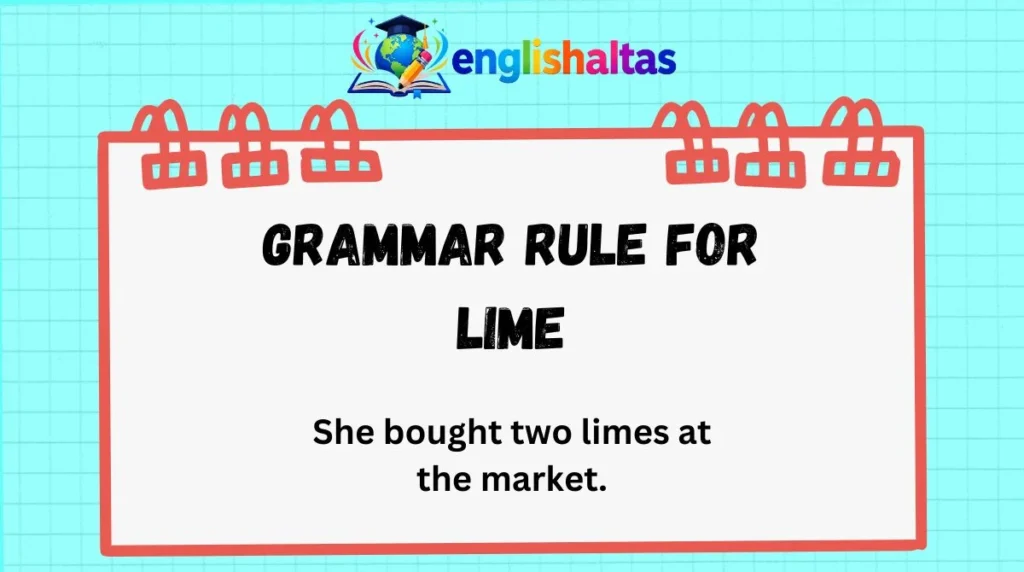
The simple grammar rule is:
Use lowercase “lime” for the common English word, unless it begins a sentence or is part of a proper name.
Here are eight examples:
- I added lime juice to my water.
- This drink has a strong lime flavor.
- She bought two limes at the market.
- The recipe needs fresh lime.
- He likes lime and lemon drinks.
- The shirt is lime green.
- Can you pass me the lime?
- Lime is often used in food and drinks.
In all these sentences, lime has its normal English meaning.
Common learner confusion about “lime”
Learners often write lime disease because they already know the word lime. It is a familiar word, and it sounds exactly like Lyme.
This is a classic homophone problem.
A homophone is a word that sounds the same as another word but has a different spelling or meaning. For example:
- sun / son
- right / write
- sea / see
- lime / Lyme
The important thing is to look at the meaning and context.
If you are talking about a fruit, write lime.
If you are talking about the illness, write Lyme disease.
Difference Between Lyme Disease and Lime Disease
The difference between Lyme disease vs lime disease is mainly a difference in spelling, meaning, and correct usage.
| Term | Meaning | Correct use | Capitalization |
|---|---|---|---|
| Lyme disease | The name of an illness | Correct medical term | Lyme is capitalized |
| lime disease | Usually a spelling mistake for Lyme disease | Usually incorrect | Lime is lowercase |
| lime | A green citrus fruit or another common word | Correct in the right context | Usually lowercase |
Usage difference
Lyme disease is the correct expression when you mean the illness.
He is reading about Lyme disease.
Lime disease is normally not the correct name of that illness.
He is reading about lime disease. ❌
The second sentence uses the wrong spelling for the medical term.
Grammar logic
This is not really a difficult grammar problem. It is mostly a vocabulary and spelling problem.
English has many words that sound alike. The grammar of the sentence may be perfectly correct, but the word choice can still be wrong.
For example:
She has lime disease.
The sentence structure is fine:
She + has + noun
But the noun is spelled incorrectly if the speaker means Lyme disease.
The correct sentence is:
She has Lyme disease.
So, remember: correct grammar does not always mean correct vocabulary.
Sentence structure difference
The expression Lyme disease works as a noun phrase.
- Lyme = name
- disease = common noun
Together, they form the name of a specific illness.
For example:
Lyme disease is discussed in the lesson.
Here, Lyme disease is the subject of the sentence.
By contrast, lime can be used in different sentence structures:
I bought a lime.
Here, lime is a noun.
I like lime juice.
Here, lime describes the type of juice.
The wall is lime green.
Here, lime is part of a color expression.
Meaning comparison
The meaning is the biggest difference.
Lyme disease is connected to health and medicine.
Lime is usually connected to food, drinks, fruit, or color.
One letter changes the word, but the topic changes completely.
A simple comparison is:
Lyme Disease vs Lime Disease
Lyme Disease vs Lime Disease
That short idea can help you make the correct choice quickly.
Grammar Rules You Must Remember
Rule #1: Use “Lyme disease” for the illness
If you mean the specific illness, always write Lyme disease.
Example:
The doctor talked about Lyme disease.
Do not change Lyme to lime just because the two words sound the same.
Rule #2: Capitalize “Lyme”
Lyme begins with a capital L in the name Lyme disease.
Example:
Lyme Disease vs Lime Disease
The capital letter helps show that Lyme is a proper name.
Rule #3: Use lowercase “lime” for the fruit
When you mean the green citrus fruit, use lime with a lowercase l in the middle of a sentence.
Example:
She squeezed a lime into the drink.
Here, lime has nothing to do with the disease.
Rule #4: Check the meaning before choosing the spelling
Do not choose the word only by its sound.
Ask yourself:
Am I talking about an illness or a fruit?
Example:
He is learning about Lyme disease.
He is drinking lime water.
The context gives you the answer.
Common Mistakes Students Make
Many students make this mistake because English spelling is not always easy to guess from pronunciation. When two words sound the same, learners often choose the word they already know.
Mistake 1: Writing “lime disease”
Wrong:
Lyme Disease vs Lime Disease
Correct:
Lyme Disease vs Lime Disease
The word lime is familiar, but the disease name is spelled Lyme.
Easy correction tip: Think of Lyme as a special name.
Mistake 2: Using a lowercase “l” in Lyme
Wrong:
She is studying lyme disease.
Correct:
She is studying Lyme disease.
The first letter of Lyme should be capitalized.
Easy correction tip: Remember that Lyme is a name.
Mistake 3: Thinking “Lyme” is a type of lime
Some learners think Lyme disease is related to a lime fruit.
That is not the meaning of the word. The similar sound is simply confusing.
Wrong idea:
“Lyme disease must be connected to lime.”
Correct idea:
Lyme and lime are different words with different meanings.
Mistake 4: Correcting the wrong part of the sentence
Sometimes a student says:
I have lime disease.
A learner may think the grammar is wrong because the sentence sounds strange.
Actually, the main problem is spelling and word choice.
The sentence should be:
I have Lyme disease.
The grammar pattern I + have + noun is fine.
Mistake 5: Trusting spelling software too much
Some spell-check tools may not understand exactly what you mean. They may suggest a familiar word such as lime.
This is why you should also use context and meaning.
Quick tip: A spell checker can help with spelling, but you must choose the correct word.
Easy Trick to Remember the Difference
Here is a very simple memory trick:
Lyme has a “Y” because it is a special name. Lime is the fruit.
You can also remember this short sentence:
Lyme Disease vs Lime Disease
Say it slowly in your head:
Lyme = illness. Lime = fruit.
Another useful trick is to imagine two different pictures.
Picture Lyme disease in a health or science lesson.
Now picture a green lime in a glass of water.
The pictures are completely different. This helps your brain connect the meaning with the spelling.
Real-life logic
Imagine you are writing a message to a teacher:
We learned about Lyme disease today.
You are talking about a health topic, so you need Lyme.
Now imagine you are texting a friend:
Please buy some lime for the drinks.
You are talking about food, so you need lime.
The topic tells you the spelling.
That is the easiest way to remember the difference.
Daily Life Examples
Here are simple examples that show how Lyme disease and lime are used in real conversations.
1. Talking about a health lesson
Student: What did you learn in science today?
Teacher: We talked about Lyme disease.
The disease name uses Lyme.
2. Talking about a drink
Friend: Why does your water taste fresh?
You: I added some lime.
Here, lime means the fruit.
3. Asking about spelling
Lyme Disease vs Lime Disease
Teacher: No. The correct spelling is Lyme disease.
This is a common spelling question.
4. Reading an online page
Aisha: What are you reading?
Sara: I am reading about Lyme disease.
The health topic clearly tells us to use Lyme.
5. Shopping for food
Mother: Can you buy lemons?
Son: Should I buy limes, too?
The conversation is about fruit, so limes is correct.
6. Writing a school sentence
Teacher: Use the correct spelling in your sentence.
Student: Lyme disease is a health condition.
The student uses the proper disease name.
7. Making a drink
Dad: What do we need for the recipe?
Daughter: We need water, sugar, and lime.
This is a normal food-related use.
8. Asking a spelling question
Student: Why do Lyme and lime sound the same?
Teacher: They are homophones. Their sounds are similar, but their meanings and spellings are different.
9. Correcting a message
Friend: I wrote “lime disease” in my homework.
You: Change it to Lyme disease if you mean the illness.
10. Talking about color
Student: What color is that shirt?
Friend: It is lime green.
Here, lime is used in a color expression.
Practice Section
Choose the correct word: Lyme or lime.
- I added fresh ___ to my drink.
- We learned about ___ disease in science class.
- Is “___ disease” the correct spelling?
- She bought three ___ at the market.
- The doctor discussed ___ disease.
Answers
- Lyme Disease vs Lime Disease
- Lyme
- Lyme
- limes
- Lyme Disease vs Lime Disease
Quick explanation
If the sentence is about fruit, food, drinks, or color, choose lime.
If the sentence is about the illness, choose Lyme.
Try making your own two sentences now. Write one sentence with Lyme disease and another with lime. This small practice can help you remember the difference much better.
FAQs
What is the difference between Lyme disease and lime disease?
Lyme disease is the correct name of a specific illness. Lime disease is usually a spelling mistake when someone means Lyme disease. The two expressions sound the same, but Lyme and lime have different spellings and meanings.
Can we use “lime” in questions?
Yes. You can use lime in questions when you mean the fruit or another correct meaning of the word.
For example: “Do we need a lime for the recipe?”
However, if you are asking about the illness, use Lyme disease: “Have you heard of Lyme disease?”
Is “Lyme disease” formal or informal?
Lyme disease is the standard and correct medical name. You can use it in formal writing, school work, news, and everyday conversation. It is not an informal slang expression.
Why do Lyme and lime sound the same?
They sound the same because Lyme and lime are homophones. English has many words with the same or very similar pronunciation but different spellings and meanings. You must use the context to choose the correct word.
Is “lime disease” ever the correct spelling?
When you mean the well-known illness, “lime disease” is normally incorrect. The correct spelling is Lyme disease. The word lime is a separate English word, usually connected with the fruit or other meanings.
How can I remember Lyme disease spelling?
Use this simple memory line: “Lyme is an illness; lime is a fruit.” Also remember that Lyme starts with a capital L because it is part of a proper disease name. Practicing two short example sentences can make the difference easy to remember.
Final Conclusion
The difference between Lyme disease vs lime disease is easy once you connect each spelling with its meaning.
Lyme disease is the correct name of an illness. The word Lyme starts with a capital L and is spelled with a y.
Lime is a different English word. It usually means the green citrus fruit and is written with a lowercase l in normal sentences.
The two words sound the same, so it is completely understandable that English learners get confused. Still, the best way to choose the correct spelling is to think about the meaning first.
Ask yourself one simple question: Am I talking about an illness or a fruit? If it is an illness, write Lyme disease. If it is a fruit, write lime.
Keep practicing with short sentences. A few examples can make this spelling difference stick in your mind for a long time.

Oliver Bennett is an English language educator and content writer passionate about simplifying grammar. He creates clear, practical lessons, writing tips, and learning resources that help readers improve their English with confidence.