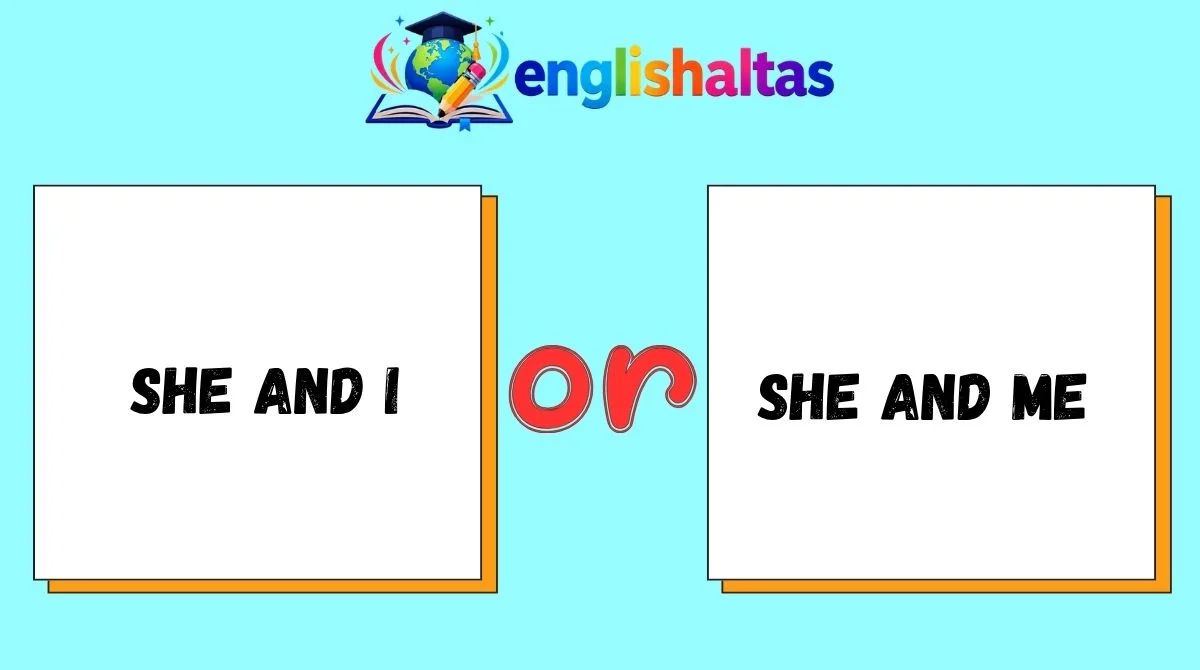
“She and I” or “she and me” — which one is correct? This is one of those English grammar questions that seems simple until you actually have to say or write the sentence.
Many learners have been taught that “she and I” is always correct and “she and me” is always wrong. That rule is too simple.
Both “she and I” and “she and me” can be correct. The right choice depends on the grammatical role of the pronouns in the sentence.
For example:
She and I went to the store.
Here, she and I are doing the action, so the subject pronouns are required.
But:
The teacher spoke to she and me.
This is not standard English. The correct sentence is:
The teacher spoke to her and me.
Notice something important: when she changes to her, the choice is no longer “she and I” versus “she and me.” The correct pair becomes her and me because both pronouns are objects.
You may also hear “me and her” in casual conversation. Native speakers sometimes use that order in informal speech, but “she and I” or “her and me” is generally more appropriate in standard English, depending on the sentence.
This guide explains the difference in plain English, with grammar rules, natural examples, everyday conversations, common mistakes, and a simple trick that makes the answer much easier to remember.
And yes, the article below is written from scratch rather than copied from another website.
What Does “She and I” Mean?
“She and I” is a combination of two subject pronouns:
- she = subject pronoun
- I = subject pronoun
We use subject pronouns when the people or things are performing the action of the verb.
For example:
She and I went shopping.
Who went shopping?
She and I.
They are the subjects of the verb went, so she and I is correct.
When should you use “she and I”?
Use she and I when the two people are the subject of the sentence.
A useful pattern is:
She and I + verb
Examples:
- She and I work together.
- She and I went to school together.
- She and I are good friends.
- She and I discussed the problem.
- She and I will meet tomorrow.
- She and I watched the movie last night.
- She and I have known each other for years.
- She and I decided to leave early.
In every sentence, she and I are connected to the action or state being described.
The grammar rule behind “she and I”
The important point is not that she and I sounds formal or educated. The reason it is correct is that both pronouns are subjects.
Compare the individual pronouns:
She went home.
I went home.
Now combine them:
She and I went home.
The grammar stays the same.
This is a useful way to understand the rule instead of simply memorizing a phrase.
“She and I” does not always come first
The pair does not have to appear at the beginning of a sentence.
For example:
After lunch, she and I went for a walk.
The sentence begins with after lunch, but she and I are still the subjects of went.
You can also say:
When the meeting ended, she and I talked outside.
Again, they are performing the action.
A common learner confusion
Some learners have heard teachers say:
“Never say me. Always say I.”
That is not a correct general rule.
I is a subject pronoun, while me is an object pronoun. Both are necessary in English, but they have different jobs.
We say:
I called her.
But:
She called me.
It would be wrong to use I in the second sentence simply because I sounds more formal.
The same principle applies to she and I and she and me.
What Does “She and Me” Mean?
“She and me” combines she, a subject pronoun, with me, an object pronoun.
Because the two pronouns have different grammatical forms, “she and me” is usually not correct in standard English when the pair performs the same grammatical role.
However, there is an important point here: when she is also functioning as an object, it changes to her.
So in standard English, you normally say:
her and me
rather than:
she and me
For example:
The manager spoke to her and me.
Both people are objects of the preposition to, so the object pronouns her and me are needed.
The correct object forms
The pronoun forms are:
| Subject | Object |
|---|---|
| she | her |
| I | me |
Therefore:
Subject pair:
she and I
Object pair:
her and me
This is one of the most useful things to remember.
Examples with “her and me”
- The teacher called her and me after class.
- The manager spoke to her and me.
- They invited her and me to dinner.
- The decision affected her and me.
- He gave her and me the same instructions.
- The coach congratulated her and me.
- Someone asked her and me for directions.
- The company hired her and me last year.
In these examples, her and me receive the action or follow a preposition.
So is “she and me” ever heard?
Yes. You may hear “she and me” in casual speech, regional varieties of English, song lyrics, or informal conversation.
But if your goal is standard written English or careful spoken English, it is better to use the correct pronoun forms based on grammatical function.
For example:
She and I went to the concert. ✓
The tickets were for her and me. ✓
Not:
She and me went to the concert. ✗
And not:
The tickets were for she and I. ✗
The important lesson is that the question is not really about choosing between I and me alone. You must first identify whether the pronoun is a subject or an object.
Difference Between She and I and She and Me
The central rule is simple:
Use subject pronouns for subjects and object pronouns for objects.
For this particular pair, that means:
- she and I → subject
- her and me → object
The phrase “she and me” is therefore generally not the standard form you want when both pronouns belong together.
Comparison Table
| Phrase | Standard? | Grammatical role | Example |
|---|---|---|---|
| she and I | Yes | Subject | She and I went home. |
| her and me | Yes | Object | They invited her and me. |
| she and me | Usually no | Mixed forms | She and me went home. |
| her and I | Usually no | Mixed forms | They invited her and I. |
The easiest test: remove the other person
This is probably the best trick for deciding between I and me.
Take the sentence:
She and I went to the store.
Remove she and.
You get:
I went to the store.
That sounds correct.
Now try:
She and me went to the store.
Remove she and:
Me went to the store.
That is incorrect in standard English.
So the correct sentence is:
She and I went to the store.
Now try an object sentence:
The teacher spoke to her and me.
Remove her and:
The teacher spoke to me.
Correct.
If you use I:
The teacher spoke to I.
Incorrect.
Therefore:
The teacher spoke to her and me.
Grammar logic
English pronouns change depending on their grammatical function.
For the first person:
- I = subject
- me = object
For the third-person feminine pronoun:
- she = subject
- her = object
So:
She and I laughed.
Both are subjects.
But:
He called her and me.
Both are objects.
This is why “she and I” and “her and me” are the natural standard pairs.
Sentence structure difference
A subject phrase commonly appears before the main verb:
She and I are studying.
An object phrase usually appears after a verb or preposition:
The teacher helped her and me.
or:
This gift is for her and me.
Look at the position and grammatical role rather than trying to decide based on which version “sounds right.”
Meaning comparison
The two forms do not express two different meanings by themselves. The difference is grammatical, not primarily semantic.
Compare:
She and I saw the doctor.
They performed the action of seeing.
The doctor saw her and me.
They received the action of being seen.
The people can be exactly the same. Only their role in the sentence changes.
Grammar Rules You Must Remember
Rule #1: Use “she and I” when they are the subjects
If the pair performs the action, use she and I.
She and I went to the market.
Test it by removing she and:
I went to the market.
Correct.
Rule #2: Use “her and me” when they are objects
If the pair receives an action or follows a preposition, use her and me.
The teacher praised her and me.
Test it:
The teacher praised me.
Correct.
Rule #3: Do not mix subject and object forms
Avoid:
She and me went home.
and:
They invited her and I.
The forms do not match the grammatical role.
Use:
She and I went home.
They invited her and me.
Rule #4: Use the same test even when the sentence is long
Long sentences can make the choice confusing.
Consider:
My sister and I, after finishing our work, went to the restaurant.
Remove the extra information:
My sister and I went to the restaurant.
Then test the pronoun:
I went to the restaurant.
So my sister and I is correct.
The same trick works with objects:
The manager gave my sister and me some useful advice.
Remove my sister and:
The manager gave me some useful advice.
So my sister and me is correct.
Common Mistakes Students Make
Mistake 1: Thinking “I” is always more correct than “me”
This happens because students sometimes hear sentences such as:
John and I went home.
Teachers may emphasize that I is correct there. Eventually, learners start using I everywhere.
That leads to sentences like:
The teacher spoke to Sarah and I.
This is incorrect in standard English.
The verb phrase is spoke to, and to requires an object here.
Correct:
The teacher spoke to Sarah and me.
Mistake 2: Using “me” because it sounds natural
Informal speech sometimes contains sentences like:
She and I or She and Me
You may hear this in everyday conversation, but it is not the form to choose for formal or standard written English.
For careful English, say:
She and I or She and Me
Mistake 3: Using “she and me” instead of “her and me”
A learner may understand that me is an object but forget that she also needs to change when it becomes an object.
Incorrect:
She and I or She and Me
Correct:
She and I or She and Me
Remember:
she → her
I → me
Mistake 4: Choosing based on politeness
Some speakers believe that saying “John and I” is automatically more polite or educated than saying “John and me.”
That is not how grammar works.
Both I and me are correct pronouns. The sentence determines which one belongs there.
Compare:
She and I or She and Me
She and I or She and Me
Neither I nor me is more polite. They simply perform different grammatical jobs.
Mistake 5: Forgetting the “remove the other person” trick
When you are uncertain, isolate the pronoun.
For:
She and I or She and Me
Think:
She and I or She and Me
For:
She and I or She and Me
Think:
She and I or She and Me
This simple test works surprisingly well.
Easy correction tip
Don’t ask:
She and I or She and Me
Ask:
She and I or She and Me
Then choose the corresponding form.
Easy Trick to Remember the Difference
Here is the quickest memory trick:
Doing the action? → I / she
Receiving the action? → me / her
Think of I and she as the people standing in front of the verb and doing something.
She and I or She and Me
Think of me and her as the people receiving something or being affected.
She and I or She and Me
The “remove one person” trick
Whenever you see a sentence with two people, temporarily remove one.
For example:
She and I or She and Me
Remove she and:
She and I or She and Me
Correct → she and I.
Now:
She and I or She and Me
Remove her and:
She and I or She and Me
Correct → her and me.
This trick is especially helpful for students who have trouble identifying subjects and objects.
A real-life picture
Imagine you and a female friend are going to a café.
You are doing the action:
She and I or She and Me
Now imagine the waiter is talking to both of you:
She and I or She and Me
The people have not changed.
Their grammatical role has changed.
That is the whole idea.
Daily Life Examples
1. Making weekend plans
A: Who’s going to the concert?
B: She and I are going.
Both people are doing the action of going.
2. Talking about a teacher
A: Did your teacher call you?
B: Yes. The teacher called her and me after class.
Both people are objects of called.
3. At work
A: Who prepared the presentation?
B: She and I prepared it together.
The two people performed the action.
4. Getting an invitation
A: Who was invited to dinner?
B: They invited her and me.
The invitation was directed toward both people.
5. Talking about a trip
A: Who went to Lahore with you?
B: She and I went together.
Both are subjects of went.
6. Talking about a gift
A: Who is this gift for?
B: It’s for her and me.
The preposition for is followed by object pronouns.
7. Discussing a decision
A: Who made the final decision?
B: She and I made it together.
The pair is doing the action.
8. Talking to a manager
A: Who did the manager speak to?
B: The manager spoke to her and me.
The preposition to requires the object forms.
9. Talking about a mistake
A: Who made the mistake?
B: She and I did.
Both people are subjects of the implied verb did.
10. Receiving help
A: Who did the coach help?
B: The coach helped her and me.
Both people receive the action of helped.
Practice Section
Choose the correct phrase in each sentence.
1.
She and I / She and me went to the library.
2.
The teacher spoke to her and me / she and I.
3.
She and I / She and me are working on the same project.
4.
The manager invited her and me / she and I to the meeting.
5.
She and I / She and me decided to leave early.
Answers
1. She and I — They are the subjects of went.
2. her and me — They are objects of the preposition to.
3. She and I — They are the subjects of are working.
4. her and me — They are objects of invited.
5. She and I — They are the subjects of decided.
A quick check confirms each answer. Remove the other person and see whether I/me or she/her fits the sentence.
FAQs
What is the difference between “she and I” and “she and me”?
In standard English, she and I is used when the pair is the subject of a sentence.
For example:
She and I or She and Me
When the pair is the object, the standard form is her and me:
They invited her and me.
Is “she and me” grammatically correct?
In standard English, she and me is generally not the form you should use when both pronouns have the same grammatical role.
If they are subjects, use she and I. If they are objects, use her and me.
You may hear she and me in informal speech, but it is best avoided in formal writing.
Which is correct: “she and I” or “she and me”?
Neither phrase is automatically correct in every sentence.
Use she and I as a subject:
She and I or She and Me
For an object, change she to her:
She and I or She and Me
So the more accurate comparison is she and I vs. her and me.
Can I say “me and her” in English?
Me and her can be heard in informal or conversational English, especially in some dialects and varieties of English.
However, for standard English, particularly in school, professional writing, or formal communication, use she and I when they are subjects and her and me when they are objects.
Is “she and I” more formal than “she and me”?
The issue is not really formality.
She and I is grammatically correct when the pair is the subject. Her and me is grammatically correct when the pair is the object.
For example:
She and I or She and Me
She and I or She and Me
Both forms are standard; the sentence determines which one is appropriate.
How can I quickly know whether to use “I” or “me”?
Remove the other person from the sentence.
If the remaining sentence needs I, use she and I:
She and I or She and Me
If it needs me, use her and me:
She and I or She and Me
This is one of the fastest and most reliable checks for everyday English.
Conclusion
The choice between “she and I” and “she and me” becomes much easier when you stop thinking of it as a question of which phrase sounds more correct. The real issue is grammar.
Use she and I when the two people are the subjects of the sentence:
She and I or She and Me
Use her and me when the two people are objects:
She and I or She and Me
The most useful trick is to remove the other person temporarily. If you would say “I went,” then “she and I” is likely correct.
If you would say “They called me,” then “her and me” is the correct object form.
Also remember that “she and me” is not the standard subject form, even though you may hear it in casual speech.
With a little practice, this becomes automatic. Listen for who is doing the action and who is receiving it.
Once you can identify that role, choosing I, me, she, or her becomes much less confusing.

Oliver Bennett is an English language educator and content writer passionate about simplifying grammar. He creates clear, practical lessons, writing tips, and learning resources that help readers improve their English with confidence.