Last updated on November 7th, 2026 at 06:44 am
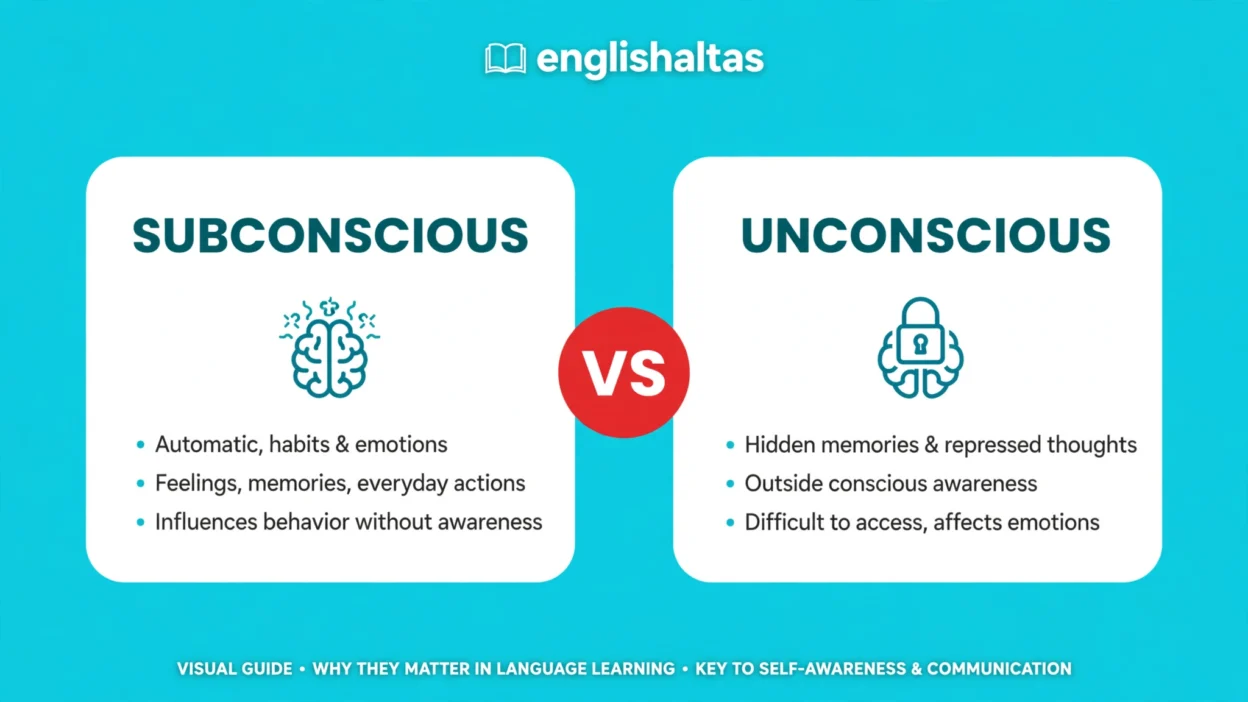
Subconscious vs unconscious is a confusing pair of terms, especially for English learners. Both words describe thoughts, feelings, or actions that are outside our normal awareness.
Because their meanings are very close, people often use them as if they mean exactly the same thing.
There is also a second reason for the confusion. In everyday English, subconscious and unconscious can both describe something happening without a person fully noticing it.
However, unconscious has another very common meaning: being not awake or not aware of what is happening around you.
For example, if someone says, “He has an unconscious fear of dogs,” they are talking about a hidden feeling.
But if they say, “He was unconscious after the accident,” they mean the person was not awake or aware.
Subconscious is often used for thoughts, memories, feelings, or influences that affect us without our active attention.
Cambridge Dictionary describes it as the part of the mind that notices and remembers information without active effort and can influence behavior without our realizing it.
Unconscious can also describe hidden thoughts and feelings, but it can additionally describe a physical state in which a person is not awake or aware.
By the end of this guide, you will know the simple difference, understand how each word works in a sentence, avoid common mistakes, and feel more confident using both words in everyday English.
What Does “Subconscious” Mean?
Subconscious describes thoughts, feelings, memories, or mental activity that can affect you even though you are not actively thinking about them.
Think of it this way: your conscious mind is what you are paying attention to right now. Your subconscious is connected with things that are happening in the background of your mind.
Cambridge Dictionary gives subconscious as both a noun and an adjective. As a noun, it can refer to the part of the mind that contains information outside active awareness. As an adjective, it describes something related to that part of the mind. (Cambridge Dictionary) Merriam-Webster also lists subconscious as both a noun and an adjective.
Simple definition
Subconscious = something in your mind that can influence you without your active awareness.
For example, imagine that you hear a song many times as a child. Years later, you hear the same song again and suddenly feel happy. You may not have been thinking about your childhood at all. Yet the old memory may still influence your feelings.
That is a good everyday example of how people use subconscious.
When should you use “subconscious”?
Use subconscious when you are talking about hidden or background thoughts, feelings, memories, preferences, or influences.
Common expressions include:
- subconscious mind
- subconscious thought
- subconscious fear
- subconscious desire
- subconscious memory
- subconscious belief
- subconscious level
- subconsciously
Here are some examples:
- She has a subconscious fear of water.
- He made the choice subconsciously.
- My subconscious mind remembered the old song.
- She had a subconscious desire to please everyone.
- He subconsciously copied his teacher’s accent.
- That childhood memory stayed in her subconscious.
- I think I subconsciously chose the blue shirt.
- Our past experiences can affect us on a subconscious level.
Notice that these sentences are about mental influences rather than a person being physically unable to respond.
A common learner confusion
Some learners think subconscious means “half asleep.” That is not the best way to understand it.
For example:
I was subconscious during the meeting. ❌
This sentence is not correct if you mean that you were sleepy or unaware.
You could say:
I was unconscious.
I was half asleep.
I was not paying attention.
If you mean that you made a decision without thinking about the reason clearly, you could say:
I subconsciously chose that color.
The key idea is hidden mental influence, not simply being asleep.
What Does “Unconscious” Mean?
Unconscious has more than one important meaning, which is one reason English learners find it difficult.
First, it can mean not awake or not aware of what is happening around you. This is very common when talking about accidents, injuries, illness, or someone who has fainted.
Second, unconscious can describe a thought, feeling, desire, or action that a person is not aware of. Cambridge Dictionary gives both meanings. (Cambridge Dictionary)
Simple definition
Unconscious = not conscious or not aware.
In a physical situation:
He was unconscious after the accident.
This means he was not awake and could not normally respond to what was happening.
In a mental situation:
She has an unconscious fear of failure.
Here, the person may not realize that the fear exists.
When should you use “unconscious”?
Use unconscious when you are talking about:
- someone who is not awake
- someone who has lost awareness
- hidden thoughts or feelings
- actions done without awareness
- mental processes outside conscious awareness
Examples:
- The injured man was unconscious for several minutes.
- She was knocked unconscious after the fall.
- He has an unconscious fear of rejection.
- She made an unconscious movement with her hand.
- He was unconsciously copying his friend’s movements.
- The experience left an unconscious impression on him.
- She has an unconscious desire to be accepted.
- He unconsciously touched his hair while speaking.
The first two examples describe a physical state. The other examples describe something happening without awareness.
The American Psychological Association also uses unconscious in more specific psychological senses. In cognitive psychology, an unconscious process can occur without a person being explicitly aware of it. In psychoanalytic theory, unconscious has a more specialized meaning connected with mental contents outside awareness. (APA Dictionary)
A useful warning
Do not assume that subconscious is simply a more scientific version of unconscious. The two words overlap, but they are not perfect synonyms.
In fact, the APA Dictionary notes that subconscious is a lay term and is considered imprecise in modern psychology. (APA Dictionary)
That matters when you are writing academically. In ordinary English, however, subconscious is still a common and useful word.
Difference Between Subconscious vs Unconscious
The easiest way to remember the difference is this:
Subconscious usually points to something happening in the background of your mind.
Unconscious can describe hidden mental activity, but it can also mean that a person is not awake or aware at all.
Quick comparison table
| Point | Subconscious | Unconscious |
|---|---|---|
| Basic idea | Outside active awareness | Not conscious or aware |
| Common use | Hidden thoughts and feelings | Hidden thoughts OR not being awake |
| Physical state | Usually no | Yes |
| Mental meaning | Yes | Yes |
| Example | subconscious fear | unconscious fear |
| Example with an accident | Not normally used | He was unconscious |
| Common adverb | subconsciously | unconsciously |
| Everyday use | Common | Very common |
Usage difference
Compare these two sentences:
She subconsciously chose the same color.
This suggests that some hidden preference or memory influenced her choice.
Now compare:
She was unconscious after the accident.
This means she was not awake or aware.
The second sentence cannot normally be replaced with subconscious.
You would not say:
She was subconscious after the accident. ❌
The correct sentence is:
She was unconscious after the accident. ✅
However, when talking about hidden thoughts, the two words can sometimes overlap:
He has a subconscious fear of dogs.
He has an unconscious fear of dogs.
Both can mean that he is not fully aware of the fear. The exact choice may depend on context and the writer’s intended meaning.
Grammar logic
Both words can work as adjectives:
- a subconscious thought
- a subconscious fear
- an unconscious thought
- an unconscious desire
They can also be used as nouns:
- her subconscious
- the unconscious
And both have adverb forms:
- subconsciously
- unconsciously
Examples:
She subconsciously avoided the topic.
He unconsciously moved closer to the door.
The important difference is not mainly grammar. It is meaning and context.
Grammar Rules You Must Remember
Rule #1: Use “unconscious” for a person who is not awake
This is one of the clearest rules.
The patient was unconscious. ✅
The patient was subconscious. ❌
You can also say:
He was knocked unconscious.
She remained unconscious for several minutes.
Here, unconscious describes a person’s physical state.
Rule #2: Use “subconscious” for hidden mental influence
When you want to describe something affecting a person’s thoughts or behavior without active awareness, subconscious is common.
She has a subconscious fear of public speaking.
He subconsciously chose the seat near the window.
The word often appears before nouns such as fear, thought, desire, belief, and memory.
Rule #3: “Unconscious” can also describe hidden thoughts
Do not think that unconscious is only about being knocked out.
It can describe mental activity too:
He has an unconscious desire to impress his parents.
She made an unconscious gesture.
His unconscious fear affected his decision.
In these examples, unconscious means not known or noticed by the person.
Rule #4: Watch the adverbs “subconsciously” and “unconsciously”
The adverbs describe how an action happens.
She subconsciously remembered the address.
This suggests that the memory was working in the background.
Subconscious vs Unconscious
This means he tapped his foot without being aware that he was doing it.
Both adverbs are useful in everyday English.
Common Mistakes Students Make
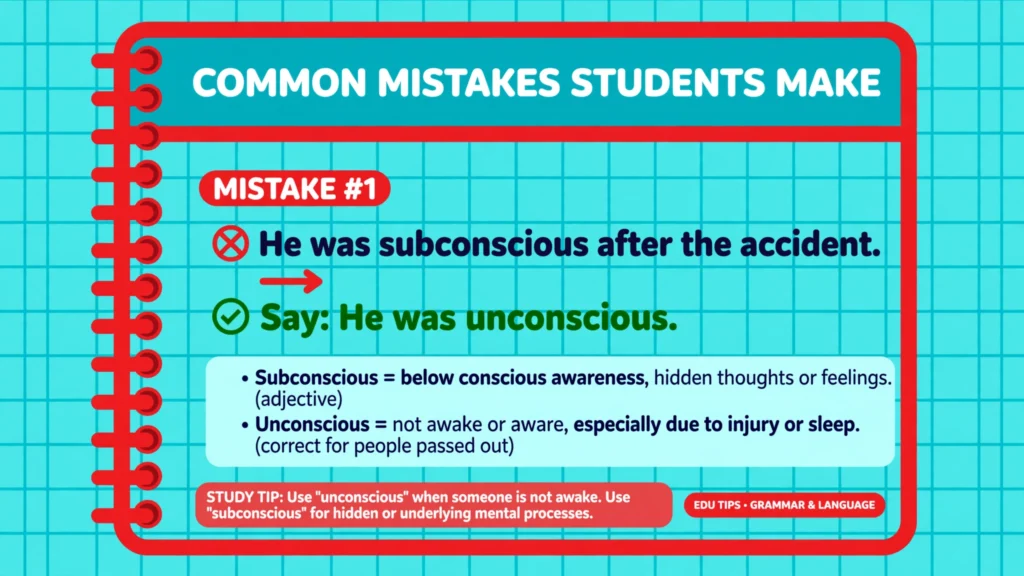
Mistake 1: Using “subconscious” to mean “unconscious”
A learner may say:
Subconscious vs Unconscious
The correct sentence is:
Subconscious vs Unconscious
Why? Because the person lost consciousness.
Easy tip: If someone is sleeping, knocked out, fainted, or unable to respond because they have lost awareness, use unconscious.
Mistake 2: Thinking “unconscious” always means physically unconscious
This is another common mistake.
Consider:
Subconscious vs Unconscious
She is not necessarily asleep. She is awake and talking. The fear is simply outside her awareness.
So remember:
Unconscious has both a physical meaning and a mental meaning.
Mistake 3: Treating “subconscious” and “unconscious” as completely different parts of the mind
In everyday English, the meanings can overlap.
For example:
Subconscious vs Unconscious
and
Subconscious vs Unconscious
Both can communicate a similar idea.
The difference becomes clearer when unconscious describes a physical state:
Subconscious vs Unconscious
That meaning has nothing to do with the usual everyday meaning of subconscious.
Mistake 4: Forgetting the adjective form
Do not confuse the adjective with the adverb.
She made a subconscious decision.
Subconscious vs Unconscious
The first uses subconscious to describe decision.
The second uses subconsciously to describe made.
The same pattern works with unconscious:
Subconscious vs Unconscious
Subconscious vs Unconscious
Easy Trick to Remember the Difference
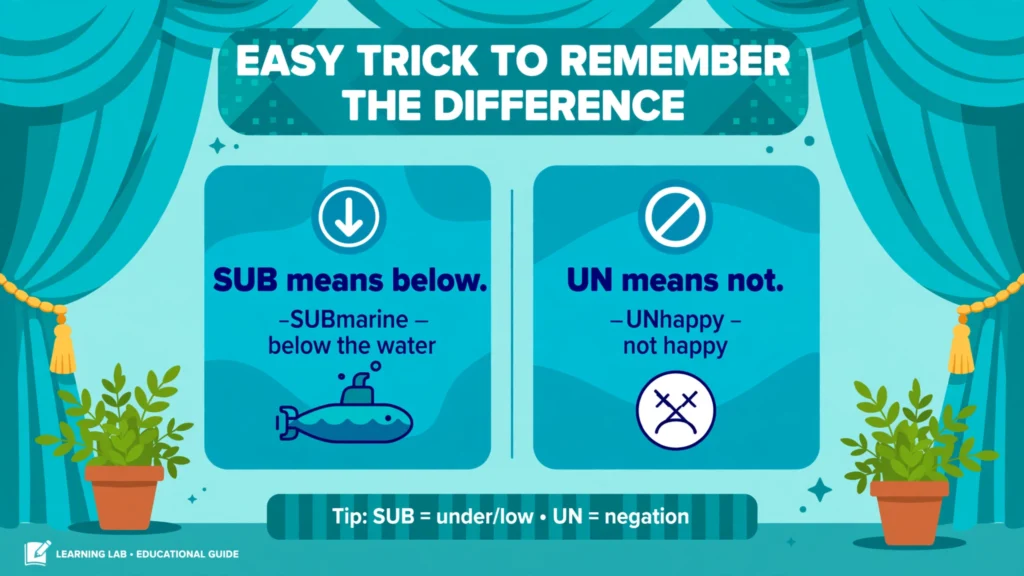
Here is a simple memory trick:
Subconscious = background mind
Think of the word sub- as something below or underneath.
Your subconscious can be imagined as information working below your active attention.
For example:
Subconscious vs Unconscious
You were not actively searching for the memory. Something in the background brought it back.
Unconscious = no awareness
Think of un- as “not.”
So:
unconscious = not conscious
If a person is unconscious after an accident, they are not awake or aware.
But remember that unconscious can also describe hidden mental thoughts:
Subconscious vs Unconscious
So the safest shortcut is:
Subconscious → hidden/background mental influence
Unconscious → not conscious; can mean physically unaware or mentally unaware
This trick will help you make the right choice in most everyday situations.
Daily Life Examples
Here are some natural examples you might hear or use in spoken English.
1. Choosing a color
Subconscious vs Unconscious
The speaker may not have planned the choice for that reason. The influence happened in the background.
2. Copying someone
Subconscious vs Unconscious
The person was awake but did not realize what they were doing.
3. After an accident
Subconscious vs Unconscious
Here, the person was not awake or aware.
4. A hidden fear
Subconscious vs Unconscious
She may not always notice that this fear affects her choices.
5. A strange habit
Subconscious vs Unconscious
The action happens without the person paying attention to it.
6. An old memory
Subconscious vs Unconscious
The smell may have triggered an old memory that was not in active attention.
7. A hidden desire
Subconscious vs Unconscious
The speaker believes the desire exists, but the person may not recognize it.
8. A sudden reaction
Subconscious vs Unconscious
She moved without deliberately deciding to do so.
9. Being knocked out
Subconscious vs Unconscious
This is a physical meaning, so unconscious is the correct word.
10. Everyday behavior
Subconscious vs Unconscious
The choice may have been influenced by a memory that the speaker was not actively thinking about.
Practice Section
Choose subconscious or unconscious in each sentence.
1.
After the accident, the driver was ______ for several minutes.
2.
She had a ______ fear of speaking in front of large groups.
3.
He ______ touched his face while answering the question.
4.
The doctor said that the patient was still ______.
5.
I think I ______ chose that song because it reminds me of school.
Answers
1. unconscious
The driver was not awake or aware.
2. subconscious
The sentence describes a hidden fear.
3. unconsciously
The word describes how he touched his face.
4. unconscious
The patient is not awake or aware.
5. subconsciously
The choice was influenced by a memory without active thought.
A useful way to practice is to ask yourself one question:
“Is this about being physically unaware, or is it about a hidden mental influence?”
That question will often give you the answer immediately.
FAQs
What is the difference between subconscious vs unconscious?
Subconscious usually describes thoughts, feelings, memories, or influences that affect you without active awareness.
Unconscious can describe hidden mental activity too, but it also commonly means not awake or not aware, such as after an accident. (Cambridge Dictionary)
Can we use “subconscious” in questions?
Yes. You can use subconscious in questions when you are asking about hidden thoughts or influences.
For example:
Subconscious vs Unconscious
You can also ask:
Subconscious vs Unconscious
These questions are natural in everyday English.
Is “subconscious” formal or informal?
Subconscious is common in everyday English and is not simply an informal mistake. However, in psychology, the term can be less precise than more specific technical terms. The APA Dictionary describes it as a lay term and notes that psychologists increasingly avoid it because of its imprecision. (APA Dictionary)
Can “subconscious” and “unconscious” mean the same thing?
Sometimes, especially when they describe hidden thoughts or feelings.
For example, subconscious fear and unconscious fear can both describe a fear that a person is not aware of.
However, they are not interchangeable in every sentence. You cannot normally use subconscious when you mean that someone is physically not awake.
Is “unconscious” only used for people who are sleeping or injured?
No.
Unconscious can describe someone who is not awake, but it can also describe thoughts, feelings, actions, and mental processes that happen without awareness. (Cambridge Dictionary)
For example:
Subconscious vs Unconscious
The person is awake. The fear is simply outside his awareness.
Which is correct: “subconscious mind” or “unconscious mind”?
Both expressions are used in English.
Subconscious mind is common in everyday speech and popular writing.
Unconscious mind is also common, especially in psychology and discussions of unconscious thoughts or processes. Cambridge Dictionary defines the unconscious mind as the part of the mind containing thoughts and feelings that a person is not aware of but that can influence behavior. (Cambridge Dictionary)
The best choice depends on your context and the level of technical accuracy you need.
Conclusion
The difference between subconscious vs unconscious becomes much easier when you focus on awareness.
Subconscious usually refers to thoughts, feelings, memories, or influences working in the background of your mind. You may not be actively thinking about them, but they can still affect your behavior.
Unconscious can also describe hidden thoughts and feelings. However, it has an important extra meaning: not awake or not aware. This is why we say, “He was unconscious after the accident,” but not “He was subconscious after the accident.”
Remember the simple rule:
Subconscious = hidden or background mental influence.
Unconscious = not conscious, including being physically unaware or having a hidden mental process.
Do not worry if these words still feel similar. Native speakers sometimes use them in overlapping ways too.
The more real sentences you read and hear, the easier the difference between subconscious vs unconscious becomes. Try making a few sentences of your own, especially about daily habits, memories, fears, and reactions.

Oliver Bennett is an English language educator and content writer passionate about simplifying grammar. He creates clear, practical lessons, writing tips, and learning resources that help readers improve their English with confidence.