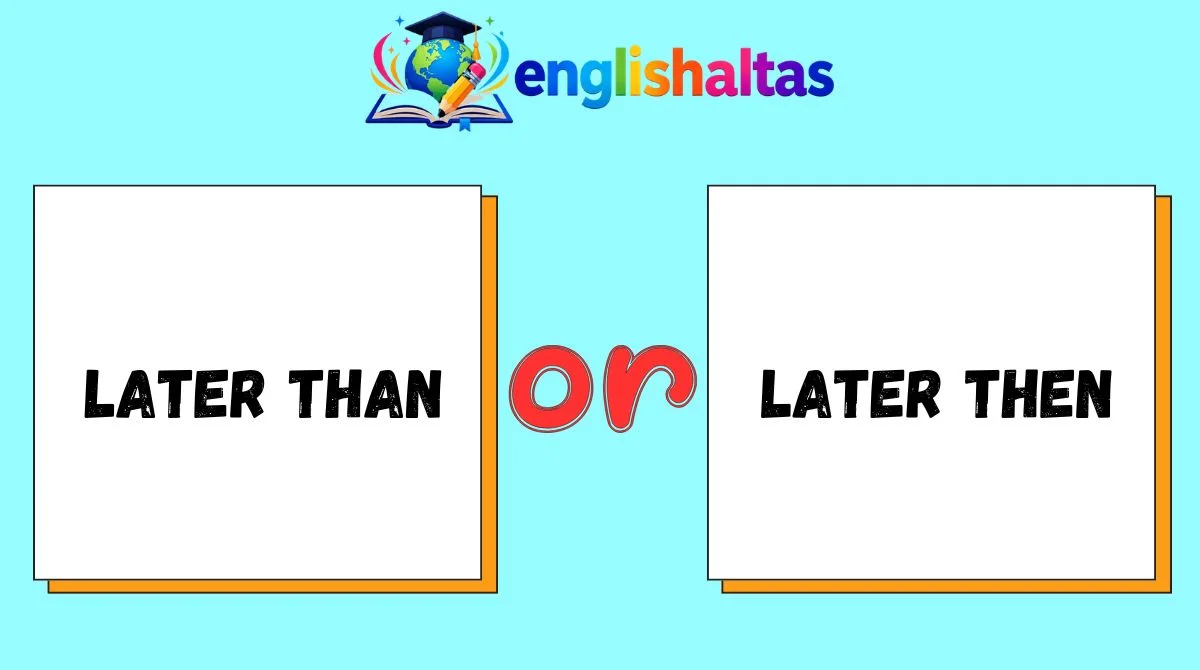
Later than or later then? These two phrases sound almost the same when people speak. That is why many English learners mix them up in writing.
You may know that later is connected to time, but the word after it can still cause trouble.
This confusion is very common in daily English. Students write “later then” when they actually mean “later than.”
The mistake often happens because than and then have very similar sounds. However, they have different jobs in a sentence.
The good news is that the rule is simple once you understand the meaning. Later than is used when you compare one time with another time.
Later then is usually not the correct phrase when you want to make a time comparison.
You will see this difference in messages, school writing, emails, and everyday conversations.
A small spelling mistake can sometimes change the meaning of your sentence or make your writing look unclear.
After reading this guide, you will understand later than or later then, know the correct grammar rule, see easy examples, and learn a simple trick to remember the difference.
You will also practice real-life sentences so the correct form feels natural when you write or speak.
What Does “Later” Mean?
Later means at a time after now or after another time. It talks about something happening in the future or at a time that comes after an earlier event.
For example, if you say, “I will call you later,” you mean you will call the person after now. You do not give an exact time.
Later can also be used to compare two times. This is where the phrase later than becomes important.
When Do We Use “Later”?
We use later when we talk about a time that comes after another time.
Look at these examples:
- I will finish my homework later.
- Later Than or Later Then
- We can talk later.
- He arrived later than his brother.
- The bus came later than usual.
- I learned the truth later.
- They went home later that night.
- I will explain everything later.
In the first, second, third, sixth, seventh, and eighth examples, later simply talks about a time after another point.
In sentences such as “He arrived later than his brother,” the word later is part of a comparison.
The Grammar Rule for “Later”
The basic grammar idea is:
later = after a time
Later Than or Later Then
later + than
Examples:
- She arrived later than me.
- The meeting started later than planned.
- Later Than or Later Then
Many learners see the word later and immediately think of then because both words are related to time in some way. But later does not automatically take then after it.
Common Confusion About “Later”
A learner may think:
“Later talks about time, and then also talks about time. So later then must be correct.”
This is understandable, but English grammar does not work that way. Words can belong to the same general topic but still have different grammar jobs.
Later tells us about a time after another time. Then usually tells us what happens at that time or next in a sequence.
What Does “Than” Mean?
Than is a word used mainly for comparison.
It helps us compare two people, things, places, amounts, or times.
For example:
- Ali is taller than Ahmed.
- Later Than or Later Then
- She arrived later than me.
In the last sentence, than connects two times or two points of arrival. It shows a comparison.
When Do We Use “Than”?
Use than when you are comparing something with something else.
Here are eight simple examples:
- My sister is older than me.
- This road is longer than the other road.
- He came later than I expected.
- The test was easier than I thought.
- I woke up earlier than usual.
- The shop is closer than the school.
- She finished the work faster than her friend.
- Later Than or Later Then
Notice the pattern. Than connects a comparison.
“Than” in Time Comparisons
This is the key point for the phrase later than.
When you say:
Later Than or Later Then
You compare the actual arrival time with the expected time.
When you say:
I went to sleep later than usual.
You compare your sleep time with your normal time.
So, later than is correct because than introduces a comparison.
Common Learner Confusion About “Than”
Many learners confuse than with then because they sound very similar in everyday speech.
A quick question can help:
Later Than or Later Then
If the answer is yes, you probably need than.
- later than expected
- better than before
- Later Than or Later Then
Difference Between Later Than and Later Then
The main difference is simple:
Later than is the correct phrase when you compare one time with another.
Later then is usually a mistake when the writer means a comparison.
| Phrase | Main Use | Meaning | Example |
|---|---|---|---|
| later than | Comparison | after a particular time or event | I arrived later than him. |
| later then | Usually incorrect for comparison | not the normal comparison form | ❌ I arrived later then him. |
| later, then | Sequence in special contexts | later, and after that | We can talk later, then decide. |
Usage Difference
The word than is connected to comparison.
The word then is connected to time, sequence, or a result.
Compare these sentences:
I arrived later than John.
This sentence compares my arrival time with John’s arrival time.
Now look at:
I arrived later, then I called John.
This sentence gives a sequence of events. First, I arrived later. Then, I called John.
The comma is important in the second sentence. Later and then are not working together as the comparison phrase later than.
Grammar Logic
Think about the job of each word.
Than = comparison
Then = next or at that time
So:
Later Than or Later Then
The sentence compares two arrival times.
But:
She came later. Then she went home.
The word then introduces the next event.
Sentence Structure Difference
The common structure for later than is:
Subject + verb + later than + person/time/event
Examples:
- I arrived later than my friend.
- The class ended later than usual.
- Later Than or Later Then
The structure with then is different:
Event 1. Then + Event 2.
Examples:
- I finished my work. Then I watched TV.
- She came home. Then she ate dinner.
- Later Than or Later Then
Meaning Comparison
Later than answers a comparison question:
Later than what?
Example:
The bus arrived later than expected.
Then answers a sequence question:
What happened next?
Example:
I finished my homework. Then I went outside.
This simple difference explains why later than is the correct phrase in most questions about “later than or later then.”
Grammar Rules You Must Remember
Rule #1: Use “than” for comparisons
When you compare two people, things, or times, use than.
Example:
I arrived later than my brother.
You are comparing two arrival times.
Rule #2: Use “then” for the next event
Use then when you mean next or after that.
Example:
I finished my work, then I went home.
The sentence shows a sequence.
Rule #3: “Later than” can compare times
You can use later than with a person, time, event, or expectation.
Examples:
- later than me
- later than 8 p.m.
- later than expected
- later than usual
Example:
The shop opened later than usual.
Rule #4: “Later then” is not the normal comparison phrase
Do not write later then when you want to compare two times.
Wrong:
❌ The train arrived later then expected.
Correct:
✅ The train arrived later than expected.
Remember: comparison = than.
Common Mistakes Students Make
Mistake 1: Writing “later then” for a comparison
This is the most common mistake.
Wrong:
❌ I came later then you.
Correct:
✅ I came later than you.
Why does the mistake happen? Than and then sound similar, especially when people speak quickly.
Easy tip: Ask yourself, “Am I comparing?” If yes, choose than.
Mistake 2: Thinking “then” is always a time word
Yes, then can talk about time, but it normally shows a particular time or the next step.
For example:
Back then, I lived in Lahore.
Here, then means at that time.
But:
I arrived later than him.
Here, than is needed because the sentence compares two times.
Mistake 3: Using “than” for a sequence
Some learners learn that than is connected with time and start using it everywhere.
Wrong:
❌ I ate dinner, than I went to bed.
Correct:
✅ I ate dinner, then I went to bed.
There is no comparison here. You are simply saying what happened next.
Mistake 4: Confusing “later than” with “after”
Sometimes learners use the wrong structure because they translate directly from their first language.
For example:
I will call you later than.
This sentence is incomplete.
You can say:
I will call you later.
Or:
I will call you later than 8 p.m.
Later than normally needs something to compare with.
Mistake 5: Forgetting the comparison idea
Look at this sentence:
She arrived later than expected.
Ask:
Later than what?
The answer is expected. This is a comparison between the actual time and the expected time.
When you understand the hidden comparison, the correct word becomes much easier to choose.
Easy Trick to Remember the Difference
Here is a very easy memory trick:
THAN = Compare
Both words are short, but you can remember than as the comparison word.
Think of these examples:
- bigger than
- faster than
- better than
- later than
All of them compare something.
Now remember:
THEN = Next
Imagine a simple story:
I woke up. Then I brushed my teeth.
Then tells you what happened next.
So, when you see later, ask yourself:
Am I comparing?
If yes:
later than
Example:
The movie started later than planned.
Am I talking about what happens next?
If yes, use then separately.
Example:
We will talk later. Then we can make a decision.
A very short memory sentence is:
Than compares. Then moves the story forward.
That one sentence can save you from many common grammar mistakes.
Daily Life Examples of Later Than and Then
Here are some natural examples from everyday English.
1. Talking about arrival
I arrived later than my friends.
You are comparing your arrival time with your friends’ arrival time.
2. Talking about a delayed bus
The bus came later than usual.
Your normal bus time is being compared with today’s time.
3. Making a plan
I will call you later. Then we can talk about the problem.
Here, later talks about a future time, and then shows the next action.
4. Talking about school
The teacher came later than expected.
The actual arrival time was after the expected time.
5. Talking about dinner
I finished my homework later than my brother.
This compares two finishing times.
6. Explaining your routine
I got home later than usual, then I went straight to bed.
Here, both words are correct. Than makes the comparison, and then shows the next event.
7. Talking about a phone call
Can I call you later than 7 p.m.?
The phrase compares the possible call time with 7 p.m.
8. Talking about work
The meeting ended later than planned.
The real ending time was after the planned time.
9. Talking about a decision
We can meet later. Then we can decide what to do.
Then means after that.
10. Talking about a late night
I went to sleep later than I wanted.
The actual sleep time was after the time you wanted.
Notice the pattern in these examples. Than is used for comparison. Then is used for sequence or “after that.”
Practice Section: Choose the Correct Word
Choose than or then in each sentence.
- I arrived later ___ my sister.
- We can eat later, ___ we can watch a movie.
- The class ended later ___ expected.
- I finished my work, ___ I went home.
- She went to bed later ___ usual.
Answers
- than — I arrived later than my sister.
- then — We can eat later, then we can watch a movie.
- than — The class ended later than expected.
- then — I finished my work, then I went home.
- than — She went to bed later than usual.
Quick check: In sentences 1, 3, and 5, there is a comparison. That is why we use than. In sentences 2 and 4, then shows the next action.
FAQs
What is the difference between “later than” and “later then”?
Later than is used to compare one time with another time. For example, “I arrived later than him.” Then usually means next or after that, so later then is not the normal phrase for a comparison.
Is “later than” grammatically correct?
Yes, later than is completely correct. It is used when you compare times or events. Examples include “later than expected,” “later than usual,” and “later than me.”
Can we use “later then” in a sentence?
You can use later and then in the same sentence, but they usually work as separate words. For example, “We can talk later, then make a plan.” Do not use later then as a replacement for later than in a comparison.
Is “than” used for comparison?
Yes. Than is a comparison word. It appears in phrases such as better than, faster than, earlier than, and later than. If you compare two times, later than is the correct choice.
Can I use “later than” in a question?
Yes, you can use later than in questions. For example, “Did he arrive later than you?” or “Can I call you later than 8 p.m.?” The phrase is correct whenever you are making a time comparison.
How can I remember than and then easily?
Remember this simple rule: Than compares; then means next. If you are comparing times, use later than. If you are explaining what happens after something, use then.
Final Conclusion
The difference between later than and later then becomes easy when you focus on the job of each word.
Later than is the correct phrase for comparing one time with another. For example, “She arrived later than expected.”
Than is used for comparison. That is the main rule to remember.
Then has a different job. It usually means next or after that. For example, “I finished my homework, then I went outside.”
Do not worry if you have made this mistake before. Than and then sound very similar, so many English learners confuse them. j
ust ask yourself one question: “Am I comparing something?” If the answer is yes, choose than.
With a little practice, later than will start to feel natural. Keep watching for this difference in messages, books, and everyday English.
Small grammar choices like this can make your writing much clearer.

Oliver Bennett is an English language educator and content writer passionate about simplifying grammar. He creates clear, practical lessons, writing tips, and learning resources that help readers improve their English with confidence.