
Anywhere and everywhere look very similar, so it is easy to mix them up. Both words talk about places, but they do not give the same meaning.
The small difference between them can completely change a sentence.
For example, if someone says, “You can sit anywhere,” they mean you can choose any place. There is no special place you must choose.
But if someone says, “I looked everywhere,” they mean they looked in all places or in every possible place.
This difference is very useful in everyday English. We use these words when talking about travel, homes, schools, shops, cities, parks, phones, websites, and many other places. You will hear them often in normal conversations.
Many English learners also become confused because anywhere is often used in questions and negative sentences, while everywhere usually has a different idea: all places or many places without exception.
The good news is that the rule is simple once you understand the basic idea. Anywhere means any place, while everywhere means all places.
By the end of this guide, you will know when to use each word, how they work in questions and negative sentences, the common mistakes to avoid, and how to choose the right word quickly when speaking or writing.
What Does “Anywhere” Mean?
Anywhere means any place or any location. It is used when the exact place is not important, when there are many possible choices, or when we are talking about a place without saying exactly where.
Think of anywhere as an open choice.
If I say:
“You can sit anywhere.”
I mean you can sit in any place you want.
It could be near the window, near the door, at the back, or somewhere else. I am not choosing one specific place.
When Do We Use “Anywhere”?
We commonly use anywhere in three situations:
- Questions — asking whether a place exists or whether someone has gone to a place.
- Negative sentences — saying that there is no place or that someone did not go to any place.
- Positive sentences — especially when we mean “any place at all” or “whichever place you choose.”
Grammar Rule for “Anywhere”
Anywhere is an adverb of place. It can usually appear after a verb or at the end of a sentence.
Common patterns include:
verb + anywhere
- go anywhere
- sit anywhere
- travel anywhere
- work anywhere
- live anywhere
Here are some examples:
- Can we go anywhere after dinner?
- You can sit anywhere you like.
- I can’t find my keys anywhere.
- Did you see my phone anywhere?
- We didn’t go anywhere yesterday.
- You can travel anywhere with this ticket.
- I don’t think you can park anywhere near the station.
- Put the bag anywhere you want.
Notice that anywhere does not always mean something negative. It can be used in positive sentences too.
For example:
“You can put the box anywhere.”
This is positive. It means any place is acceptable.
Anywhere in Questions
Questions are one of the most common places where learners see anywhere.
For example:
“Did you go anywhere last weekend?”
The speaker is asking whether the person went to any place at all.
Another example:
“Is there anywhere we can eat?”
This means:
Is there any place where we can eat?
So, when you are asking about the existence of a possible place, anywhere is often the natural choice.
Anywhere in Negative Sentences
We also frequently use anywhere with negative words such as not, never, and can’t.
Examples:
“I can’t find my wallet anywhere.”
This means I cannot find it in any place.
“We didn’t go anywhere.”
This means we went to no place.
Be careful with the difference between anywhere and nowhere. They can sometimes express a similar idea, but their grammar is different.
For example:
I didn’t go anywhere.
I went nowhere.
Both can mean that I did not go to any place, but the first sentence is much more common in everyday English.
What Does “Everywhere” Mean?
Everywhere means all places, in all places, or to all places, depending on the sentence.
Think of everywhere as including the whole area or every relevant place.
If I say:
“I looked everywhere for my glasses.”
I mean I looked in all the places I could think of.
Maybe I checked the bedroom, kitchen, living room, car, desk, and bag. I am not talking about one possible place. I am talking about all the places.
When Do We Use “Everywhere”?
We use everywhere when something is present in, happens in, or moves to all places or many places.
It often describes something that is widespread.
For example:
“There are flowers everywhere.”
This means flowers can be seen in many places all around.
Another example is:
“People were taking photos everywhere.”
This means people were taking photos in all parts of the place.
Grammar Rule for “Everywhere”
Like anywhere, everywhere is an adverb of place.
Common patterns include:
verb + everywhere
- look everywhere
- search everywhere
- travel everywhere
- go everywhere
- walk everywhere
It can also come after a noun and verb when describing where something exists:
“There are books everywhere.”
Here are eight examples:
- I looked everywhere for my glasses.
- There were people everywhere at the festival.
- She takes her camera everywhere.
- We saw beautiful buildings everywhere.
- He searched everywhere for his passport.
- Children were playing everywhere in the park.
- You can see advertisements everywhere these days.
- My little brother leaves his toys everywhere.
Does “Everywhere” Mean Literally Every Place?
Not always.
This is an important point.
When people say:
“There were people everywhere.”
They usually do not mean every single place on Earth. They mean there were people all around the particular area being discussed.
If you are talking about a shopping mall, “everywhere” means all around the mall or in many parts of the mall.
If you are talking about a city, it can mean many parts of the city.
The exact meaning depends on the context.
Difference Between Anywhere and Everywhere
The easiest way to understand the difference is to focus on choice versus all places.
Anywhere = any place
Everywhere = all places
Compare these two sentences:
You can sit anywhere.
This means you may choose any place.
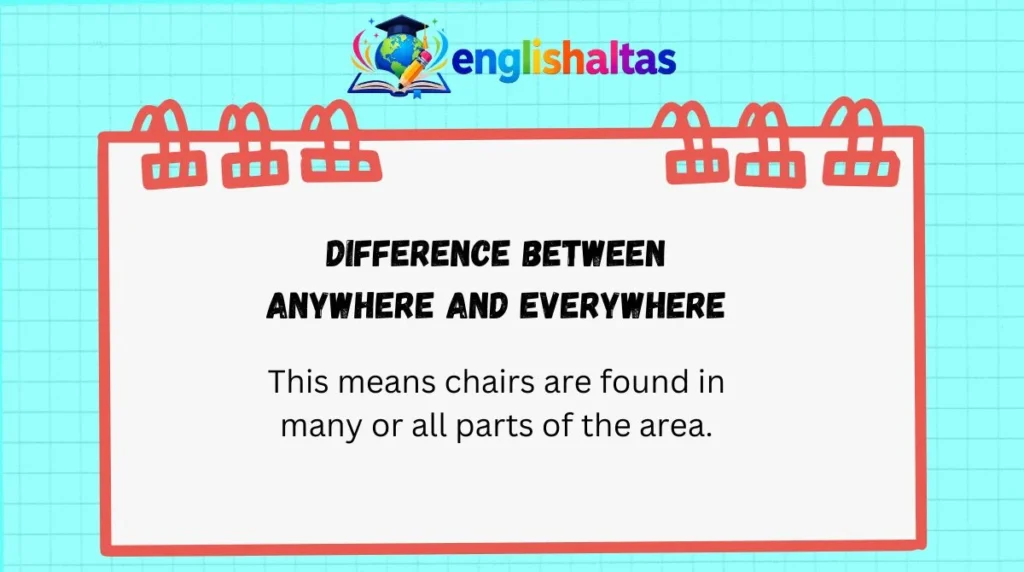
There are chairs everywhere.
This means chairs are found in many or all parts of the area.
The first sentence gives a choice. The second describes something spread across a place.
Comparison Table
| Anywhere | Everywhere |
|---|---|
| Means any place | Means all places or all around |
| Often shows choice | Often shows a complete or widespread situation |
| Common in questions | Common in statements |
| Common in negative sentences | Usually used in positive statements |
| Focuses on one possible place among many | Focuses on all relevant places |
| “You can sit anywhere.” | “People are sitting everywhere.” |
| “Did you go anywhere?” | “We went everywhere.” |
| “I can’t find it anywhere.” | “I looked everywhere.” |
Usage Difference
Consider this conversation:
Tom: Where can I sit?
Sara: Anywhere.
Sara is giving Tom a choice. She means:
You can choose any place.
Now imagine a different situation:
Tom: Where did you look for the missing book?
Sara: Everywhere!
Sara means she searched in all the places she could think of.
The key difference is the scope of the place.
With anywhere, the speaker does not choose one specific place.
With everywhere, the speaker includes all relevant places.
Grammar Logic
The words are connected to two important ideas:
- any = one or more possibilities, without choosing a particular one
- every = all members of a group considered one by one
So:
any + where = any place
every + where = every place
This is why:
“You can go anywhere.”
means you can choose your destination.
But:
“We went everywhere.”
means the group visited all or nearly all the relevant places.
Sentence Structure
Both words normally work as adverbs, so they do not need a preposition before them.
We say:
I looked everywhere.
Not:
I looked at everywhere.
We say:
Did you go anywhere?
Not:
Did you go to anywhere?
However, there are situations where a preposition is needed for a different structure.
For example:
I can go anywhere.
But:
I can go to any place you choose.
The second sentence uses any place as a noun phrase, so to is needed before it.
This is a useful distinction for learners.
Grammar Rules You Must Remember
Rule #1: Use “Anywhere” for Any Possible Place
Use anywhere when the person has a free choice of place.
You can park anywhere.
The driver can choose any suitable parking place.
Another example:
Anywhere or Everywhere
The listener has freedom to choose a seat.
Rule #2: Use “Everywhere” for All Relevant Places
Use everywhere when you mean all around a particular area or all the relevant places.
Anywhere or Everywhere
The search covered many or all possible places.
Another example:
Anywhere or Everywhere
The meaning is that restaurants are found in many parts of the city.
Rule #3: “Anywhere” Is Very Common in Questions and Negative Sentences
Examples:
Anywhere or Everywhere
Anywhere or Everywhere
Anywhere or Everywhere
Anywhere or Everywhere
This does not mean anywhere is always negative. Positive sentences are also possible:
Anywhere or Everywhere
Rule #4: “Everywhere” Usually Describes a Widespread Situation
Examples:
Anywhere or Everywhere
Anywhere or Everywhere
Anywhere or Everywhere
The word gives the idea that something covers or includes many places.
Common Mistakes Students Make
Learners often make mistakes because any and every seem very close. The best way to correct these mistakes is to ask what the speaker really means.
Mistake 1: Using “Everywhere” for Choice
❌ You can sit everywhere you want.
This may sound strange if you mean the listener can choose any seat.
Better:
✅ You can sit anywhere you want.
The idea is free choice, so use anywhere.
Mistake 2: Using “Anywhere” for All Places
❌ I looked anywhere for my phone.
If you mean you searched in all possible places, this is not correct.
Better:
✅ I looked everywhere for my phone.
You searched all around.
Mistake 3: Adding “At” Before “Anywhere”
❌ Is he at anywhere?
Correct:
✅ Is he anywhere?
Or, depending on the meaning:
✅ Is he anywhere near here?
“Anywhere” already works as an adverb, so it normally does not need at before it.
Mistake 4: Adding “To” Before “Anywhere”
❌ Where do you want to go to anywhere?
Correct:
✅ Where do you want to go?
Or:
✅ You can go anywhere you want.
Do not automatically add to before anywhere.
Mistake 5: Thinking “Anywhere” Always Means “No Place”
This is another common misunderstanding.
Some learners see:
Anywhere or Everywhere
and think anywhere = nowhere.
That is not the basic meaning.
Anywhere means any place. The negative word can’t gives the sentence its negative meaning.
Compare:
Anywhere or Everywhere
Anywhere or Everywhere
The word anywhere has not changed. The surrounding grammar changes the meaning.
Easy Correction Tip
When you are unsure, ask yourself:
“Am I talking about a choice, or am I talking about all places?”
- Choice → anywhere
- All places → everywhere
That simple question will solve most problems.
Easy Trick to Remember the Difference

Here is a classroom trick that makes the difference easy.
Imagine a teacher points to the seats in a classroom.
She says:
Anywhere or Everywhere
She is saying:
“Choose any seat.”
Now imagine the teacher walks into the classroom after a group of students has made a huge mess.
She says:
Anywhere or Everywhere
She means:
“Books are all around the room.”
So remember:
ANYWHERE = YOUR CHOICE
You choose any place.
EVERYWHERE = ALL AROUND
Something is found in all or many places.
You can also connect the words with the numbers:
ANY = one possible choice
EVERY = all members
That is why:
Anywhere or Everywhere
Anywhere or Everywhere
This trick is especially useful when speaking because you do not have time to think about complicated grammar rules. Just ask:
“Choice or all around?”
Choice means anywhere.
All around means everywhere.
Daily Life Examples
The best way to learn these words is to hear how people actually use them.
Example 1: Choosing a Seat
Ali: Where should I sit?
John: You can sit anywhere.
Here, John is giving Ali a free choice.
Example 2: Looking for a Phone
Sara: Have you seen my phone?
Mina: No. I looked everywhere, but I couldn’t find it.
Mina searched all around the relevant area.
Example 3: Asking About a Trip
Ahmed: Did you go anywhere during the holiday?
Bilal: Yes. We went to Lahore for three days.
The question asks whether Ahmed went to any place.
Example 4: A Busy Street
Nadia: Was the market busy?
Hina: Very busy! There were people everywhere.
The word means people were all around the market.
Example 5: Choosing a Restaurant
Dad: Where do you want to eat?
Son: Anywhere is fine.
The son does not have a specific choice.
Example 6: Searching for a Document
Manager: Did you check the office?
Employee: Yes. I looked everywhere.
The employee means all the possible places in the office were checked.
Example 7: Finding a Quiet Place
A: Is there anywhere quiet around here?
B: Yes. There is a small library nearby.
The speaker is asking whether there is any suitable place.
Example 8: A Festival
A: How was the festival?
B: Amazing! There was music everywhere.
This means music could be heard throughout the area.
Example 9: Working Online
A: Where can I work with my laptop?
B: You can work anywhere with a good internet connection.
The idea is that many locations are possible.
Example 10: A Child’s Toys
Mother: Why are there toys everywhere?
Child: Sorry, Mom!
The toys are spread around many parts of the room.
Practice Section
Choose anywhere or everywhere in each sentence.
1.
You can put your coat __________.
2.
I searched __________ for my missing keys.
3.
Did you go __________ interesting last weekend?
4.
There were flowers __________ in the garden.
5.
We didn’t find a hotel __________.
Ansput your coat anywhere.
This gives a choice of place.
2. everywhere
Anywhere or Everywhere
This means I searched all the relevant places.
3. anywhere
Anywhere or Everywhere
This is a question asking whether the person went to any interesting place.
4. everywhere
Anywhere or Everywhere
The flowers were spread around the garden.
5. anywhere
Anywhere or Everywhere
The negative sentence means we could not find a hotel in any place.
Frequently Asked Questions
What is the difference between anywhere and everywhere?
Anywhere means any place and often gives a choice or asks about any possible place. Everywhere means all places or all around a particular area. For example, “You can sit anywhere” gives a choice, while “There are people everywhere” means people are all around.
Can we use anywhere in questions?
Yes. Anywhere is very common in questions. For example, “Did you go anywhere?” asks whether someone went to any place. You can also say, “Is there anywhere to sit?” when asking whether a suitable place exists.
Is anywhere formal or informal?
Anywhere is normal in both spoken and written English. It is not especially formal or informal. You can use it in everyday conversations, school writing, emails, and most other situations.
Is everywhere always used in positive sentences?
No. Everywhere can appear in different sentence types, although it is especially common in positive statements. For example, “I didn’t look everywhere” is grammatically possible. The negative word didn’t changes the meaning of the sentence.
Can anywhere and everywhere be used for people?
These words refer to places, not directly to people. However, people can be located somewhere. For example, “People are everywhere” means people are in many places. If you want to talk about people as individuals, words such as anyone and everyone are usually more suitable.
Is “I looked anywhere” correct?
Usually, no, if you mean that you searched all possible places. The natural sentence is “I looked everywhere.” However, anywhere can be correct in a different structure, such as “You can look anywhere you want,” where it means any place you choose to look.
Conclusion
The difference between anywhere and everywhere is small, but it matters.
Anywhere means any place. We often use it when talking about a choice, asking about a possible place, or saying that something did not happen in any place.
Anywhere or Everywhere
Anywhere or Everywhere
Anywhere or Everywhere
Everywhere means all places, or all around the area we are talking about.
Anywhere or Everywhere
Anywhere or Everywhere
The fastest way to remember the difference is to think about choice versus all places. If you mean “choose any place,” use anywhere.
If you mean “all around” or “in all the relevant places,” use everywhere.
Do not worry if you make mistakes at first. These words become much easier when you hear and use them in real situations.
Try making a few sentences about your home, school, workplace, or last trip. With regular practice, choosing between anywhere and everywhere will soon feel natural.

Oliver Bennett is an English language educator and content writer passionate about simplifying grammar. He creates clear, practical lessons, writing tips, and learning resources that help readers improve their English with confidence.